Over Half of UAE Knowledge Workers Have a Side Income. What Can Employers Actually Restrict?
New HP data shows 54% of UAE knowledge workers now have a side venture. With MOHRE's part-time permit letting people hold more than one role, employers are asking where their rights stop. A balanced guide to what the permits allow and what you can legitimately protect — with a model outside-work policy.
A balanced guide for HR, founders, and people managers.
A finding from HP's Work Relationship Index 2026, published on 1 October, reframes a conversation many UAE employers would rather avoid: 54% of UAE knowledge workers now have an income-generating side venture — against 32% worldwide — rising to 61% among Gen Z. At the same time, 70% say it feels too risky to leave their main job right now. The picture is not of people heading for the exit. It is of a workforce that increasingly expects to hold a main job and something of their own on the side.
For employers, that raises a practical question that gets asked emotionally and should be answered precisely: where do our rights actually stop? The UAE framework has moved toward allowing more than one role, so a blanket "no second jobs" clause is both out of step and, in places, unenforceable. This guide separates what the permits now allow from what an employer can still legitimately protect — and gives you a model policy to replace the blanket ban.
Informational only — not legal advice. This article is point-in-time (October 2026) and summarises the general framework, not a legal opinion. Specific Labour Law article numbers, non-compete limits, and any rule on outside work during leave should be confirmed with a qualified legal adviser before you rely on them. The DIFC and ADGM operate separate employment frameworks. Verify with MOHRE or a qualified adviser before acting.
The shift behind the numbers
Side income in the UAE is no longer a fringe behaviour to be policed — it is close to the norm for knowledge workers, and the majority position among the youngest ones. Treating it as inherently disloyal misreads the workforce. The more productive stance is to assume many of your people either have, or will want, outside work, and to build a policy that channels it rather than one that pretends it does not exist.
That shift is reinforced by the regulatory direction, which has made holding more than one role genuinely possible.
What the permits now allow
Two routes matter here.
The MOHRE part-time work permit. As part of its upgraded work-permit system, MOHRE offers a part-time permit that lets a worker hold roles with more than one employer. The widely reported features are a two-year validity, the ability to work for multiple employers, and — importantly — that it is aimed at workers in the higher skill levels (levels 1–2). Coverage has reported that approval from the primary employer is not required for this permit "provided specific regulations are met." That exemption is real but conditional: the exact conditions are not spelled out in the general coverage and should be confirmed with MOHRE before you rely on either reading — that a given employee needs your sign-off, or that they do not.
The self-sponsored freelance permit. Separately, the UAE's freelance permit lets an individual sponsor themselves to offer services independently, outside a single employer relationship. An employee building a side venture may well be operating under this route rather than a second employment contract — which changes the picture, because they are a service provider on their own account, not your employee moonlighting.
The practical takeaway: the existence of these permits means a second income is often entirely lawful, and your policy should start from "here is how we handle it," not "this is forbidden."
What an employer can legitimately protect
Allowing outside work does not strip an employer of its legitimate interests. The question is not whether someone has a side venture, but whether it harms the business. Five interests are defensible and worth writing down:
- Confidentiality. Your data, client lists, pricing, and trade secrets are protected regardless of what an employee does after hours. A side venture never licenses using or disclosing them.
- Conflict of interest. An employee working for — or running — a competitor, soliciting your clients, or steering opportunities away from you is a genuine conflict. This is the core of what you can restrict, and it is about the nature of the outside work, not its mere existence.
- Working time and rest. The Labour Law sets limits on hours and mandates rest. An outside role that leaves someone unfit to do their main job safely, or that breaches working-time and rest protections, is a legitimate concern — particularly in safety-sensitive work.
- Company time and equipment. You are entitled to insist that the side venture happens on the employee's own time, with their own tools — not on your laptop, your network, your software licences, or your paid hours.
- Post-employment non-compete. Federal Decree-Law No. 33 of 2021 permits non-compete terms, but only within limits — they must be reasonable in time, place, and scope, and tied to a genuine interest. An overbroad clause is unlikely to hold. Have your adviser confirm the current limits and enforcement conditions before you rely on a non-compete.
Notice what is not on this list: a general right to forbid any and all outside work. That is the clause to retire.
A model "outside work" policy
Replace the blanket ban with a declare-and-assess process. A workable outline:
- Declare. Employees disclose any outside work or side venture, in writing, before starting it — and existing arrangements within a set window.
- Assess conflict. HR or the manager reviews the declaration against a fixed test: does it compete, use confidential information, risk client solicitation, rely on company time or equipment, or breach working-time and rest limits?
- Approve or decline, with reasons. Most declarations clear easily. Where there is a genuine conflict, decline or set conditions — and record why, so the decision is consistent and defensible rather than personal.
- Review yearly. Circumstances change. Re-confirm declarations annually, and require employees to flag material changes (a new client that is your competitor, a big jump in outside hours) when they happen.
Keep the policy's tone permissive by default and restrictive only where a real interest is at stake. That is both more enforceable and better for retention than a ban people quietly ignore.
A short manager script
When an employee raises a side venture, managers do better with a calm script than an instinctive "no":
"Thanks for telling me — that's exactly what the policy asks for. Let me check it against a few things: whether it overlaps with what we do, whether it uses anything confidential, and whether it fits around your hours here. Assuming it clears, there's no problem. If there's an overlap, we'll talk about how to handle it. Can you put the basics in writing so I can log it?"
It signals that disclosure is welcome, keeps the assessment objective, and avoids turning a normal, legal choice into a confrontation.
The bottom line
Side income is now the majority experience for UAE knowledge workers, and the permit framework has made holding more than one role genuinely lawful. The employers who handle this well will not be the ones with the strictest clause — they will be the ones who swapped the unenforceable blanket ban for a clear declare-and-assess policy that protects what actually matters: confidentiality, conflicts, working time, company resources, and reasonable post-employment limits. Get the policy right, and outside work becomes something you manage openly rather than something your best people hide.
For the surrounding framework, see RadixHR's guides to the new UAE Labour Law 2026 and MOHRE services for employers.
Keep outside-work approvals consistent and logged
RadixHR keeps contracts, policy acknowledgements, and employee declarations tracked in one place, so outside-work approvals are consistent, logged, and easy to review.
This article is for general information only, not legal advice. Survey figures are drawn from HP's Work Relationship Index 2026 as published and are point-in-time. Verify current data and legal requirements before relying on them.
Related Articles
Cut Their Salary, Cut Their Gratuity? What UAE Employers Must Document Before They Reduce Basic Pay
Before you reduce anyone's basic salary in the UAE, get the documentation right: why written consent is mandatory, why a downturn alone isn't a valid ground, and how an undocumented cut becomes a live gratuity liability. With a before-you-reduce checklist.
The UAE's September 2026 Nafis Reform: What Changes for Employers Who Already Meet Their Emiratisation Quota
The September 2026 Nafis reform brings an AED 6,000 salary threshold, uncapped child allowances, and a pension-contribution shift onto employers. What it means for companies that already employ Emiratis — with a payroll re-audit checklist.
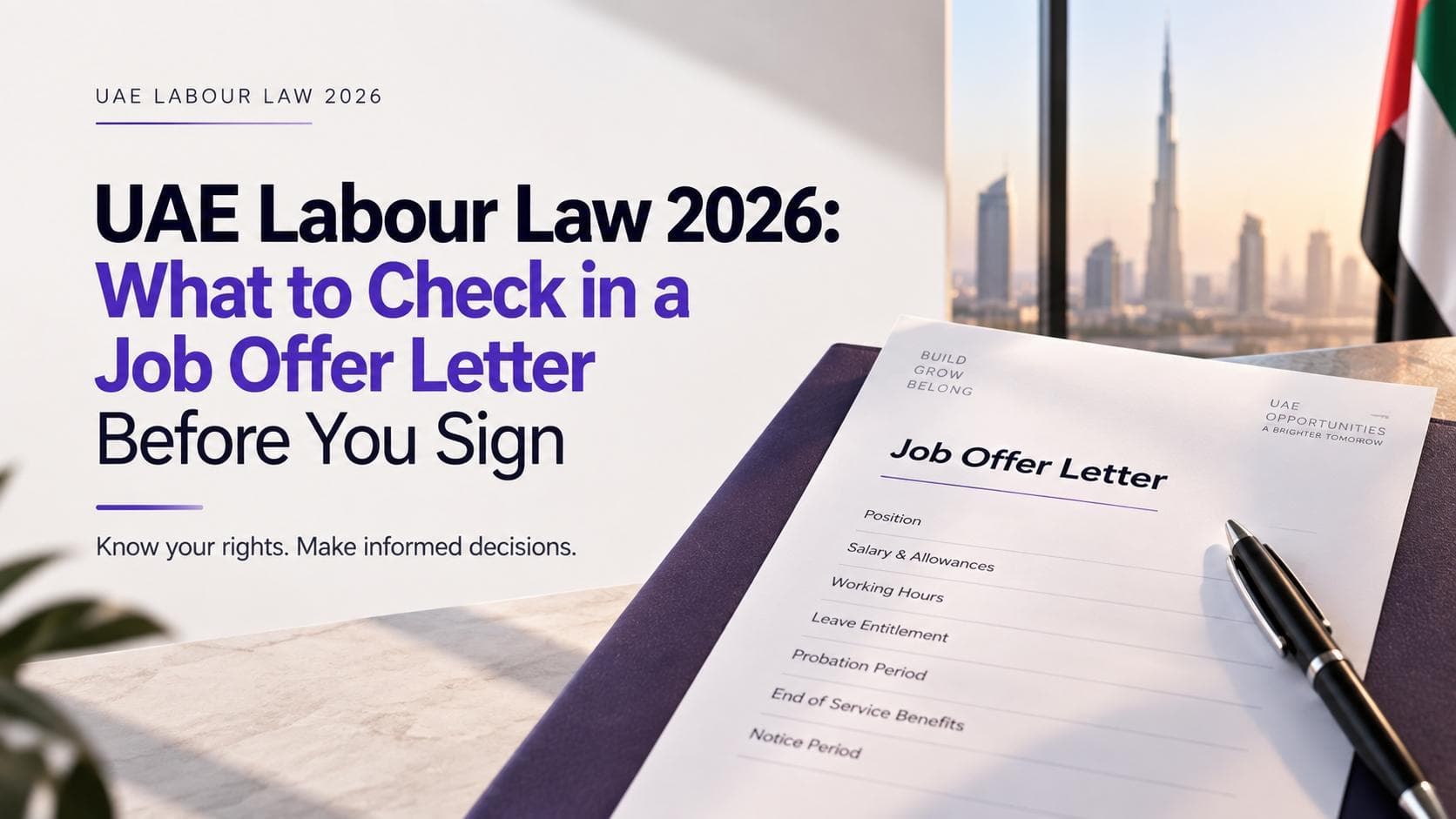
UAE Labour Law 2026: What to Check in a Job Offer Letter Before You Sign
Before you sign a UAE job offer letter in 2026, check these things: basic vs allowances, contract type and term, probation, notice, benefits, and that the MOHRE offer matches the contract. A practical pre-signing checklist under Federal Decree-Law No. 33 of 2021.