A careful, practical guide for HR, operations, and site managers.
MOHRE guidance this month reminded employers of domestic workers to report an unexplained absence within five days — and in the same coverage, the distinction worth holding onto surfaced: for private-sector employees, an absence report generally applies only after more than seven consecutive days of unexplained absence. "Absconding" is one of the most-searched UAE employment terms, and it is also one of the most misused. Filed too early, or as a way to pressure someone, an absence report can rebound on the employer.
This guide is about private-sector staff, not domestic workers, and it treats the process as what it is: a careful, evidence-led last step, not a panic button. It covers the absence report and when it can actually be filed, the separate route of termination without notice under Article 44, what an approved report does to the work permit and the WPS, what is still owed, and a day-by-day checklist.
Informational only — not legal advice. This article is point-in-time (last updated November 2026) and summarises the general framework, not a legal opinion. The report conditions, article references, work-permit and WPS effects, and any labour-ban consequence should be confirmed against the MOHRE service card and the law text. The DIFC and ADGM operate separate frameworks. Verify with MOHRE (mohre.gov.ae) or a qualified adviser before acting.
First: domestic workers vs private-sector employees
The two sit under different rules, and conflating them is the first error.
- Domestic workers (covered by their own legislation): employers have been reminded to report an unexplained absence within a short window — reported as five days.
- Private-sector employees (under the Labour Law): the absence report generally applies only after more than seven consecutive days of unexplained absence.
Everything below is about the private-sector case.
The absence report — and when it can actually be filed
The MOHRE service is a "Labour Complaint – Absence From Work" report — often loosely called an absconding report. It is not something to file the moment someone misses a shift. As described in the Executive Regulations (reported as Article 28) and advisory guidance, the conditions typically are all of the following together:
- the employee has been absent for more than seven consecutive days;
- the whereabouts are unknown and the employee cannot be reached;
- the employee is inside the UAE (it is not the route for someone who has left the country); and
- the employer has made genuine attempts to contact the employee and can show them.
Because these conditions are cumulative and the exact wording matters, confirm them on the current MOHRE service card before filing — the specifics (including any phone or channel for reporting) are set by MOHRE and change.
The separate route: Article 44 termination without notice
An absence report is not the same thing as a dismissal. Separately, the Labour Law allows termination without notice in defined cases of unjustified absence, under Article 44. The absence grounds commonly cited are:
- more than seven consecutive days of absence without a valid reason; or
- more than twenty non-consecutive days in a single year without a valid reason.
These grounds let an employer end the contract without serving notice — but "without notice" is not "without process." The absence still has to be genuinely unjustified, and you still need the evidence. Confirm the exact Article 44 wording and any procedural steps (such as warnings) before relying on it.
What an approved report does
Where an absence report is accepted, the practical consequences reported are significant:
- the employee's work permit is cancelled; and
- the worker drops out of the establishment's WPS calculation, so they no longer count toward the wages the WPS expects you to pay.
That second point is why a premature or false report is dangerous: you have told the system the person is gone when they may not be, which creates its own exposure if the facts do not hold up.
A false or premature report can be cancelled
An absence report is not irreversible, and that cuts both ways. If an employee returns with a valid reason, or the report was filed prematurely, there is a route to cancel or correct it. The flip side is that a report filed without the conditions being met — or filed to pressure an employee into resigning or dropping a claim — is exactly the kind of misuse that can be unwound and can leave the employer, not the employee, on the wrong side of the outcome.
Never file an absence report as leverage. It is a factual report about a genuinely absent, uncontactable employee, not a negotiating tool.
The payroll side, and the evidence that decides it
On pay: the employee is owed wages for the days actually worked up to the point of unjustified absence, plus any accrued entitlements due under the law. Wages are not owed for the unjustified-absence days themselves. The exact end-of-service position depends on how and why the contract ends, so calculate it on the facts rather than assuming.
The thing that decides the whole case, though, is evidence. If this is ever challenged, what matters is whether you can show:
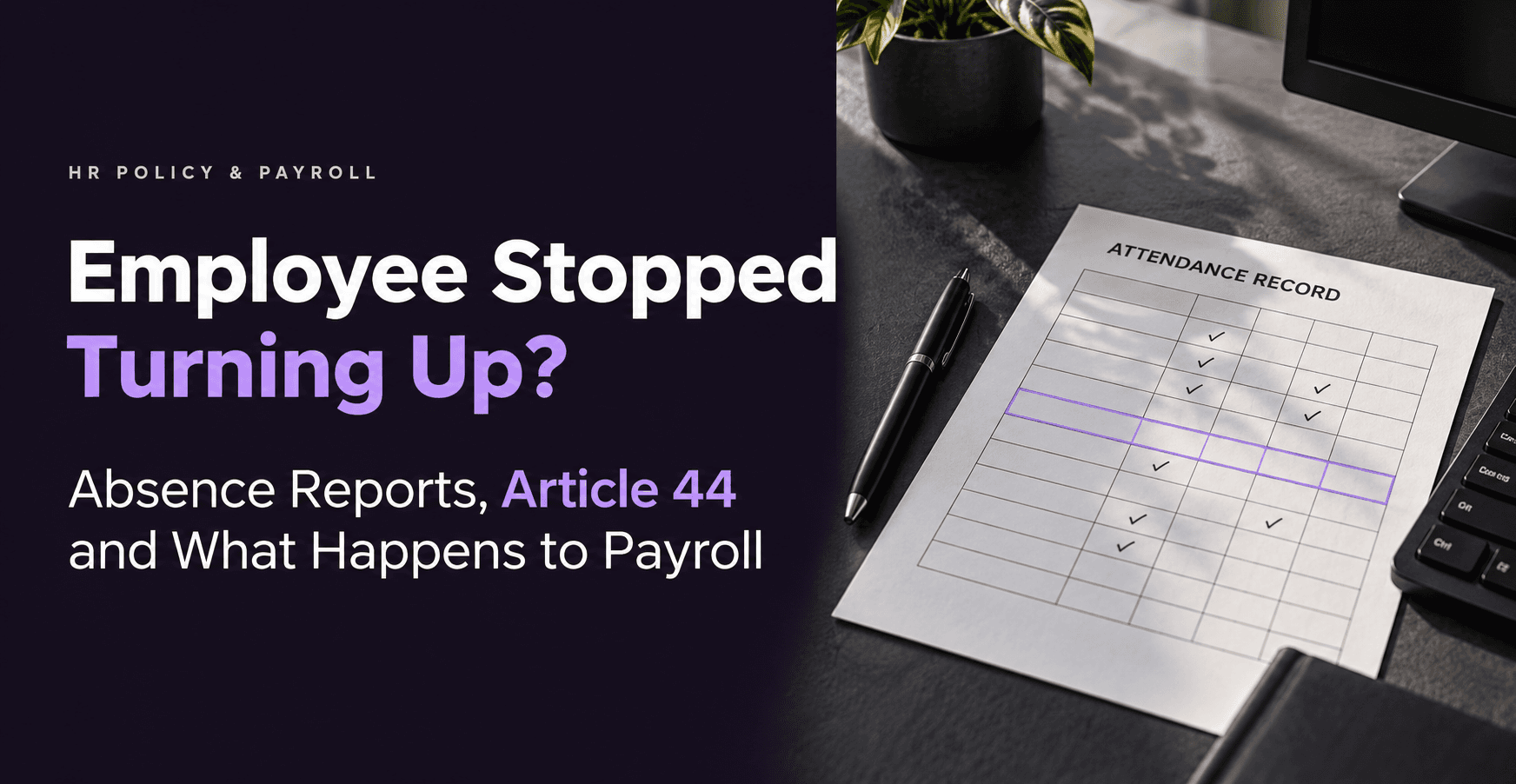
- attendance records proving the consecutive days of absence;
- call and message logs showing genuine, repeated contact attempts; and
- leave records proving the absence was not approved leave.
Reports fail — and employers lose — when the absence turns out to have been authorised leave that payroll never recorded, or when there is no proof anyone actually tried to reach the person. Clean attendance and leave data is not administrative housekeeping here; it is the case.
For the systems behind that evidence, see RadixHR's guides to biometric attendance and attendance–payroll integration.
A note on labour bans
It is tempting to assume an absence report automatically triggers a one-year labour ban. Do not state it as automatic. A restriction under Article 50 applies only in certain cases, and the consequences depend on the facts. Point employees and managers to the general rules rather than promising a specific ban outcome. RadixHR's UAE labour ban rules guide covers the general framework.
A day-by-day checklist from day 1 of absence
- Day 1–2: Log the absence against attendance. Attempt contact through every channel — call, message, email, emergency contact — and record each attempt with date and time.
- Day 2–3: Check leave records. Confirm there is no approved leave, sick note, or pending request that explains the absence. If there is, this is not an absconding situation.
- Day 3–6: Continue documented contact attempts. Send a written notice to the employee's registered address/email asking them to return or explain, and keep proof of sending.
- Day 7: Review the full evidence pack — attendance, contact log, leave records, written notice. Confirm the absence is genuinely unexplained and the employee is uncontactable.
- After seven consecutive days: If the conditions are met, consider the MOHRE absence report and/or Article 44 termination — and confirm the current conditions on the MOHRE service card first.
- Throughout: Keep the evidence pack complete and never file to pressure the employee. If they return with a valid reason, correct or cancel the report.
The bottom line
When an employee stops turning up, the UAE framework gives private-sector employers a defined process — but it rewards patience and evidence, not speed. Wait for the seven-consecutive-day threshold, document every contact attempt, confirm there is no approved leave behind the absence, and only then consider the absence report or an Article 44 termination. The report cancels a work permit and removes the worker from your WPS calculation, so it has to be right. Your attendance, contact, and leave records are what make it right — or what sink it.
For the wider offboarding rules, see RadixHR's termination of employment guide.
Sources & references
This guide is based on the following official UAE sources, current at the time of writing (verify the latest versions directly, as the law and MOHRE services are updated periodically):
- Federal Decree-Law No. 33 of 2021 on the Regulation of Employment Relationships (as amended) and its Executive Regulations — including Article 44 (termination without notice) and Article 50 (work-permit restrictions). Published on the UAE Legislation portal.
- MOHRE (mohre.gov.ae) — the "Labour Complaint – Absence From Work" service and its current conditions, and guidance on the Wage Protection System for the mainland private sector.
- Domestic workers — covered by separate legislation and MOHRE guidance with their own reporting window.
- DIFC and ADGM — separate employment frameworks with their own rules. Confirm the applicable regime with the relevant authority.
Keep the evidence complete before you ever need it
RadixHR keeps attendance, contact logs, and leave approvals in one place, so if an absence ever becomes a dispute, the evidence that decides it is already complete and time-stamped.
This article is for general information only and does not constitute legal advice, and is point-in-time (last updated November 2026). Absence-report conditions, termination grounds, and work-permit consequences are set under Federal Decree-Law No. 33 of 2021, its Executive Regulations, and MOHRE service rules, which are subject to change; the DIFC and ADGM operate separate frameworks. Verify current requirements with MOHRE or a qualified adviser before acting.