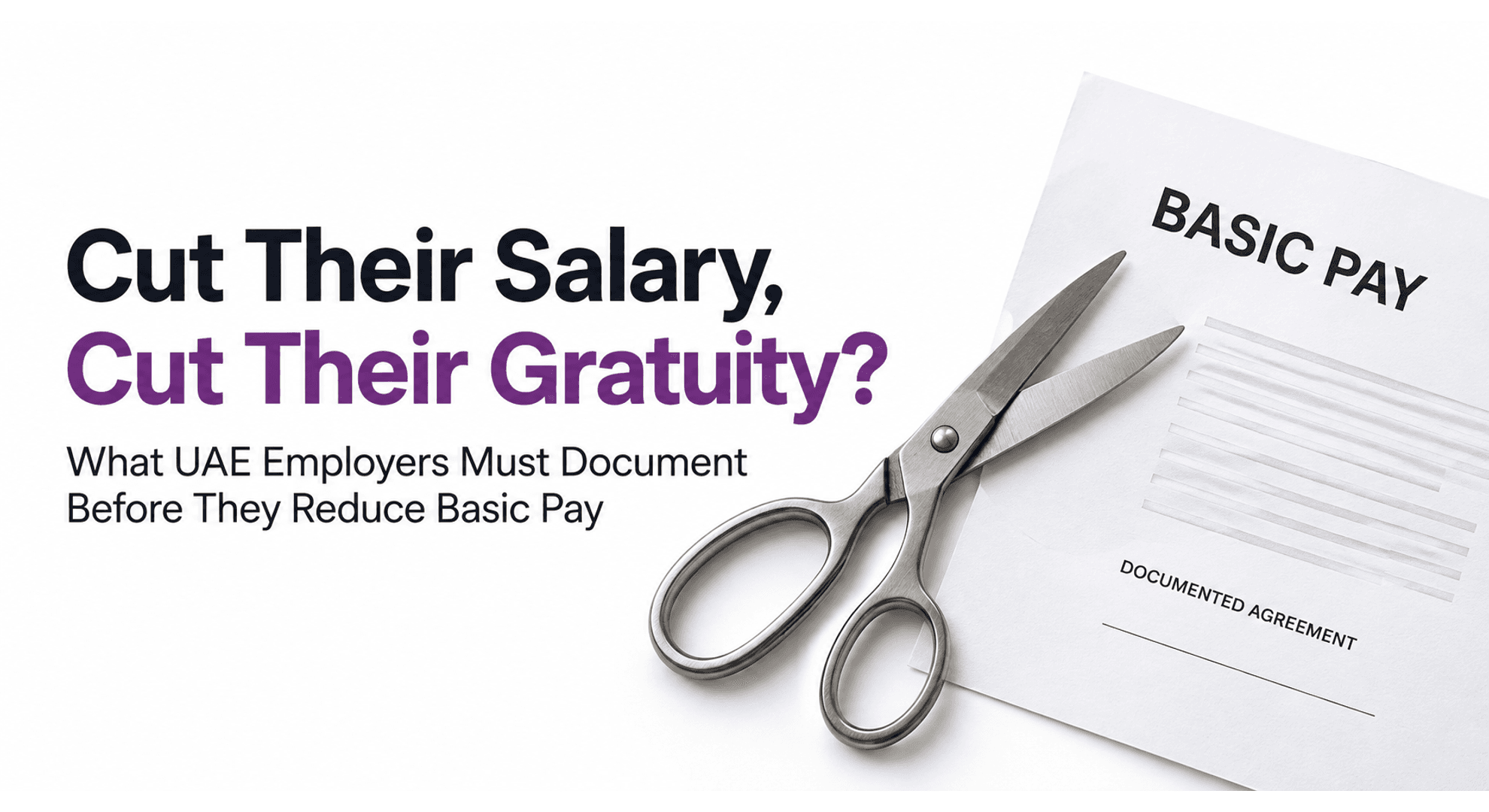
A recent "Ask Gulf News" column captured a dispute UAE HR teams should never want to be on the wrong side of: an employee whose employer cut their salary by 20% with no signed agreement, now unsure whether their end-of-service gratuity will be calculated on the original basic wage or the reduced one. The employee's question is a legal one. But flip it around and it becomes an HR and payroll question — and a preventable one: what should the company have documented before it touched that salary at all?
This guide answers that. It is written for the employer who wants to reduce a salary lawfully — or who wants to be sure they never end up as the subject of that reader's complaint. Because in the UAE, a pay cut is not a payroll-system edit. It is a change to a registered contract, and if it is not documented correctly, it sits on your books as a live liability until the day the employee leaves.
Informational only — not legal advice. This article is point-in-time (last updated September 2026) and summarises the general legal framework, not a specific legal opinion. Salary, contract, and gratuity rules are set under Federal Decree-Law No. 33 of 2021 and MOHRE regulations and are subject to change. Verify your position with MOHRE (mohre.gov.ae) or a qualified adviser before acting.
The wage the law actually looks at
Start with the single fact that governs everything else: the basic wage the law recognises is the one stated in the MOHRE-registered employment contract — not a figure in a verbal instruction, an email, or a quiet edit to your payroll system.
This matters because HR and payroll teams often treat the payroll software as the source of truth. It is not. If your system says an employee's basic salary is AED 8,000 but their registered MOHRE contract still says AED 10,000, the contract is what governs their statutory entitlements — gratuity included. A salary "reduced" only in the payroll system, without the contract being formally changed, has not been lawfully reduced at all. It has simply created a gap between what you pay and what you are contractually committed to.
Why a downturn is not, by itself, a ground to cut pay
The most common trigger for a pay cut is financial pressure — a slow quarter, a lost client, regional uncertainty. It is worth being blunt about this: general financial difficulty is not, on its own, a recognised legal ground for a unilateral pay cut in the UAE.
Employment-law commentary on the current framework is consistent on the point — as one legal expert put it in coverage of recent salary-cut questions, an employer "cannot reduce an employee's salary without the employee's express written consent," and external pressures such as a downturn or wider tensions "do not, in themselves, create any legal exception to this rule." Emergency measures have been introduced in the past (as during COVID-19), but absent such a specific provision, the default stands: the employer cannot simply impose a reduction because times are hard.
That does not mean pay can never come down. It means the route matters.
What a lawful reduction actually requires
Reducing a basic salary lawfully turns on one principle: an employment contract cannot be changed unless both parties agree, in writing. In practice, that means:
- A signed addendum to the existing contract, or a revised MOHRE-registered contract, reflecting the new basic wage.
- Clear, express written consent from the employee — a genuine agreement to the change, not a notification that it is happening.
- The change registered with MOHRE, so the official contract matches the new reality.
The critical word is consent. A memo announcing a cut, a line in a town-hall deck, or a new figure appearing on the next payslip are not consent. They are the employer acting unilaterally — which is precisely what the law does not permit.
"They kept working, so they agreed" — why that fails
Employers sometimes assume that if an employee continues to work after a pay cut, they have accepted it. This is one of the riskiest assumptions in UAE HR.
Continuing to work is not the same as legal consent. The standard is express written consent, and passive acceptance — simply not resigning — does not meet it. An employee can continue working under a reduced salary for months and still, later, dispute the reduction and claim the difference, along with entitlements calculated on the original wage. The absence of a signed agreement does not fade with time; it remains a gap the employee can point to whenever they choose. Silence is not signature.
How this becomes a live gratuity liability
Here is where an undocumented cut turns from an HR irregularity into a number on your balance sheet.
End-of-service gratuity is calculated on the employee's last basic wage — 21 days of basic pay per year for the first five years of service, 30 days per year beyond five, on basic salary only, capped at two years' total wage. The intent behind a pay cut is usually to reduce that liability along with the monthly cost.
But if the reduction was never properly documented and consented to, the employee has a live argument that their real contractual basic wage was never lawfully changed — and that their gratuity, leave encashment, and other entitlements should be calculated on the original, higher figure. Until that employee leaves and is settled, the difference is an unquantified, disputable liability sitting quietly on your books. You may believe you cut the cost; in fact you may only have deferred a larger, contested settlement to exit day.
A properly documented reduction, by contrast, cleanly resets the basic wage the law looks to. The paperwork is not bureaucracy — it is what makes the saving real.
The connection to your WPS file
There is a payroll-compliance layer on top of the legal one. Once a salary is lawfully reduced, the new basic wage has to flow through to your WPS Salary Information File, so that what you pay, what the contract says, and what the SIF reports all agree. Under the 2026 WPS framework, a basic-salary figure in the SIF that does not match the registered MOHRE contract is exactly the kind of inconsistency that surfaces in monitoring. A pay change that is updated in one place but not the others creates a mismatch — the same root problem as an undocumented cut, seen from the payroll side. For how the basic-vs-allowance split flows through payroll, see our guide to UAE payslips and salary structure.
Before-you-reduce-a-salary checklist
Run this every time a salary reduction is on the table:
- Confirm there is a lawful basis and genuine agreement — not just financial pressure and an intention to impose it.
- Draft a signed addendum or a revised contract stating the new basic wage and effective date.
- Obtain express written consent from the employee — a real signature on the change, kept on file.
- Register the change with MOHRE so the official contract matches.
- Update the WPS/SIF record to the new basic wage before the next submission, so payroll, contract, and SIF agree.
- Keep the full documentation trail — the signed addendum, the MOHRE registration, and the updated payroll record together.
- Recalculate accrued entitlements on the correct basis and understand which wage governs gratuity and leave encashment going forward.
If any step is skipped, treat the reduction as unsettled — because a court or MOHRE may too.
The bottom line
The Gulf News reader's dispute exists only because, somewhere, an employer reduced a salary without the paperwork to support it. That is the avoidable mistake. In the UAE, a pay cut is a contract change that requires the employee's express written consent, a downturn alone is not a ground to impose one, and continuing to work is not agreement. Get the documentation right — signed addendum, MOHRE registration, matching WPS record — and the reduction is clean and the gratuity resets to the new wage. Get it wrong, and you have not saved money; you have parked a disputed, higher settlement on your books until the employee walks out the door.
For the mechanics behind the numbers, see our UAE payslips and salary structure guide and our gratuity calculator guide. The legal framework is Federal Decree-Law No. 33 of 2021, published on the UAE Government Portal at u.ae; the reader question that prompted this piece was answered in Gulf News.
Keep every salary change documented everywhere it matters
RadixHR keeps every contract change, WPS record, and gratuity calculation in sync, so a documented salary change stays documented everywhere it matters.
This article is for general information only and does not constitute legal advice, and is point-in-time (last updated September 2026). Salary, contract, consent, and gratuity requirements are set under Federal Decree-Law No. 33 of 2021 and its Executive Regulations and MOHRE regulations, and are subject to change; the DIFC and ADGM operate separate frameworks. This piece cites the legal framework generally and is not a substitute for advice on a specific case. Verify current requirements with MOHRE or a qualified adviser before acting.