A practical, update-driven guide for HR, payroll, and founders with existing Emirati employees. Last updated: September 2026.
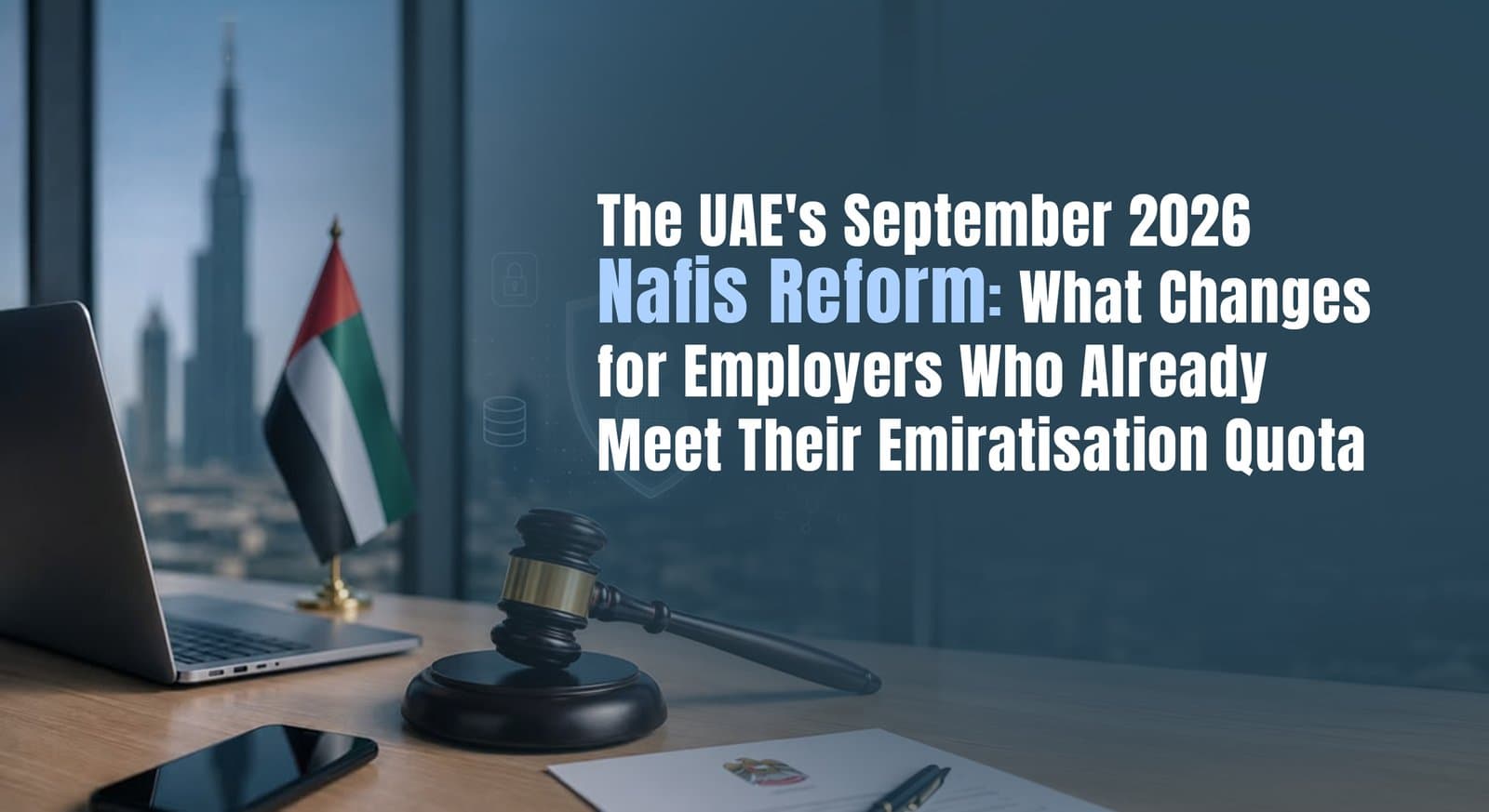
Most Nafis coverage is written for companies chasing their quota. This one is for the employers who are often overlooked: those who already have Emiratis on the payroll and assume the September 2026 Nafis reform is somebody else's problem. It is not. The revised framework that began rolling out this month changes the economics of employing UAE nationals — the salary floor that qualifies for support, how child allowances work, and, most directly for your cost base, who pays the pension contribution. If you already employ Emiratis, some of these land on your existing payroll, not just your next hire.
Here is what changed, what it means for the Emiratis already on your books, and a payroll re-audit to run before year-end.
Informational only — not financial or legal advice. This article is point-in-time (last updated September 2026) and describes a live rollout; figures and mechanics may firm up further. Verify the current position against Nafis (nafis.gov.ae), the ETCC, and MOHRE, and confirm pension-contribution specifics with a qualified adviser before acting.
What changed versus the previous Nafis structure
Nafis — the federal programme that incentivises Emiratis into private-sector jobs, now extended to 2040 — has been overhauled, with the revised framework taking effect from September 2026 for new beneficiaries and existing recipients transitioning gradually. Four changes matter most to employers:
- A standard AED 6,000 minimum salary threshold to qualify for Nafis support, aligned with the Emirati minimum-wage policy in force from January 2026.
- Uncapped child allowances — the old limit on the number of eligible children is removed.
- A pension-contribution shift onto employers — the piece with the most direct cost impact.
- A raised support ceiling and new family schemes — the maximum salary for salary support moves to around AED 20,000, and new support schemes for wives and children of Emiratis working in the private sector are being introduced.
Each of these interacts with a payroll you are already running, which is why "we already meet our quota" is not a reason to skip it.
The AED 6,000 floor and your existing Emirati pay bands
The headline number is a AED 6,000 minimum monthly salary as the standard eligibility threshold for Nafis support. For new beneficiaries from September 2026, a salary below that floor means no support under the revised scheme.
Why this reaches employers who already comply: if any Emirati already on your payroll sits below AED 6,000, they are now below both the minimum-wage expectation for UAE nationals and the Nafis support threshold. That is a live payroll issue, not a hiring one. The minimum wage for Emiratis (AED 6,000 for new or renewed work permits) already required existing Emirati staff to be brought up to the floor, and the Nafis reform reinforces the same number as the line beneath which support falls away. The action is simple to state: check that no Emirati on your books sits below AED 6,000, and correct any that do.
There is also a support ceiling to be aware of — salary support tapers and cuts off at the upper end (around AED 20,000) — so both ends of your Emirati pay bands are worth mapping against the revised thresholds.
Uncapped child allowances: what it changes
Under the old model, the Nafis child allowance was limited to a set number of children (commonly cited as a maximum of four). The reform removes that cap: eligible Emirati employees can now receive the child allowance — reported at AED 600 per month per eligible child — for every qualifying child, subject to salary conditions (broadly, a salary at or above AED 6,000 and within an upper limit).
For employers, this is mostly good news to communicate rather than a cost to bear — the allowance is a government support payment to the employee, not an employer liability. But it matters for two practical reasons: it strengthens the value proposition of an Emirati role at your company (useful for retention and recruitment), and it is the kind of benefit employees will ask HR about, so your team should understand it well enough to point people to the right place (their individual Nafis record) rather than guess.
The pension-contribution change — where your cost actually moves
This is the change with the clearest impact on employer cost, and it needs care. Previously, Nafis effectively subsidised part of the employer's pension obligation — reimbursing a portion (commonly cited as 2.5%) of the employer's contribution for eligible Emirati employees earning below a threshold. From September 2026, that employer-side subsidy is being removed, and employers assume their full statutory share of the pension contribution for Emirati employees, with Nafis redirecting its support to the employee side (salary top-ups and family allowances) instead.
Two things to hold clearly:
- The underlying GPSSA contribution split is a statutory matter and is not what changed — what changed is that the Nafis reimbursement of part of the employer share is being withdrawn, so the employer's net cost rises by roughly the amount that was previously subsidised.
- The exact figures and how they apply to each employee are pension-technical — they depend on registration date and the applicable pension law, and any transitional treatment for employees still migrating under the old schedule. This is precisely the point to confirm with a pension/payroll adviser rather than estimate.
The practical takeaway for budgeting: the cost of an Emirati employee is going up modestly from the employer side because a subsidy is going away — factor that into your Emirati payroll cost from September onward, and get the specific per-employee numbers verified.
How this shifts the Emiratisation hiring calculation
Employers plan further Emiratisation hiring on a net-cost basis: the salary, minus the support the employee attracts, weighed against the alternative of the monthly non-compliance fine. The reform nudges several inputs at once — the employer now carries the full pension share (cost up a little), while the employee-side support (salary top-ups, uncapped child allowances, new family schemes) is richer, which strengthens the overall attractiveness and stability of an Emirati role even if the employer's direct line-item rises.
The net effect is not that Emirati hiring got more expensive in any meaningful sense — set against the AED 9,000-per-month penalty for an unfilled quota role, a genuinely employed Emirati remains far cheaper than the fine. But the composition of the cost has shifted, and the models HR built a year ago need re-running on the September 2026 numbers.
Payroll re-audit checklist (before year-end)
Run this over your existing Emirati population now, ahead of the 31 December Emiratisation checkpoint:
- List every Emirati employee with their current basic and gross monthly salary.
- Flag anyone below AED 6,000 — correct to the floor; this is both a minimum-wage and a Nafis-eligibility issue.
- Map salaries against the support band (roughly AED 6,000 up to the ~AED 20,000 support ceiling) so you understand who attracts what.
- Re-budget the pension line — add back the employer share that Nafis previously subsidised, with per-employee figures confirmed by your adviser.
- Confirm WPS records reflect the corrected salaries, so the payroll, the contract, and the SIF all agree. See our WPS compliance guide for the full framework.
- Brief your team on the uncapped child allowance and new family schemes, so employee questions get a correct pointer to Nafis rather than a guess.
- Re-run your Emiratisation hiring model on the new net-cost inputs before planning year-end hires.
- Note the transition window — existing beneficiaries move to the revised framework gradually (reported as up to three years), so confirm current-year treatment per employee rather than assuming the new rules apply to everyone at once.
The bottom line
The September 2026 Nafis reform is not just a recruitment-incentive update — it reaches into the payroll of every employer who already has Emiratis on staff. The AED 6,000 floor is a salary-compliance line to check now; the pension change is a real, if modest, increase in employer cost that belongs in your budget from this month; and the richer employee-side support changes the story you tell when recruiting UAE nationals. Treat it as a payroll re-audit, verify the pension specifics with an adviser, and go into the year-end Emiratisation checkpoint with your Emirati pay structures already aligned to the new rules.
For the wider compliance picture, see our MOHRE services guide for employers, our WPS compliance guide, and our guide to MoHRE's fake Emiratisation crackdown for the documentation standard your genuine Emirati hires need to meet. Official details are published by Nafis at nafis.gov.ae and the ETCC.
Sources & references
This guide is based on the following official UAE government sources, current at the time of writing (this is a live rollout — verify the latest figures directly, as thresholds and transitional arrangements are being applied in phases):
- Emirati Talent Competitiveness Council (ETCC) — the official announcement (14 April 2026) of the updated Nafis framework following the programme's extension to 2040, which sets out the standardised AED 6,000 minimum salary threshold for support eligibility, the revised Salary Support Scheme, the phased transition for existing beneficiaries (up to three years), the free-zone glide path (100% / 70% / 30% support over 15 months), and the pension-contribution position. etcc.gov.ae
- Nafis — the official programme portal for eligibility, salary support, child allowances, and the pension contribution support scheme, and the place employees should check their individual records. nafis.gov.ae
- MOHRE (mohre.gov.ae) — Emiratisation obligations, the Emirati minimum-wage policy (AED 6,000 from 1 January 2026 for new or renewed work permits), and the WPS framework that Emirati salaries are paid and recorded through.
- Federal Decree-Law No. 57 of 2023 on pension and social security — the statutory GPSSA contribution split for Emirati employees (which is unchanged; what changed in September 2026 is the withdrawal of the Nafis reimbursement of part of the employer share), administered by the GPSSA.
- UAE Cabinet minimum-wage decision — the AED 6,000 monthly minimum for Emiratis in the private sector, to which the Nafis eligibility threshold is aligned.
The September 2026 changes take effect for new beneficiaries from September 2026, with existing beneficiaries transitioning gradually over a period of up to three years. Pension-contribution figures depend on each employee's registration date and applicable pension law and should be confirmed per employee with a qualified pension or payroll adviser. This reference list points to primary government sources; where third-party summaries were consulted, the underlying official text was used as the authority.
Emiratisation, made easy to keep compliant
RadixHR keeps Emirati salary bands, WPS records, and Emiratisation tracking aligned, so a reform like this is a re-audit you run in an afternoon, not a scramble. See how it fits with RadixHR's payroll and compliance tools.
This article is for general information only and does not constitute financial, legal, or pension advice, and is point-in-time (last updated September 2026). The Nafis reform is a live rollout; thresholds, allowances, and pension-contribution mechanics are set by the ETCC, Nafis, MOHRE, and the applicable pension authority and are subject to change and transitional arrangements. Verify current figures with Nafis (nafis.gov.ae) and confirm pension-contribution treatment with a qualified adviser before acting.