A practical guide for candidates signing an offer — and for employers who want their offers to hold up.
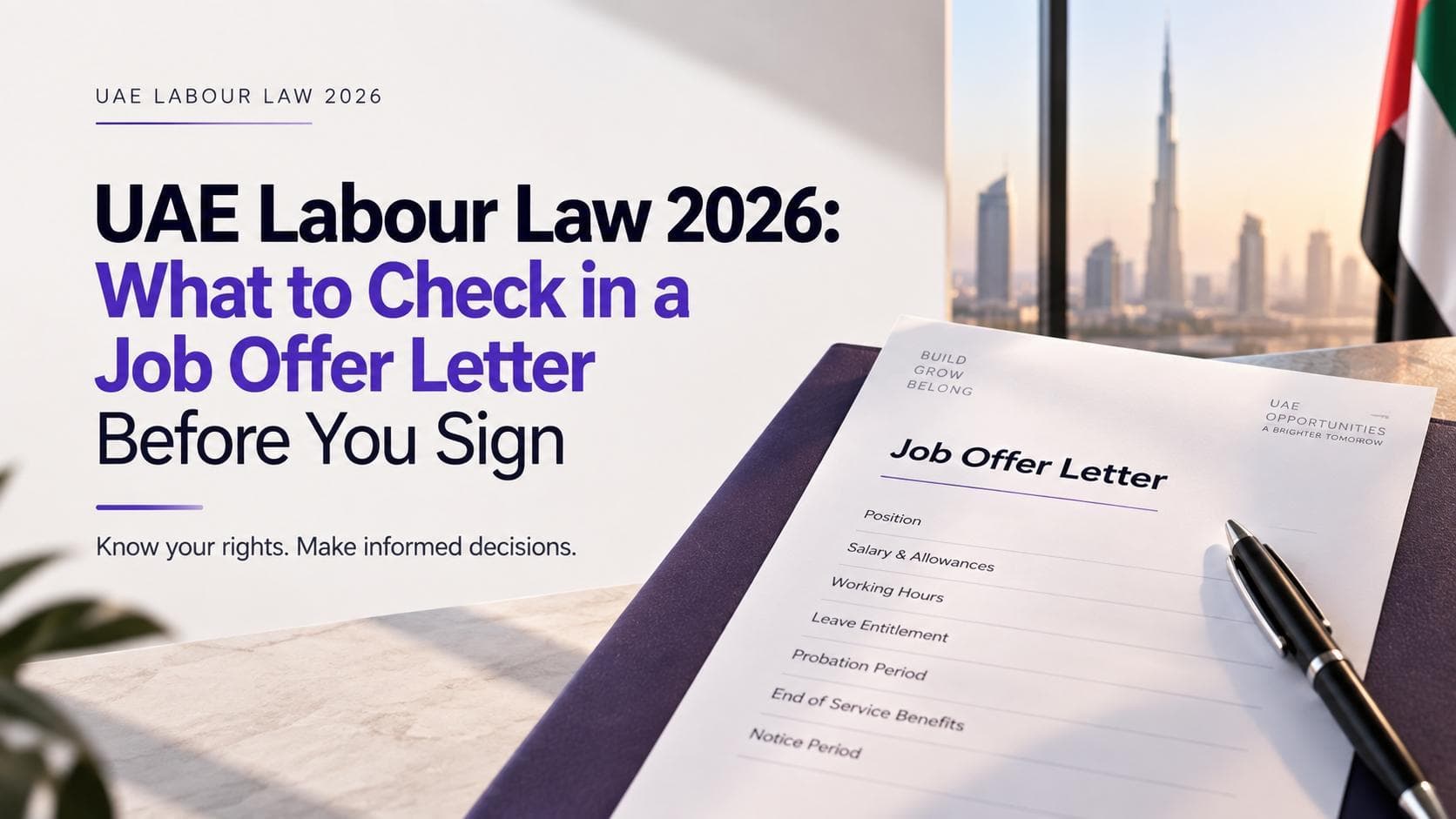
A job offer letter in the UAE is not a formality you skim on the way to a new role. Under Federal Decree-Law No. 33 of 2021, the signed offer is a legally significant document: for mainland roles it is approved through MOHRE before your work permit can even be issued, and the employment contract that follows is supposed to be built directly on top of it. Sign carelessly, and you can find yourself locked into terms you never intended to accept — or, worse, handed a contract weeks later that quietly differs from what you agreed.
This guide walks through exactly what to check before you sign. It is written for the person accepting the offer, but it doubles as a checklist for employers who want their offers to be clear, compliant, and dispute-proof from the start.
Informational only — not legal advice. This article is point-in-time (last updated September 2026) and covers the UAE mainland private sector. The DIFC and ADGM run their own frameworks. Verify your position with MOHRE (mohre.gov.ae) or a qualified adviser before signing anything.
1. The salary breakdown — basic vs allowances
This is the single most important line to read carefully, and the one most people skip. A good offer does not just state a gross monthly figure — it separates basic salary from allowances (housing, transport, and so on).
Why it matters so much: several of your most valuable entitlements are calculated on basic salary only, not the gross total. End-of-service gratuity is based on basic pay. So is overtime. A tempting-looking gross salary with a very low basic and large allowances can mean a much smaller gratuity years down the line than you would expect. Before you sign, look at what the basic figure actually is — not just the headline number — and make sure the split is stated in dirhams, not left vague. For the full picture of how this split should look on paper, see our guide to UAE payslips & salary structure.
If an offer states only a single gross figure with no breakdown, ask for the basic and allowances to be specified. It is a reasonable request, and the answer tells you a lot.
2. Contract type and term
UAE private-sector employment is now fixed-term. The old "unlimited" contracts were phased out under the 2021 law, so every new offer should specify a defined term and a renewal expectation. Check that the contract type and its length are actually stated in the offer, rather than left to be filled in later at the employment contract stage — because the type affects your notice obligations and what happens if either side ends the relationship early.
Also confirm the renewal position: fixed-term contracts renew by agreement, and a clause that describes how renewal works is a good sign of a well-drafted offer.
3. The probation period
Probation in the UAE is capped: it cannot exceed six months, and it can only be applied once with the same employer. Check the offer states the probation length clearly and that it sits within that limit. It is also worth understanding the notice rules during probation, which differ from those after it — particularly the notice you must give if you decide to leave during probation, or move to another UAE employer.
A probation clause that is vague, longer than six months, or silent on notice is a flag to query before signing.
4. Notice periods and how you can leave
Read how the relationship can be ended, by either side. Notice periods should be stated, and under the current law they typically run from 30 to 90 days for either party once employment is confirmed. Pay attention to what is required of you if you want to resign — including during probation — so there are no surprises if your plans change. Our guide to notice periods in the UAE covers the full range of scenarios.
Be especially wary of anything that looks like a penalty for leaving, an attempt to make you forfeit earned entitlements, or a notice period that is wildly unbalanced between the two sides.
5. Benefits, leave, and what is actually included
Confirm the offer spells out the benefits you are counting on, rather than leaving them to assumption:
- Annual leave — the statutory entitlement is 30 calendar days per year after one year of service; check the offer reflects this. See our guide to types of leave under UAE labour law for the full entitlement picture.
- Air tickets — an annual flight home is a common benefit but not a legal entitlement, so if it was discussed, make sure it is written into the offer rather than promised verbally.
- Medical insurance — confirm it is provided and, ideally, the level of cover.
- Visa and Emirates ID — the offer should confirm the employer arranges and funds your residence visa, work permit, and Emirates ID.
Anything agreed in conversation but missing from the written offer is, in practice, not agreed. If it matters to you, get it on the page.
6. Restrictive clauses — non-compete and the fine print
Check for any non-compete or restrictive clause. UAE law allows these, but they are limited — a non-compete must be reasonable in duration, geography, and scope, and is generally capped at a maximum of two years. An overly broad clause that would stop you working anywhere in your field for years is worth questioning before you commit, not after you want to move on.
Read the rest of the fine print too: clauses on repayment of costs, deductions, or confidentiality. You are allowed to ask for clarification or amendment before signing — that is what the pre-signing stage is for.
7. The most important check: does the offer match the contract?
Here is the scenario that causes more UAE employment disputes than almost any other. A candidate signs an offer, resigns from their old job, relocates — and then receives a MOHRE employment contract with materially different terms: a lower basic salary, removed allowances, a changed job title, or a different contract type.
Know your position: under UAE labour law, the employment contract is meant to be based on the signed offer letter, and you are not obliged to sign a MOHRE contract that contradicts it. For mainland roles the MOHRE offer is approved electronically — often confirmed with an OTP to your own phone or through UAE PASS — before the work permit issues, and where a company offer and the MOHRE offer differ, the MOHRE version takes priority.
So, two practical rules:
- Keep your signed offer letter. It is your evidence of the agreed terms. Never hand over the only copy or delete it.
- If the contract does not match, do not just sign it. Raise the discrepancy in writing, ask for a corrected contract, and if the employer refuses, you can complain to MOHRE citing the signed offer — MOHRE takes signed offers into account, and complaints can generally be raised within two years of the issue.
A quick note for employers reading this from the other side: the cleanest way to avoid all of the above is to make sure the offer and the registered contract say exactly the same thing, in dirhams, from the start. A mismatch is not just a candidate's problem — submitting inconsistent information to MOHRE is itself a compliance risk.
Before-you-sign checklist
- Basic salary stated separately from allowances, in dirhams.
- Contract type and term specified, with the renewal position clear.
- Probation stated and within six months.
- Notice periods stated for both sides, including during probation.
- Annual leave, insurance, tickets, visa/Emirates ID written in, not just promised.
- Non-compete / restrictive clauses reviewed and reasonable.
- Bilingual — offer in Arabic and English (the Arabic version is authoritative).
- Copy kept of everything you sign.
- Contract checked against the offer before you sign the MOHRE contract.
The bottom line
An offer letter is the one moment where you have the most leverage and the least pressure — before you have resigned, relocated, or started. Reading it properly, checking the basic-salary split, and confirming the eventual contract matches it are what separate a smooth start from a costly dispute. Take the time at the offer stage; it is far cheaper than fixing a mismatch after you have already moved.
For the wider picture, see our guides to UAE employment contracts and UAE payslips & salary structure. Official guidance on job offers and contracts is published on the UAE Government Portal at u.ae and by MOHRE at mohre.gov.ae.
Sources & references
This guide is based on the following official UAE government sources, current at the time of writing (verify the latest versions directly, as offer and contract requirements are updated periodically):
- Federal Decree-Law No. 33 of 2021 on the Regulation of Labour Relations — the private-sector labour law, including provisions on contract terms, probation, and notice periods. See our UAE labour law guide.
- MOHRE (mohre.gov.ae) — guidance on offer letters, contract registration, and the electronic approval process for mainland work permits.
- UAE Government Portal (u.ae) — official information on employment contracts and job offers in the UAE.
Offers and contracts that match, every time
RadixHR keeps offer letters, MOHRE contracts, and payroll perfectly aligned, so what a candidate signs is exactly what they are onboarded and paid against. See how it fits with RadixHR's recruitment and payroll tools.
This article is for general information only and does not constitute legal advice, and is point-in-time (last updated September 2026). UAE employment offers and contracts are governed by Federal Decree-Law No. 33 of 2021 and its Executive Regulations and are subject to change; the DIFC and ADGM operate separate frameworks. Verify current requirements with MOHRE or a qualified adviser before signing or acting.