Emiratisation Year-End 2026: The 31 December Deadline, AED 9,000 Fines & Nafis Extended to 2040
Emiratisation deadline December 2026: the 10% skilled-role target, the AED 9,000/month fine per unfilled role, the 20–49 sector rule, fictitious-Emiratisation penalties, and the news that Nafis is extended to 2040. With a year-end action plan and quota checklist.
A practical, update-driven guide for HR, founders, and finance teams.
There is just over four months left on the most consequential Emiratisation deadline of the cycle. By 31 December 2026, private-sector companies with 50 or more employees must reach 10% Emiratisation of their skilled roles — the final step of a target that has climbed two percentage points a year since 2023. Miss it, and the shortfall costs AED 9,000 per month for every unfilled Emirati position — around AED 108,000 a year, each.
Two things make this year different. First, the fine is at its highest level since the programme began. Second, a piece of news most published guidance still gets wrong: Nafis, the federal support programme, has been extended to 2040 — it is not ending in 2026. This guide sets out who is in scope, exactly what is due by year-end, the penalties and how they escalate, the traps that catch employers, and a year-end action plan to close the gap.
Informational only — not legal advice. This article summarises general principles as currently published by MOHRE and Nafis, and is point-in-time (last updated August 2026). Targets, fines, and programme rules change. Verify your position with MOHRE or a qualified adviser before acting.
What is due by 31 December 2026
The 2026 target is the culmination of the current cycle:
- The 10% target. Companies with 50 or more employees must have Emiratis in 10% of their skilled roles by 31 December 2026. This is the highest target the programme has set.
- The half-year structure. The annual 2% increase is split into two 1% checkpoints: 1% by 30 June and a further 1% by 31 December. We covered the June 30 checkpoint as it landed — the year-end checkpoint is the one now approaching, and it is the one that closes out the full 10% for 2026.
- The measure is skilled roles. The target applies to skilled positions, not total headcount — so the denominator is your skilled workforce, and the definition matters when you calculate your own gap.
If you are at 8% and need 10%, that gap is not a rounding error at year-end — it is a monthly fine per missing position until it is closed.
Who is in scope
Emiratisation obligations are not the same for every business:
- 50 or more employees — the percentage target applies: 10% of skilled roles by end-2026, under the MOHRE Emiratisation resolutions.
- 20 to 49 employees, in 14 designated sectors — a separate rule (Cabinet Resolution No. 44 of 2024) requires a fixed number of Emirati hires rather than a percentage. These companies entered their second compliance year on 1 January 2026.
- Mainland, MOHRE-registered companies — Emiratisation applies to the mainland. Free-zone establishments (DIFC, ADGM, DMCC and others) are, as a current policy position, outside the mandatory quota — though government signalling has pointed toward a phased extension to some free-zone employers in future years. A mainland LLC under a free-zone holding still carries the quota on its mainland licence.
Confirm which rule applies to your company before calculating anything — the percentage target and the fixed-number rule are different obligations. Our Emiratisation compliance guide breaks down the quota math and the skilled-employee criteria in more detail.
What counts as a skilled role
Because the 10% target is measured against skilled positions, getting the classification right is the foundation of any accurate compliance calculation. MOHRE's framework generally treats skilled roles as those in the higher occupational skill levels — broadly, positions requiring a recognised qualification, such as managers, professionals, technicians, and certain clerical and skilled trades — as opposed to elementary or unskilled roles. The precise classification follows MOHRE's occupational categories and the qualification and wage attached to each role.
The practical consequence: two companies with identical headcounts can have very different Emiratisation targets depending on how many of their roles are skilled. Before you can know your gap, you have to know your skilled-role denominator — and misclassifying roles, in either direction, produces a wrong target and a wrong compliance position. If there is any doubt about how a role is classified, confirm it against MOHRE's categories rather than assuming.
The AED 9,000 fine and how it escalates
The financial consequence is straightforward and large:
- AED 9,000 per month for each unfilled Emirati position, in 2026 — up from AED 6,000 when the programme started in 2023, rising by AED 1,000 each year.
- That is roughly AED 108,000 per year per unfilled role. A company three skilled positions short of its target is paying about AED 27,000 a month — AED 324,000 a year — in contributions that generate no business value.
- The fine is a monthly charge that accrues until the position is filled, so every month of delay adds to it.
This is now one of the largest recurring penalties an HR team will encounter, and it is enforced through MOHRE's monitoring, work-permit restrictions, and company classification.
The traps that catch employers
Beyond simply missing the number, three specific issues cause problems:
The two-month replacement window. If an Emirati employee resigns, you generally have a limited window — commonly cited as around two months — to replace them before the position counts against your target again. Losing an Emirati hire late in the year, with no replacement lined up, can push you back into non-compliance right before the deadline. Plan for attrition, not just for hitting the number once.
Fictitious Emiratisation. Registering an Emirati who does not genuinely work, paying a "salary" to tick the box, or similar arrangements are treated as fraud. Penalties are severe — reported at AED 100,000 per worker, alongside subsidy clawback and further consequences such as tender bans. MOHRE uses AI-assisted audits that cross-check payroll, WPS, and contract records, so fake arrangements are increasingly detectable. This is not a shortcut; it is a serious liability.
Counting the wrong base. Because the target is a percentage of skilled roles, miscounting the denominator — including unskilled roles, or misclassifying positions — produces a wrong gap and a wrong compliance position. Get the classification right before you plan hires.
The Nafis news most guides get wrong
Here is the update that changes the calculus: the Nafis programme has been extended to 2040. Most content published still tells employers Nafis ends in 2026. It does not — the programme was formally extended in 2026, with an updated phase launching from September 2026.
Why this matters to the year-end decision:
- Nafis lowers the real cost of an Emirati hire. It provides salary support (reported at up to AED 7,000 per month for qualifying degree holders, for a period of years), pension-contribution support, training, and a free recruitment platform connecting employers with Emirati job-seekers.
- The subsidy does not reduce the fine directly — but by lowering the net cost of hiring, it makes filling the position (and eliminating the monthly fine) far more financially viable than paying the penalty.
- Genuine hiring beats paying the fine, comfortably. A fine of AED 108,000 a year per unfilled role, versus a subsidised hire whose net cost to the employer can be substantially offset, is not a close call — and now, with Nafis running to 2040, the support is not a closing window.
The strategic point: employers who treat this as "hire genuinely, with Nafis support" rather than "pay the fine or fake it" come out ahead on cost, risk, and compliance.
Year-end action plan
With just over four months left before the deadline, work this sequence:
- Measure the exact gap now. Log in to MOHRE's Smart Services / e-quota system and confirm your current Emirati headcount in skilled roles against your required 10%. Do not estimate — pull the number.
- Confirm which rule applies (50+ percentage target, or the 20–49 fixed-number rule) and verify your skilled-role denominator.
- Register and post roles on Nafis (nafis.gov.ae) immediately — the platform connects you to Emirati candidates for free, and the earlier you post, the more time to fill.
- Model the economics per role: the AED 9,000/month fine avoided, against the Nafis-subsidised net salary cost. This usually makes the hiring case obvious.
- Build in an attrition buffer. Account for the replacement window if an existing Emirati employee leaves before year-end.
- Keep every hire genuine and documented — real role, real work, clean payroll and WPS records — to stay clear of fictitious-Emiratisation exposure.
- Track weekly through Q4. A gap closed in October is far cheaper than one scrambled in late December.
Quota-status checklist
Run this to confirm where you stand:
- Headcount confirmed — total employees and skilled-role count verified.
- Applicable rule identified — 10% target (50+) or fixed number (20–49 in 14 sectors).
- Current Emirati count in skilled roles pulled from MOHRE e-quota.
- Gap calculated — positions still needed to reach 10% by 31 December.
- Nafis registered and open roles posted.
- Cost modelled — fine exposure vs Nafis-subsidised hire, per role.
- Attrition buffer planned for the replacement window.
- All hires genuine and documented — no fictitious arrangements.
- Mid-year (30 June) checkpoint confirmed as met, and year-end tracked weekly.
The bottom line
The 31 December 2026 deadline is the expensive end of a multi-year cycle, and the fine — AED 9,000 a month per unfilled role — is designed to make non-compliance the costliest option. The good news most employers have not registered is that Nafis is not closing: extended to 2040, it makes a genuine Emirati hire far cheaper than the penalty. With Q4 now the operative window, the winning move is to measure the gap precisely, use Nafis to fill it genuinely, and document everything.
Sources & references
This guide is based on the following official UAE government sources, current at the time of writing (verify the latest versions directly, as targets, fines, and programme rules are updated periodically):
- MOHRE (mohre.gov.ae) — Emiratisation resolutions setting the annual percentage target, skilled-role classification, and the half-year checkpoint structure for private-sector establishments with 50 or more employees.
- Cabinet Resolution No. 44 of 2024 — the fixed-number Emiratisation requirement for companies with 20–49 employees across 14 designated economic sectors.
- Nafis (nafis.gov.ae) — the federal Emiratisation support programme, including salary support, pension-contribution support, training, and the free employer–jobseeker recruitment platform, extended to 2040 with an updated phase from September 2026.
- UAE Government Portal (u.ae) — general guidance on private-sector Emiratisation obligations and enforcement.
Track your Emiratisation ratio automatically
RadixHR tracks your Emiratisation ratio against target, flags the gap early, and keeps your MOHRE and WPS records clean through the year-end deadline — so the number is measured continuously, not discovered in December. See how it fits with RadixHR's UAE compliance tools.
This article is for general information only and does not constitute legal or financial advice, and is point-in-time (last updated August 2026). Emiratisation targets, fines, scope, and Nafis programme terms are set by MOHRE and the UAE Cabinet and are subject to change. Verify current requirements with MOHRE, Nafis, or a qualified adviser before acting.
Related Articles
90 Days to the Emiratisation Deadline: A September Action Checklist Before 31 December 2026
The 10% Emiratisation target for 50+ employee companies falls on 31 December 2026 — the final checkpoint of the cycle. A month-by-month countdown for September to December, why the June checkpoint doesn't cover you, and how the AED 9,000 penalty compounds.
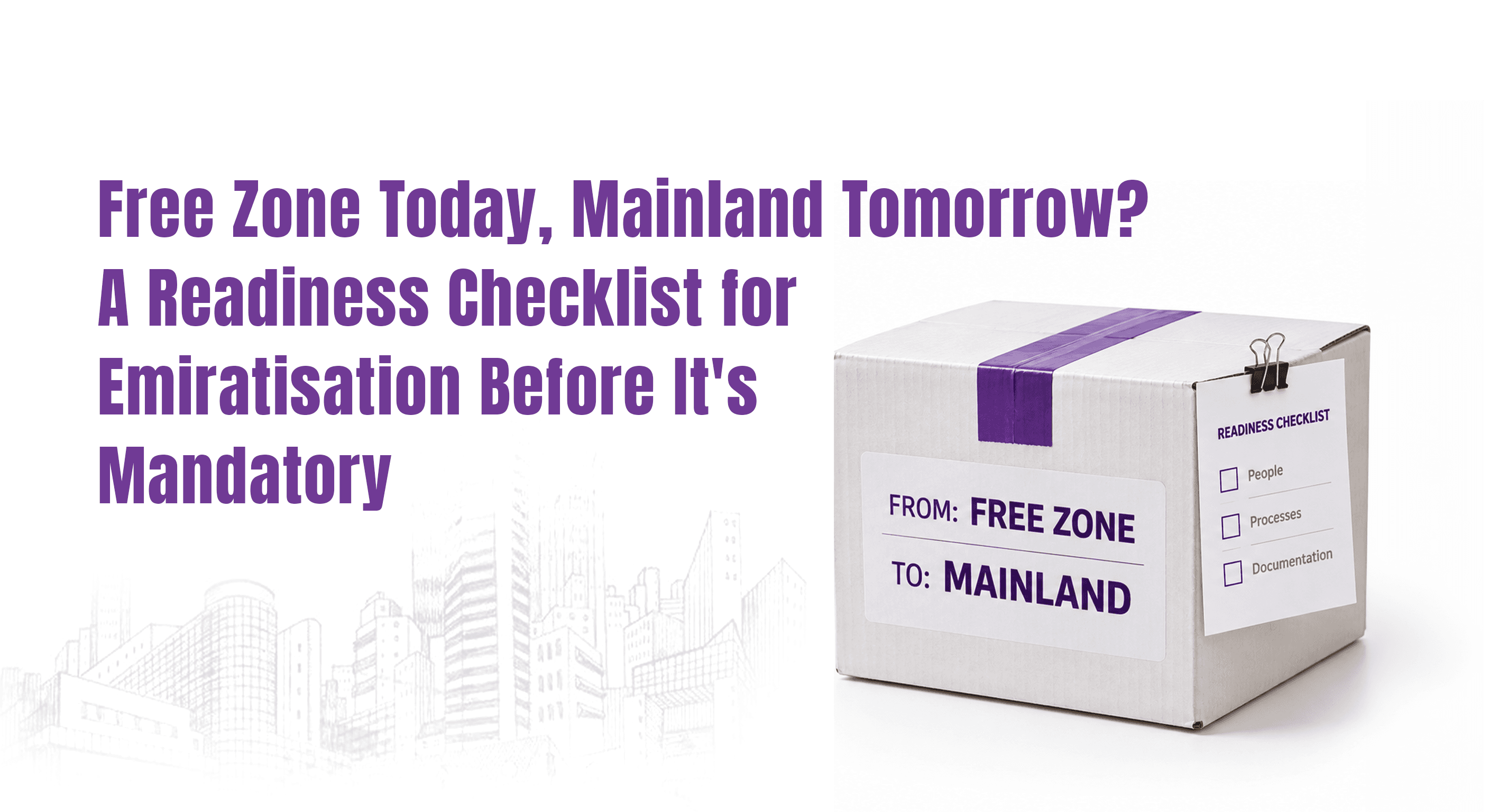
Free Zone Today, Mainland Tomorrow? A Readiness Checklist for Emiratisation Before It's Mandatory
Free zones sit outside the mandatory Emiratisation quota today, but 2026 compliance commentary increasingly frames extension as a matter of when, not if. A no-regret readiness checklist for free zone HR leaders — framed as reported industry expectation, not confirmed policy.
MoHRE's Fake Emiratisation Crackdown: What "Genuine Employment" Actually Means for Your Payroll Records
MoHRE is using AI to detect fake Emiratisation — 377 cases across 266 firms in H1 2026. This is an audit-readiness guide: the two penalty tracks, how detection works, and the exact documentation you should already have on file for every Emirati hire.