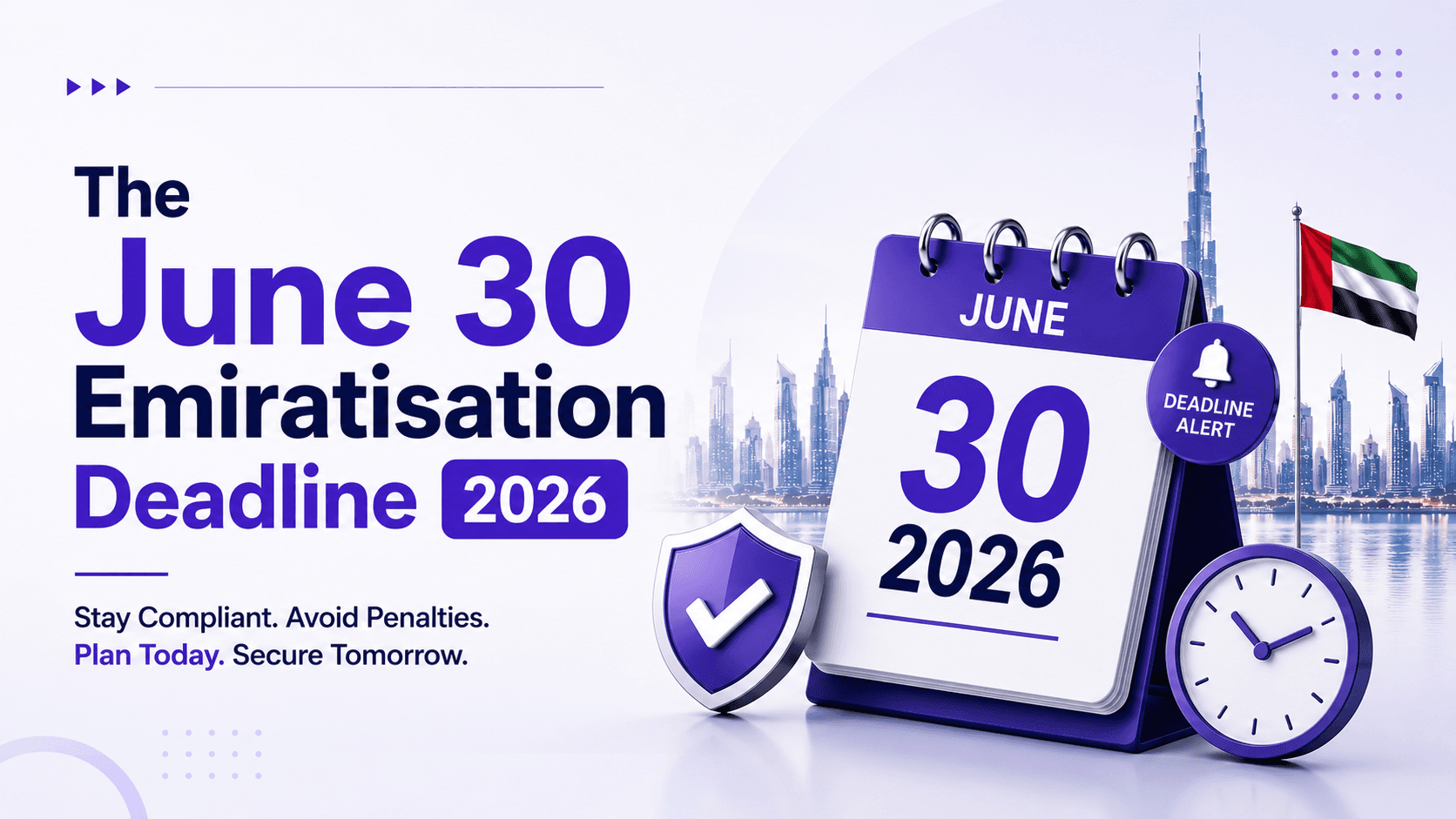
Public-sector HR teams have had this on their calendars for months. But for private-sector founders, finance leads, and HR managers in the UAE, the 30 June 2026 Emiratisation deadline can feel like it crept up overnight. The Ministry of Human Resources and Emiratisation (MOHRE) has now confirmed it is a hard date, not a soft nudge: from 1 July 2026, AI-powered enforcement begins, verification kicks in, and financial contributions are applied to companies that have fallen short.
If your company has 50 or more employees and has not confirmed its Emiratisation targets for the first half of 2026, this is the week to act. If you are in the 20–49 employee band and operate in one of 14 designated economic sectors, you have the same deadline for a different requirement. And if you have Emirati staff already on the books, there is a second June 30 deadline hiding in the same regulation: all existing Emirati contracts must be aligned to the new AED 6,000 minimum wage by that date.
This guide sets out who is in scope, what the half-year target actually requires, how it is calculated, what makes an Emirati hire genuinely "count," the real risks around so-called fake Emiratisation, and a step-by-step checklist to run before the deadline.
Informational only — not legal advice. This article summarises general principles for the UAE private sector mainland as currently published. Figures and targets are set by MOHRE and Cabinet decisions and change over time. Verify your specific position against current MOHRE guidance, and take professional advice for your establishment.
Who is in scope
Emiratisation quotas apply to mainland private-sector companies registered with MOHRE. There are two distinct groups:
- Companies with 50 or more employees must meet a percentage-based target for Emiratis in skilled roles. This is the group the 30 June 2026 deadline is primarily about.
- Companies with 20 to 49 employees operating in one of 14 designated economic sectors (including information and communications, finance and insurance, real estate, professional and technical activities, education, healthcare, construction, manufacturing, and hospitality) face a headcount requirement rather than a percentage: at least one Emirati hired by end of 2024 and a second by end of 2025.
Most free zones are currently exempt, but note this is a matter of policy rather than statute, and the direction of travel is toward wider coverage. Free zone entities should not assume permanent exemption.
What the H1 2026 target actually requires
For companies with 50+ employees, the rule is framed as growth, not a flat number. MOHRE requires:
- a 1% increase in the Emiratisation rate of skilled jobs in the first half of 2026 (the 30 June checkpoint), and
- a further 1% increase in the second half, bringing the total annual growth to 2% by 31 December 2026.
This sits inside the wider Cabinet policy of raising Emiratisation in skilled roles by 2% per year, working toward an overall cumulative target of around 10% by the end of 2026. The operative requirement you are measured on for this deadline, however, is the 1% half-year growth on your own skilled workforce — so the practical task is to confirm your baseline and close the gap.
How the target is calculated
The target is a percentage of your skilled workforce, not your total headcount. A "skilled" role under MOHRE's classification generally sits in the first five occupational categories, requires at least a post-secondary qualification, and — from 2026 — must carry a salary at or above the Emirati minimum wage (see below).
Worked example (illustrative):
- A company has 200 skilled employees.
- Annual target = 2% of 200 = 4 Emirati skilled roles to be added across 2026.
- Half-year target (by 30 June) = 1% of 200 = 2 Emirati skilled roles.
So this company needs at least two qualifying Emirati skilled employees in place by 30 June, on top of any requirement carried over from previous years. Where the calculation produces a fraction, MOHRE applies rounding rules, so confirm the exact figure for your establishment in your MOHRE portal rather than estimating — our Emiratisation calculator can help you work the target out. The targets are cumulative — each half-year requirement is added to what you were already obliged to maintain.
What makes an Emirati hire actually "count"
This is where compliance most often quietly fails. Putting an Emirati on the books is not enough. To count toward your target, the hire generally has to satisfy four conditions:
- A genuine skilled role with real duties and responsibilities — not a title on paper.
- Salary paid through the Wage Protection System (WPS). If the salary does not flow through WPS, MOHRE's system will not recognise the employee, even if they genuinely work for you.
- Registration with the pension fund — GPSSA in most emirates, or the Abu Dhabi Pension Fund (ADPF) for Abu Dhabi-based offices — within one month of the work permit being issued, with contributions paid on time every month.
- Salary at or above the Emirati minimum wage that applies from 2026.
Pension registration and WPS
Registering the Emirati employee with the correct pension authority is both a pension obligation and an Emiratisation requirement. The pension fund is determined by where the office operates, not where the employee lives. Late registration carries a penalty (reported at AED 5,000 per employee) plus back-payment of all missed contributions, so this should happen at the point of hire, not at month-end. Keep the registration confirmation on file — you may need it during MOHRE inspections.
The AED 6,000 minimum-wage alignment — also a 30 June deadline
A second deadline lands on the same date. From 1 January 2026, the minimum monthly wage for Emiratis in the private sector is set at AED 6,000 for new, renewed, and amended work permits. Crucially, existing Emirati employees' contracts must be aligned to this minimum by 30 June 2026. Many companies that hired Emiratis at lower salaries have not yet updated those contracts — if that is you, this needs to be actioned alongside any new hiring.
Using the Nafis platform to hire
Nafis is the federal programme that connects employers with Emirati jobseekers and offsets the cost of hiring them. MOHRE explicitly directs companies that are behind on targets to use the Nafis platform to reach a broad pool of national talent across specialisations.
For employers, Nafis is the practical route to compliance because it can substantially reduce the cost of an Emirati hire through:
- Salary support that tops up wages (reported at up to AED 7,000 per month for degree holders, for up to five years),
- child allowance and pension contribution support, and
- training subsidies.
A useful correction to a common misconception: Nafis has been extended to 2040 under the directives of the UAE leadership, with increased child-allowance support and longer support periods — so the narrative that "Nafis is closing in 2026" is out of date. That said, the cost advantage of registering and hiring early is real, and the platform is the channel MOHRE expects you to use.
What counts as "fake Emiratisation" — and the risks
"Fake Emiratisation" is any arrangement designed to appear compliant without genuinely employing Emiratis in real roles. MOHRE treats this as a serious offence, and enforcement has sharpened considerably. Examples include:
- hiring an Emirati on paper only ("ghost" employees) with no real duties,
- fictitious contracts or fabricated roles created solely to hit a number,
- reclassifying or reducing the workforce to manipulate the target ratio, and
- deducting an Emirati's salary under the pretext that they receive government support.
MOHRE uses an AI-powered monitoring system to flag these patterns. The Ministry reported detecting 405 cases of fake Emiratisation in the first half of 2025, and over 1,300 establishments have been penalised. The consequences are significant:
- Administrative fines under Cabinet Decision No. 43 of 2025 reported in the range of AED 20,000 to AED 100,000 per worker involved in the circumvention.
- Repayment of any improperly obtained Nafis funds.
- Criminal prosecution — false employment of UAE nationals can be treated as fraud against public funds.
- Downgrade in MOHRE's establishment classification system, and restrictions on new work permits.
Earlier instruments — including Cabinet Resolution No. 95 of 2022 and Ministerial Resolution No. 663 of 2022 — already set the framework for penalising circumvention. The 2025 additions raised the stakes. The takeaway for employers is simple: a compliant-looking number that does not reflect a real, paid, pension-registered employee is a liability, not an asset.
The cost of missing the target
For companies with 50 or more employees, the financial contribution for an unfilled Emirati position is AED 9,000 per month per position in 2026. This figure began at AED 6,000 per month in 2023 and has risen by AED 1,000 each year — so it works out to roughly AED 108,000 per year per missing position. Miss the target by several roles and the annual exposure climbs quickly.
For 20–49 employee companies in the designated sectors, the contribution is a lump sum collected each January: failing to hire the required second Emirati for 2025 resulted in AED 108,000, collected in January 2026.
These contributions are deducted through the MOHRE system and can affect your ability to obtain new work permits. They escalate annually, which is the point — the structure is designed to make compliance cheaper than non-compliance over time.
What changes from 1 July 2026
The deadline is not the end of the process; it is the start of verification. From 1 July 2026:
- MOHRE begins checking which 50+ establishments met their H1 target, and applies financial contributions to those that did not.
- Verification specifically includes confirming that newly hired Emiratis are registered with a social insurance fund and that contributions are being paid regularly.
- The second-half clock starts: the next 1% increase is due by 31 December 2026, completing the 2% annual growth.
- The AED 6,000 minimum wage now applies to existing Emirati employees, not just new permits — alignment was due by 30 June.
In other words, a company that scrapes over the line on 30 June still has a live obligation for H2 and ongoing monitoring of pay, pension, and retention. If a UAE national resigns, there is a replacement window (reported at around two months) before the position is treated as unfilled — but that window is easy to miss without a tracking system.
Pre-deadline action checklist
Run through this before 30 June:
- Confirm your headcount band — 50+, or 20–49 in a designated sector — and your exact obligation in the MOHRE portal.
- Establish your skilled-workforce baseline and calculate the 1% H1 target as a hard number, accounting for rounding.
- Count only qualifying Emiratis — genuine skilled role, WPS salary, pension registered, at or above minimum wage. Strip out anyone who does not meet all four.
- Identify the gap and the number of qualifying hires needed before 30 June.
- Post roles and source candidates through Nafis, and apply for the relevant salary and training support.
- Register every new Emirati with GPSSA or ADPF within one month of the work permit and start contributions immediately.
- Route all Emirati salaries through WPS and verify the payments are landing correctly in the system.
- Align existing Emirati contracts to the AED 6,000 minimum wage.
- Set up a retention and replacement tracker so a resignation triggers an immediate replacement timer.
- Document everything — contracts, pension confirmations, WPS records — ready for MOHRE inspection.
Most of these failure points come down to data sitting in disconnected places: headcount in one system, payroll in another, pension confirmations in an inbox. When your Emirati count, WPS status, pension registration, and target gap are visible in one place, the deadline becomes a number you watch, not a scramble you survive.
Talk to us — bring your Emiratisation tracking, WPS payroll, and pension registration into one connected workflow, so you can see your target gap in real time and act before the deadline. Get in touch at radixhr.com.
This article is for general information only and does not constitute legal or financial advice. Emiratisation targets, contribution amounts, minimum-wage figures, and penalties are set by MOHRE and UAE Cabinet decisions and are subject to change. Specific obligations depend on your establishment's size, sector, and MOHRE classification, and free zone rules differ. Verify current requirements with MOHRE or a qualified adviser before acting.