WPS Automation in the UAE: Cutting Payroll Errors & MOHRE Fines
A single wrong IBAN digit can turn an on-time payroll into a MOHRE violation. Here's how WPS automation in the UAE prevents SIF rejections and fines: where manual filing fails, how automated SIF generation and validation work, the 1st-of-month deadline under Resolution 340 of 2026, the graduated penalties it helps you avoid, mainland vs free-zone filing, and an error-prevention checklist.
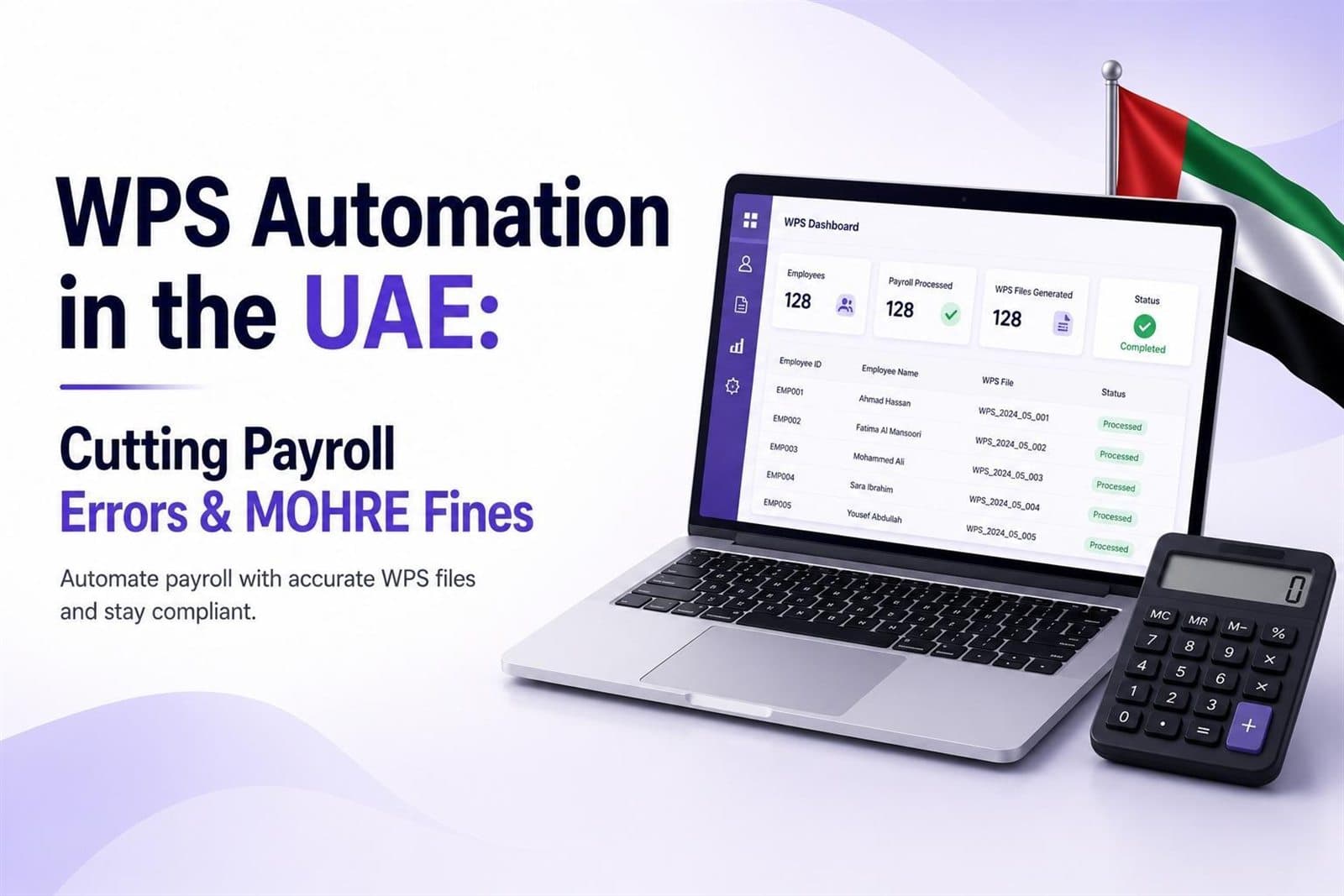
A practical guide for HR, payroll, and finance teams.
A single wrong digit in an IBAN can turn an on-time payroll into a MOHRE violation. The Wage Protection System does not care that the money was ready, the approvals were signed, and the intent was there — if the Salary Information File is rejected or the transfer misses the deadline, the enforcement clock starts. Since Ministerial Resolution No. 340 of 2026 removed the 15-day grace period, that clock now starts on the 2nd of the month.
This is the case for WPS automation in the UAE: not as a nice-to-have, but as the difference between a file that clears first time and one that bounces back on the 30th with no time left to fix it. This guide covers where manual WPS filing goes wrong, how automated SIF generation prevents rejections, what good validation checks before submission, the deadline automation helps you hit, the penalties it helps you avoid, the mainland-versus-free-zone difference, and a WPS error-prevention checklist.
Informational only — not legal advice. This article summarises general principles as currently published by MOHRE and the UAE Government Portal. Rules, thresholds, and penalties change. Verify your specific obligations with MOHRE or a qualified adviser before acting.
Where manual WPS filing goes wrong
Most WPS rejections are not caused by a shortage of funds. They are data errors in a file that was assembled by hand, and they cluster in a few predictable places:
- IBAN and account mismatches. A transposed digit, an old account, or an IBAN that does not match the employee's name. The transfer bounces, and that employee reads as unpaid.
- MOL / labour card and Establishment ID errors. A wrong, expired, or mistyped identifier that does not match MOHRE's record. Since the WPS moved to real-time verification, these are flagged at submission rather than discovered later.
- Wrong amounts. A salary below the registered contract figure, a manual overtime miscalculation, or an allowance keyed incorrectly. The file may be rejected, or worse, accepted and then flagged as an underpayment.
- Header-versus-detail mismatches. The Salary Control Record total does not equal the sum of the Employee Detail Records, or the record count is off — a classic copy-paste-into-spreadsheet error.
- Missing records and missing codes. An employee left out entirely, a new joiner omitted, or an unpaid employee filed without the required NOPAY code, or a lawful deduction without its deduction code.
- Format and naming errors. A wrong date or timestamp format, or an incorrectly named file that the agent's system will not read.
Every one of these has the same root cause: a human moving numbers between systems under time pressure at month-end. The fix is not more careful typing — it is removing the retyping.
How automated SIF generation prevents rejections
Automation attacks the problem at the source. Instead of exporting figures and rebuilding them into a .sif file by hand, an automated payroll system generates the SIF directly from the same data it used to run payroll. The IBANs, identifiers, and amounts in the file are the ones already held against each employee record — not re-keyed, so not re-mistyped.
That single change removes most of the failure modes above:
- Identifiers and bank details come straight from the employee master record, so they cannot drift from what payroll calculated.
- Amounts are the calculated figures — basic, allowances, overtime at the correct 125% or 150% rate on basic pay, and coded deductions — carried through without manual re-entry.
- Header totals are computed from the detail records, so the control record and the employee records reconcile by construction.
- File format and naming follow the required specification automatically.
The point of WPS automation is not speed for its own sake. It is that the file which reaches the bank is a faithful copy of the payroll you already approved — nothing added, nothing dropped, nothing mistyped in between. For the full anatomy of the file and its records, see our WPS and SIF explainer, and you can build a submittable file to spec with our WPS SIF generator.
Validation and error-checking before submission
Generating the file cleanly is half the job. The other half is validating it before it leaves the building, so an error is caught on your screen rather than in a rejection notice days later. A capable system runs these checks pre-submission:
- Reconciliation — control-record totals equal the sum of employee records, and the headcount matches.
- Identifier validation — labour card / MOL numbers and Establishment ID are present and correctly formatted, and flagged if expired.
- Bank-data checks — IBAN structure is valid and the routing/agent code is recognised.
- Contract cross-check — each salary is at or above the registered contract figure, and Emirati salaries meet the AED 6,000 minimum wage that applies from 2026.
- Completeness — every active employee appears, with NOPAY and deduction codes where needed.
- Threshold check — at least 85% of total wages are being transferred on time, with any shortfall backed by a lawful, coded deduction.
Because the December 2025 digital WPS upgrade moved much of this checking to real time on MOHRE's side, catching the same errors before you submit is what keeps a rejection from eating the last days before the deadline.
Meeting the monthly salary deadline
The deadline is the reason all of this matters. Under Ministerial Resolution No. 340 of 2026, salaries for the previous month must clear through WPS by the 1st of the following Gregorian month. There is no 15-day grace period, and the date is fixed regardless of weekends or public holidays.
Because banks and WPS agents typically need one to two working days to process a transfer, a clean file has to be submitted by around the 29th–30th. That leaves no room for a rejection-and-rebuild cycle at the end of the month. Automation protects the deadline in two ways: it produces a submittable file faster, and — more importantly — it produces one that is far less likely to come back rejected, which is the failure that actually blows the deadline. The official rules are set out on the UAE Government Portal's payment of wages page.
The penalties automation helps you avoid
Under Resolution 340, enforcement is automatic and front-loaded. Missing the deadline starts a graduated escalation that no longer waits two weeks to bite:
- Day 2 — MOHRE notifications and warnings begin, logged on your compliance record.
- Day 5 — new work permit applications are suspended. For any business that lives on visa quota, this is the stage that hurts first.
- Day 11 — administrative fines (under the Cabinet Resolution No. 21 of 2020 framework) and possible reclassification to the Third Category, applied to establishments with a repeated violation within the preceding six months. First-time delays do not attract the fine at this stage.
- Day 16 — automatic registration of a labour dispute on employees' behalf, targeting establishments with 25 or more affected workers.
- Day 21 — asset attachment, a travel ban on the person in charge, and referral to Public Prosecution, particularly for larger establishments in persistent violation.
The reclassification and reputational damage often outweigh the fine itself: a Third Category downgrade raises MOHRE service fees, restricts visa quotas, and is visible to banks and partners. You can estimate exposure for a given delay with our WPS fine calculator. Automation does not change the penalties — it reduces the chance you ever trigger them, by making the on-time, clean submission the default rather than a month-end gamble. RadixHR's WPS-compliant payroll feature and its UAE compliance tools are built around exactly this.
Mainland vs free-zone filing
Automation has to respect where you actually file, and this is a common point of confusion. The dividing line is not simply "mainland versus free zone" — it is whether your employees hold MOHRE-issued labour cards.
- Mainland companies registered with MOHRE file the federal SIF through a Central Bank-approved WPS agent, and Resolution 340 applies in full.
- Most free zones — DMCC, JAFZA, DAFZA, IFZA, RAKEZ and others — issue MOHRE labour cards, so they file the same federal WPS/SIF as mainland companies.
- DIFC and ADGM run their own independent frameworks and do not file the federal MOHRE SIF.
Good automation is configured to your filing route rather than assuming one. If you operate across a mainland entity and a free-zone entity, the system needs to handle each correctly rather than forcing both through one path. For a fuller breakdown of who files what, see our WPS and SIF explainer.
WPS error-prevention checklist
Run this every cycle, before the file goes to your agent:
- Employee master data is current — IBANs, labour card / MOL numbers, and Establishment ID all verified and unexpired.
- Joiners and leavers reconciled — every new hire due to be paid is included; final settlements are handled.
- Amounts match the contract — no salary below the registered figure; Emirati salaries at or above AED 6,000.
- Overtime is rate-coded correctly — 125% / 150% on basic pay, not a flat rate on gross.
- Deductions are lawful and coded — within the categories and the 50% cap, each with the correct code.
- SIF generated from payroll, not rebuilt in a spreadsheet.
- Header and detail reconcile — control-record total equals the sum of employee records; headcount matches.
- NOPAY codes applied for anyone not paid this cycle.
- 85% threshold met on time, with any shortfall documented.
- Submitted by the 29th–30th so the transfer clears by the 1st, allowing for bank processing.
- Agent confirmation captured and archived with the SIF for the cycle.
Most of these are checks a machine can run in seconds and a person can miss at 6 PM on the 30th. That is the whole argument for automation: not replacing judgement, but removing the manual steps where errors and fines are born. There is more practical UAE payroll guidance on the RadixHR blog.
Sources & references
This guide is based on the following official UAE government sources, current at the time of writing (verify the latest versions directly, as the law and MOHRE guidance are updated periodically):
- UAE Government Portal (u.ae) — "Payment of salaries/wages," which sets out the WPS obligation, the 1st-of-month deadline, the 85% on-time threshold, and the WPS filing framework. u.ae/en/information-and-services/jobs/employment-in-the-private-sector/payment-of-wages
- Ministerial Resolution No. 340 of 2026 on the Wage Protection System — the 1st-of-month payment deadline, the removal of the 15-day grace period, and the graduated Day 2 / Day 5 / Day 11 / Day 16 / Day 21 enforcement escalation.
- Cabinet Resolution No. 21 of 2020 — the administrative-fines and establishment-classification framework referenced in WPS enforcement.
- Federal Decree-Law No. 33 of 2021 on the Regulation of Employment Relationships (as amended) — the definition of wage and basic wage, permitted deductions and the 50% cap, and the overtime provisions that run on basic pay.
- MOHRE (mohre.gov.ae) and the Central Bank of the UAE — the WPS framework, Central Bank-approved WPS agents, and the Salary Information File (SIF) structure, whose fixed and variable components are checked against the registered contract.
- Emirati minimum wage — the AED 6,000 monthly minimum for Emiratis in the private sector, effective 2026, as published by MOHRE.
The DIFC and ADGM operate their own independent frameworks and do not file the federal MOHRE SIF; confirm requirements with the relevant authority. This reference list points to primary government sources; where third-party summaries were consulted, the underlying official text was used as the authority.
Turn a clean WPS file into the default, not a month-end gamble
WPS automation only pays off when the file that reaches your agent is a faithful copy of the payroll you approved. RadixHR generates a validated SIF straight from your payroll run, checks it against MOHRE format and contract rules before submission, flags identifier, IBAN, and threshold problems on your screen, and keeps every cycle's file and agent confirmation audit-ready — so the on-time, clean submission is the default.
This article is for general information only and does not constitute legal or financial advice. WPS rules, thresholds, deadlines, and penalties are set by MOHRE and the Central Bank of the UAE under Federal Decree-Law No. 33 of 2021, Ministerial Resolution No. 340 of 2026, and Cabinet Resolution No. 21 of 2020, and are subject to change. The DIFC and ADGM operate separate frameworks. Verify current requirements with MOHRE or a qualified adviser before acting.
Related Articles
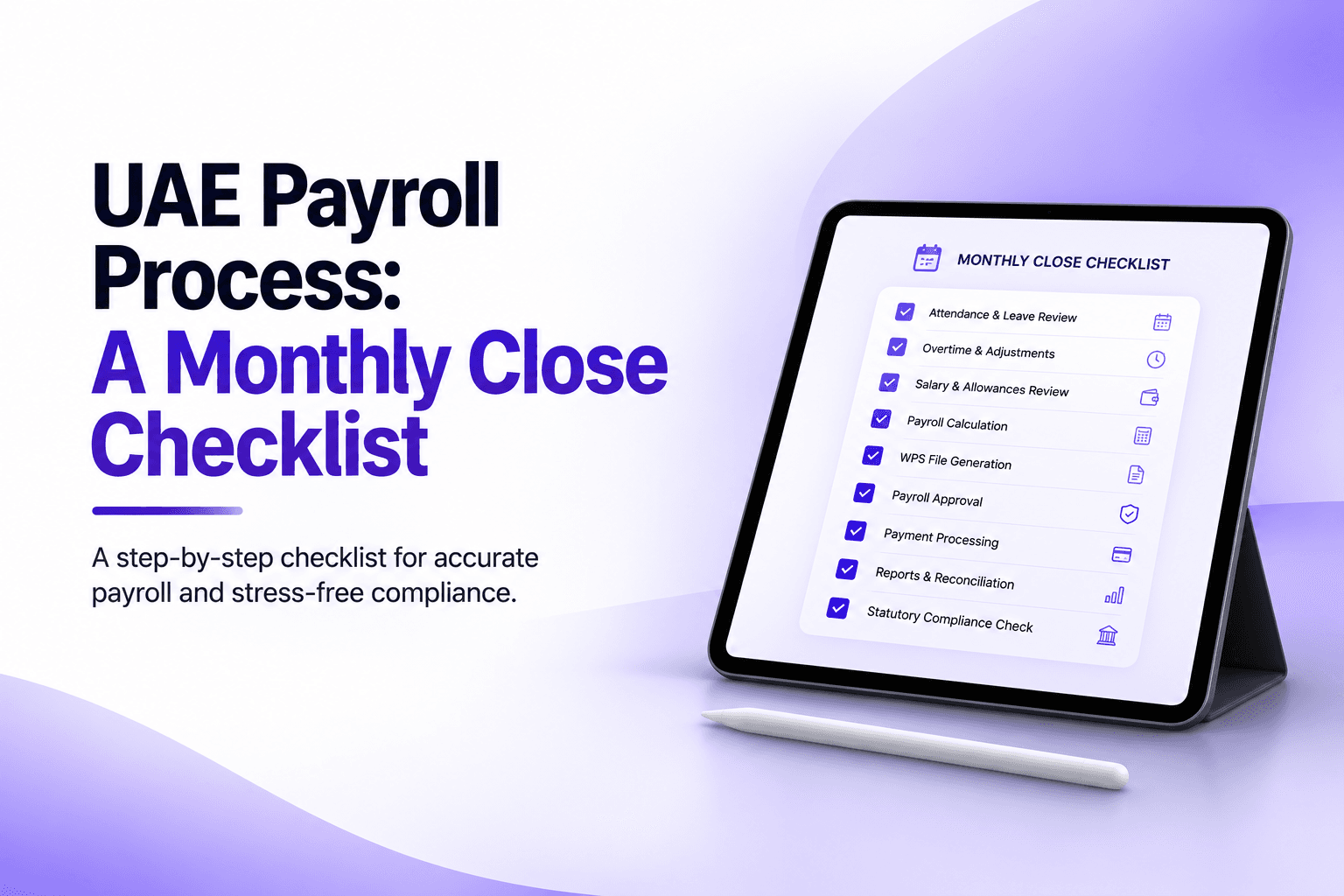
UAE Payroll Process: A Monthly Close Checklist for HR Teams
The UAE payroll process is a monthly close with a hard external deadline attached. Here is the end-to-end sequence from cut-off to payslip — locking attendance and overtime inputs, applying lawful deductions, generating and validating the WPS/SIF file, segregated approvals, funding before the 1st, and reconciliation — plus an 11-step close checklist with owners and timings.

UAE Payslips & Salary Structure: Basic vs Allowances & Bilingual Compliance
Gratuity and overtime run on basic salary, not gross — and the split you set at contract stage decides what you owe for years afterwards. A practical 2026 guide to structuring basic vs allowances, the 60% rule that isn't a rule, what a defensible payslip must show, the Arabic-English position, how salary structure feeds your WPS SIF, and the mistakes that cost the most.
WPS & SIF Files Explained: Mainland vs Free Zone Payroll in the UAE
What a UAE SIF file contains, who files the federal WPS SIF vs DIFC/ADGM, the new 1st-of-month deadline under Resolution 340 of 2026, rejection reasons & penalties.