UAE Payroll Process: A Monthly Close Checklist for HR Teams
The UAE payroll process is a monthly close with a hard external deadline attached. Here is the end-to-end sequence from cut-off to payslip — locking attendance and overtime inputs, applying lawful deductions, generating and validating the WPS/SIF file, segregated approvals, funding before the 1st, and reconciliation — plus an 11-step close checklist with owners and timings.
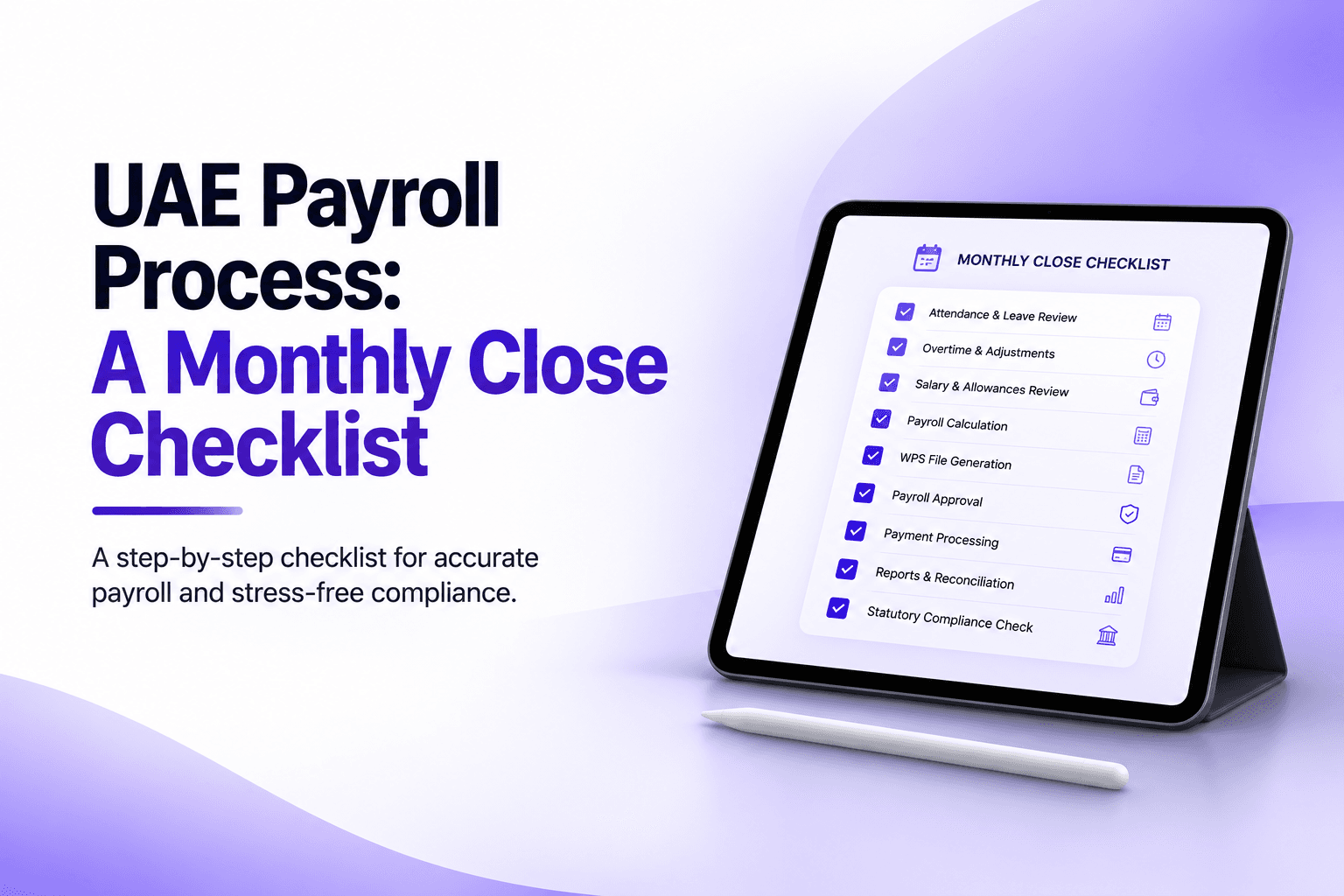
A practical process guide for HR and payroll teams.
The UAE payroll process is not a single task on pay day — it is a monthly close with a hard external deadline attached. Since Ministerial Resolution No. 340 of 2026 came into force, salaries must clear through the Wage Protection System by the 1st of the following month, and the old 15-day grace period is gone. That turns payroll from a flexible month-end job into a scheduled close with fixed checkpoints, clear owners, and no room to run late.
This guide walks the end-to-end sequence — from cut-off to payslip — and ends with a monthly payroll-close checklist you can assign by owner and timing. It is written for the mainland MOHRE-regulated private sector; free zones such as the DIFC and ADGM run their own frameworks.
Informational only — not legal advice. This article summarises general principles as currently published by MOHRE and the UAE Government Portal. Rules, thresholds, and deadlines change. Verify your specific obligations with MOHRE or a qualified adviser before acting.
Why the monthly payroll close needs a fixed process
Most payroll errors are not maths errors — they are process errors. A late attendance file, an allowance changed in an email and never in the system, a SIF built by hand on the 30th. When the sequence is the same every month, with each step owned and time-boxed, those failures stop happening by accident.
The close runs backwards from one fixed point: the salary must be in the employee's account by the 1st. Because banks and WPS agents typically need one to two working days to process transfers, your file should be funded and submitted by around the 29th–30th. Everything else — inputs, calculations, validation, approvals — has to finish before that. The rest of this guide fills in the sequence.
Step 1 — Set and communicate the cut-off (around the 20th–22nd)
The close starts with a data cut-off: the date after which no new inputs are accepted for the current cycle. Set it around the 20th–22nd, publish it, and hold to it. Anything that lands after cut-off moves to next month.
By cut-off, these inputs should be locked:
- Attendance — days worked, absences, and unpaid leave, reconciled against the roster.
- Overtime — approved hours, separated into daytime, night, rest-day, and holiday, because each carries a different rate.
- Leave — approved annual, sick, and other leave, with the correct pay treatment.
- Joiners and leavers — new hires to be paid this cycle, and final settlements for anyone exiting.
- One-off items — bonuses, commissions, reimbursements, and approved deductions.
A clean cut-off is the single biggest lever on a smooth close. Chase the missing timesheets and approvals before the date, not after.
Step 2 — Validate attendance and overtime inputs
Raw inputs are not payroll-ready until they are checked. Attendance should reconcile to the roster, and every overtime hour should be approved and rate-coded correctly.
This is where a lot of money leaks or over-pays. Overtime in the UAE runs on the basic wage only and the rate depends on when the hours fell — 125% for normal daytime overtime, 150% for work between 10 PM and 4 AM and for rest-day and public-holiday hours. Applying a flat rate to everything either underpays the employee (a claim risk) or overpays the business. For the full rate rules and worked examples, see our guide to UAE overtime rules and rates, and you can check an individual case against the bands with our overtime calculator. The principle to hold onto at close: the right rate on the right hours, calculated on basic.
Step 3 — Apply allowances and deductions within legal limits
Next, build each employee's gross from the basic salary and allowances set in the contract, then apply any deductions.
Two rules govern deductions and must be checked every cycle:
- Only lawful categories. Under Article 25 of Federal Decree-Law No. 33 of 2021, deductions are limited to specific categories — recovery of advances or overpayments, lawful fund contributions, court-ordered amounts, and documented damage — most requiring the employee's written consent. "Administrative fees" and similar invented charges are not permitted.
- The 50% cap. Total deductions in any single month cannot exceed 50% of the wage, with tighter sub-caps on individual categories. Our guide to legal salary deductions in the UAE works through the categories and the sub-caps.
Because the basic/allowance split drives overtime, gratuity, and leave — and because a payslip that only shows a gross figure cannot be defended — getting the structure right matters well beyond this one cycle. Our guide to UAE payslips and salary structure covers the split in detail.
Step 4 — Generate and validate the WPS/SIF file
With earnings and deductions finalised, generate the Salary Information File (SIF) — the fixed-format file submitted to your WPS agent each cycle. It carries one Salary Control Record (the company header and totals) and one Employee Detail Record per employee (identifiers, bank details, and the fixed and variable pay components).
Validate before you submit, because since the December 2025 digital WPS upgrade many errors are checked in real time against the registered contract:
- Header vs detail totals reconcile — the control-record total equals the sum of the employee records.
- Identifiers and bank data are correct — labour card / Establishment ID, IBANs, and agent routing codes.
- Every employee is included, with a NOPAY code for anyone not paid this cycle and the correct deduction codes applied.
- Salaries meet the registered contract and any applicable minimum (the AED 6,000 Emirati minimum wage is cross-checked).
Generating the SIF straight from payroll — rather than rekeying into a spreadsheet — removes the most common rejection causes. For the full breakdown of the file and the mainland-versus-free-zone rules, see our WPS and SIF explainer, build a file to spec with the WPS SIF generator, and note that RadixHR's WPS-compliant payroll feature generates and validates the file in one step.
Step 5 — Review, approve, and sign off
Payroll should never move to the bank on one person's say-so. Build in a segregated review and sign-off:
- Payroll prepares the run and a variance report against last month, flagging anything unusual — a salary that jumped, an unexpected new payee, a large deduction.
- HR confirms the people data: joiners, leavers, salary changes, and leave all reflect what was actually approved.
- Finance signs off the total value and confirms funds are available.
- An authorised approver gives final sign-off before submission.
Keep the variance report and the approval trail — they are your evidence in an audit or a dispute, and they are what separates a controlled process from a rubber stamp.
Step 6 — Fund and submit before the salary deadline
Once approved, fund the payroll and submit the SIF to your WPS agent early enough to clear the 1st. Working back from the deadline, aim to submit by the 29th–30th so the bank's one-to-two-day processing window still lands salaries on time. Remember that the 1st is fixed regardless of weekends or public holidays — there is no business-day extension — so a month ending on a weekend needs the file in even earlier.
The compliance target under Resolution 340 is to transfer at least 85% of total wages on time, with any shortfall backed by lawful, coded deductions. Confirm the agent's acceptance and keep the confirmation. For the deadline rule and its day-by-day enforcement escalation, see our guide to the UAE monthly salary deadline, and you can size the exposure of a given delay with the WPS fine calculator. The official rules are set out on the UAE Government Portal's payment of wages page.
Step 7 — Issue payslips
Once salaries are paid, issue payslips that itemise the pay period, basic salary on its own line, each allowance separately, overtime with the rate applied, gross, itemised deductions, and net — with payment details. Issuing them in Arabic and English serves both the authorities (Arabic is the official language for employment records) and the large share of the workforce that does not read English fluently. A clear payslip is also the cheapest way to cut the leave-balance and salary-query traffic that otherwise lands back on HR.
Step 8 — Reconcile and keep records
Close the loop after pay day:
- Reconcile the bank debit and the WPS confirmation against the approved payroll total. Investigate any mismatch immediately.
- Archive the SIF, the bank advice, the agent confirmation, the variance report, and the approval trail together for the cycle.
- Retain records in line with the obligation to keep employment and wage records for at least two years after the relationship ends.
Good records are not bureaucracy — they are what let you answer an employee, an auditor, or MOHRE with evidence rather than memory.
The monthly payroll-close checklist
Assign each step an owner and a timing, and run it the same way every month:
| # | Step | Owner | Timing |
|---|---|---|---|
| 1 | Publish and enforce the data cut-off | HR / Payroll | ~20th–22nd |
| 2 | Lock attendance, overtime, and leave inputs | Line managers / HR | By cut-off |
| 3 | Validate overtime hours and rate-coding | Payroll | Cut-off +1 day |
| 4 | Build gross; apply allowances and lawful deductions | Payroll | Cut-off +1–2 days |
| 5 | Generate and validate the WPS/SIF file | Payroll | ~26th–28th |
| 6 | Variance review and people-data confirmation | HR + Payroll | ~27th–28th |
| 7 | Finance sign-off and funds confirmation | Finance | ~28th |
| 8 | Final approval and submission to WPS agent | Authorised approver | ~29th–30th |
| 9 | Confirm salaries cleared by the deadline | Payroll | By the 1st |
| 10 | Issue bilingual payslips | HR / Payroll | 1st–3rd |
| 11 | Reconcile bank/WPS and archive records | Payroll / Finance | 1st–5th |
Adjust the dates to your own bank's processing times and any month-end that falls on a weekend, but keep the sequence and the ownership fixed. A named owner per step is what stops a task from silently falling between two people.
Turning the close from a scramble into a routine
Almost every painful payroll close traces back to the same root cause: the inputs live in different places. Attendance in one system, contracts in another, allowances in a spreadsheet, the SIF assembled by hand at the last minute. Each handoff is a chance for a number to drift.
When attendance, leave, contracts, and payroll share one source of truth, the close compresses. Overtime flows in already rate-coded, the basic/allowance split is consistent by construction, the SIF validates itself before it leaves the building, and payslips reconcile to the contract automatically. Our guide to WPS automation in the UAE covers how removing the manual rekeying step cuts rejections, and you can see how this fits together across RadixHR's payroll and UAE compliance tools. There is more practical UAE HR guidance on the RadixHR blog.
The deadline is fixed and the penalties are automated. The way to stay ahead of both is a close that runs the same way, on the same schedule, every month.
Sources & references
This guide is based on the following official UAE government sources, current at the time of writing (verify the latest versions directly, as the law and MOHRE guidance are updated periodically):
- UAE Government Portal (u.ae) — "Payment of salaries/wages," which sets out the WPS obligation, the 1st-of-month deadline, the 85% on-time threshold, and the WPS filing framework. u.ae/en/information-and-services/jobs/employment-in-the-private-sector/payment-of-wages
- Ministerial Resolution No. 340 of 2026 on the Wage Protection System — the 1st-of-month payment deadline and the removal of the 15-day grace period.
- Federal Decree-Law No. 33 of 2021 on the Regulation of Employment Relationships (as amended) — the definition of wage and basic wage, the overtime provisions that run on basic pay, permitted deductions and the 50% cap under Article 25, and the record-retention obligation.
- MOHRE (mohre.gov.ae) and the Central Bank of the UAE — the WPS framework, Central Bank-approved WPS agents, and the Salary Information File (SIF) structure, whose fixed and variable components are checked against the registered contract.
- Emirati minimum wage — the AED 6,000 monthly minimum for Emiratis in the private sector, effective 2026, as published by MOHRE.
The DIFC and ADGM operate their own independent frameworks and do not file the federal MOHRE SIF; confirm requirements with the relevant authority. This reference list points to primary government sources; where third-party summaries were consulted, the underlying official text was used as the authority.
Run the whole close in one place
RadixHR runs the monthly close end to end: attendance and rate-coded overtime flowing straight into payroll, allowances and deductions checked against the contract and the 50% cap, a validated WPS SIF generated from the approved run, bilingual payslips issued on pay day, and an audit-ready record of every approval and confirmation for the cycle.
This article is for general information only and does not constitute legal or financial advice. UAE payroll, WPS, and record-keeping requirements are set under Federal Decree-Law No. 33 of 2021, Ministerial Resolution No. 340 of 2026, and MOHRE regulations, and are subject to change. The DIFC and ADGM operate separate frameworks. Verify current requirements with MOHRE or a qualified adviser before acting.
Related Articles
WPS Automation in the UAE: Cutting Payroll Errors & MOHRE Fines
A single wrong IBAN digit can turn an on-time payroll into a MOHRE violation. Here's how WPS automation in the UAE prevents SIF rejections and fines: where manual filing fails, how automated SIF generation and validation work, the 1st-of-month deadline under Resolution 340 of 2026, the graduated penalties it helps you avoid, mainland vs free-zone filing, and an error-prevention checklist.

UAE Payslips & Salary Structure: Basic vs Allowances & Bilingual Compliance
Gratuity and overtime run on basic salary, not gross — and the split you set at contract stage decides what you owe for years afterwards. A practical 2026 guide to structuring basic vs allowances, the 60% rule that isn't a rule, what a defensible payslip must show, the Arabic-English position, how salary structure feeds your WPS SIF, and the mistakes that cost the most.
No New Rules, Faster Alerts: What MOHRE's Late-Salary Monitoring Means for Your Payroll Team
Headlines called it a crackdown, but MOHRE says its late-salary measures add no new substantive obligations — they standardise how WPS compliance is monitored. Here's the alert sequence, who inside your company should own it, and a same-day response playbook.