UAE Monthly Salary Deadline 2026: What Every Employer Must Do Before June 1
Ministerial Resolution No. 340 of 2026 makes the 1st of every month the unified salary deadline for UAE private-sector employers from June 1, 2026. Full breakdown of the rule, the 85% compliance threshold, the day-by-day penalty timeline, exclusions, exemptions, and the 13-day pre-deadline checklist.

The UAE has issued one of the most significant wage protection updates of the past decade. From June 1, 2026, every private sector employer registered with the Ministry of Human Resources and Emiratisation (MOHRE) must pay employee salaries by the first day of every month, transferred through the Wage Protection System (WPS) or another MOHRE-authorised channel. Any salary credited later than the 1st will be classified as delayed, with escalating penalties starting from the second day.
The rule comes under Ministerial Resolution No. 340 of 2026 and represents a structural shift in how UAE payroll is governed. Until now, the broad rule was that salaries had to be paid within 15 days of the due date set out in the employment contract. From June 1, the due date is harmonised across the entire private sector — the 1st of the month for the previous month's wages — and the enforcement timeline tightens dramatically.
For HR and finance teams, the practical question is no longer "are we paying on time?" It is "can we close the payroll cycle, validate the SIF, and have funds cleared into WPS by the morning of the 1st, every single month, without exception?"
Source note: This article is based on official reporting of Ministerial Resolution No. 340 of 2026 published in May 2026. The official Arabic-language text of the resolution is the binding reference; final procedural detail should be verified with MOHRE or a licensed PRO.
What the resolution actually says
The core mechanism of Resolution No. 340 has four moving parts that HR teams need to internalise immediately:
1. The unified deadline. Salaries for the previous month must be transferred by the 1st of the following month. This replaces the older 15-day grace window for the purposes of MOHRE enforcement.
2. The 85% compliance threshold. A company is treated as compliant if it transfers at least 85% of total wages due to workers on time. An individual employee is not classified as unpaid if they receive at least 85% of their salary and the remaining amount is the result of legally documented deductions (the deductions permitted under Article 25 of Federal Decree-Law No. 33 of 2021 — loans, court orders, disciplinary fines, damages, and the others).
3. WPS as the only valid channel. Salary must go through the Wage Protection System or another payment system authorised by the ministry. Cash transfers, employee-account bank transfers outside WPS, or informal arrangements are not compliant, regardless of whether the employee received the money.
4. Documentation duty. Every MOHRE-registered private establishment must be able to produce documents and data proving salary payments in line with the approved regulations. The burden of proof sits with the employer.
The 85% threshold is the most commonly misunderstood part of the new rule. It is not a target — it is the bare minimum. A company paying 84% of total wages on time, or any individual employee receiving less than 85% of their salary for reasons other than lawful deductions, falls into the enforcement track.
The penalty timeline: day by day
Resolution No. 340 sets out a graduated enforcement timeline that begins immediately after the 1st of the month if salaries are unpaid. To estimate the exposure of a missed deadline, use our WPS fine calculator:
Day 2 — Electronic monitoring and warning
MOHRE's WPS 2.0 monitoring layer flags the non-payment. Electronic warning notices are issued to the employer. This is the system's "soft warning" stage — no fines yet, but the violation is now on record.
Day 5 — Work permit suspension
If the delay continues, MOHRE moves to suspend new work permits for the company. No new hires, no permit renewals, no transfers. Formal violation notices are issued and the employer is required to settle unpaid wages.
Day 11 — Administrative fines and classification downgrade
From the 11th day of delay, if the violation has occurred more than once within a six-month window, administrative fines under existing cabinet regulations apply. The company is also downgraded to the third business classification category — Class 3 — which materially increases the cost of every future work permit the company issues.
Day 16 — Labour dispute registration
By the 16th day of delay, MOHRE may register individual or collective labour disputes on behalf of affected workers. Further work permit suspensions may follow, with particular intensity on companies that:
- Employ 25 workers or more, and/or
- Operate in construction, transport, storage, security, cleaning, or recruitment services
These sectors carry elevated enforcement attention because of their workforce size and historical wage-protection sensitivity.
Day 21 — Public prosecution and asset action
The harshest tier kicks in from the 21st day. For companies with 50 employees or more with repeated violations over two consecutive months, cases are referred to public prosecutors. MOHRE may also:
- Issue enforcement orders to recover unpaid wages
- Impose precautionary asset seizures on the company
- Apply travel bans on responsible company officials
- Notify other government entities to take parallel legal measures
In practical terms: a salary delay that starts on the 1st of the month can, by the 21st of the same month, result in the company's officials being unable to leave the country.
What is excluded from compliance calculations
Resolution No. 340 explicitly carves out several worker categories from the wage protection compliance calculation. These groups are not counted when MOHRE measures whether a company has hit the 85% on-time threshold:
- Workers involved in active labour disputes
- Employees reported absent from work
- Workers on unpaid leave
- Foreign workers paid outside the UAE by overseas entities (typically secondees or globally-paid expatriates)
The HR consequence: company records on absences, dispute filings, and unpaid leave must be accurate and up-to-date, because the same record is what MOHRE's monitoring will use to exclude (or fail to exclude) that headcount from the company's compliance ratio.
What is exempt entirely
A separate, narrower list of employers and arrangements is fully exempt from Resolution No. 340:
- Short-term work permits of less than 3 months
- Fishing boats
- Citizen-owned public taxis
- Banks and financial institutions
- Places of worship
For everyone else — the vast majority of UAE private sector employers — the rule applies from June 1.
Third-party payroll processors: the responsibility doesn't transfer
Resolution No. 340 confirms that companies may authorise third parties to process salary payments — exchange houses, payroll bureaus, outsourced HR providers, or banks acting as agents.
But the resolution is explicit on one point: legal responsibility for timely wage transfer remains with the employer. If a third-party processor misses the 1st-of-month deadline, the employer is the one MOHRE penalises. Contractual recourse against the processor is a private matter; the labour-law liability does not transfer.
This makes processor selection a compliance decision, not just an operational one. Cut-off times, payment-instruction deadlines, holiday calendars, and back-up channels all need to be specified in the service-level agreement before June 1.
The 13-day pre-deadline checklist
With the rule taking effect on June 1, 2026, every UAE employer has a short window to validate readiness. Work through the items below before the next payroll cycle closes.
Payroll process
- Confirm the closing date for attendance, overtime, and leave data each month, with enough buffer to validate the SIF and have funds in WPS by the morning of the 1st.
- Lock the payroll approval workflow — who approves the final run, by what date, with what fallback if that person is unavailable.
- Validate the SIF generation cycle against the MOHRE-registered contract for every employee — basic salary, allowances, deductions, and any month-specific variances. You can build a compliant file with our WPS SIF generator.
- Audit the 85% threshold scenario: if one or two transfers are delayed, can the company still hit ≥ 85% of total wages on time?
Banking and WPS
- Verify WPS agent cut-off times with the bank or exchange house. Most cut-offs are 24–48 hours before the value date.
- Confirm the value date instruction is set to the 1st, not "next business day."
- Establish a back-up payment channel with a second MOHRE-authorised agent in case the primary channel fails.
- Ensure sufficient funded balance is available in the disbursement account 3–5 days before month-end.
Documentation
- Maintain an audit trail of payment instruction, bank confirmation, and WPS transmission acknowledgement for every payroll cycle. Retain for at least 5 years.
- Reconcile bilingual payslips (English-Arabic) against the SIF.
- Update internal records for absentees, unpaid leave, and active disputes so the compliance calculation excludes the right headcount.
Policy and people
- Brief the finance team on the new timeline and the consequences of a missed 1st.
- Brief the HR team on the day-by-day penalty escalation.
- Update the employee handbook payroll section to reflect the new deadline.
- If using a third-party processor, document the cut-offs and fallback procedure in the service agreement.
If the company cannot tick every item on this list before June 1, the operating assumption must be that the first payroll cycle under the new rule will be the riskiest.
Why this matters in 2026
Resolution No. 340 sits inside a broader UAE wage-protection enforcement push. WPS 2.0's real-time monitoring layer already cross-references salary transfers against MOHRE-registered contracts; the Emirati minimum salary of AED 6,000 is now in force; Emiratisation targets are being audited from July; and Article 25 deduction caps are increasingly enforced through automated SIF validation.
The cumulative effect is that UAE payroll has become a daily compliance function, not a monthly task. The companies that will get through the June 1 transition smoothly are the ones that have already moved beyond manual spreadsheets and quarterly checklists. Those still running payroll in Excel, with no automated cut-off validation, no SIF pre-check, and no documented escalation path for missed dates, are the ones most exposed to the Day 5 through Day 21 penalty tiers.
The cost of a single missed 1st under the new rule — work permit suspension, possible Class 3 downgrade, administrative fines, and reputational damage — is now structurally higher than the cost of putting proper payroll infrastructure in place.
Stay compliant from June 1 with RadixHR
The June 1 deadline rewards employers who have automated the payroll cycle end-to-end: validated attendance and leave feeding clean payroll data, SIF generated and pre-validated days before month-end, WPS submission tracked with bank acknowledgements, audit trail retained, and bilingual payslips delivered automatically.
RadixHR is built for exactly this UAE payroll discipline: WPS-ready SIF generation aligned with MOHRE-registered contracts, automated payroll cut-offs configured to the 1st-of-month rule, Article 25 deduction caps enforced at calculation time, full audit trail for every cycle, and bilingual (English-Arabic) payslips issued on schedule.
Stay compliant from June 1. Visit www.radixhr.com to see how the platform handles the new monthly deadline, the 85% compliance threshold, and the full WPS workflow — without the cut-off risk that comes with manual spreadsheets.
Disclaimer
This article is for general information only and is not legal, financial, or compliance advice. The rules summarised here are based on publicly available reporting on Ministerial Resolution No. 340 of 2026 and MOHRE communications as of May 2026. Final wording, exemptions, sector-specific application, and procedural detail are governed by the official Arabic-language text of the resolution and any subsequent ministerial guidance. Always verify current requirements with MOHRE, a qualified UAE labour lawyer, or a licensed PRO before acting.
Authoritative sources
MOHRE (mohre.gov.ae) · UAE Government Portal (u.ae) · Ministerial Resolution No. 340 of 2026 · Federal Decree-Law No. 33 of 2021 (UAE Labour Law) · Ministerial Resolution No. 43 of 2022 (Wage Protection System) · Cabinet Resolution No. 1 of 2022 (Executive Regulations).
Related Articles

MOHRE's New Salary Rule 2026 (Ministerial Resolution 340): The Unified WPS Deadline Explained
MOHRE's new salary rule 2026 under Ministerial Resolution No. 340: salaries must clear WPS by the 1st of the following month, and the 15-day grace period is gone. What changed, who it applies to, the day-by-day penalties, and a payroll-timing checklist to finish early every month.
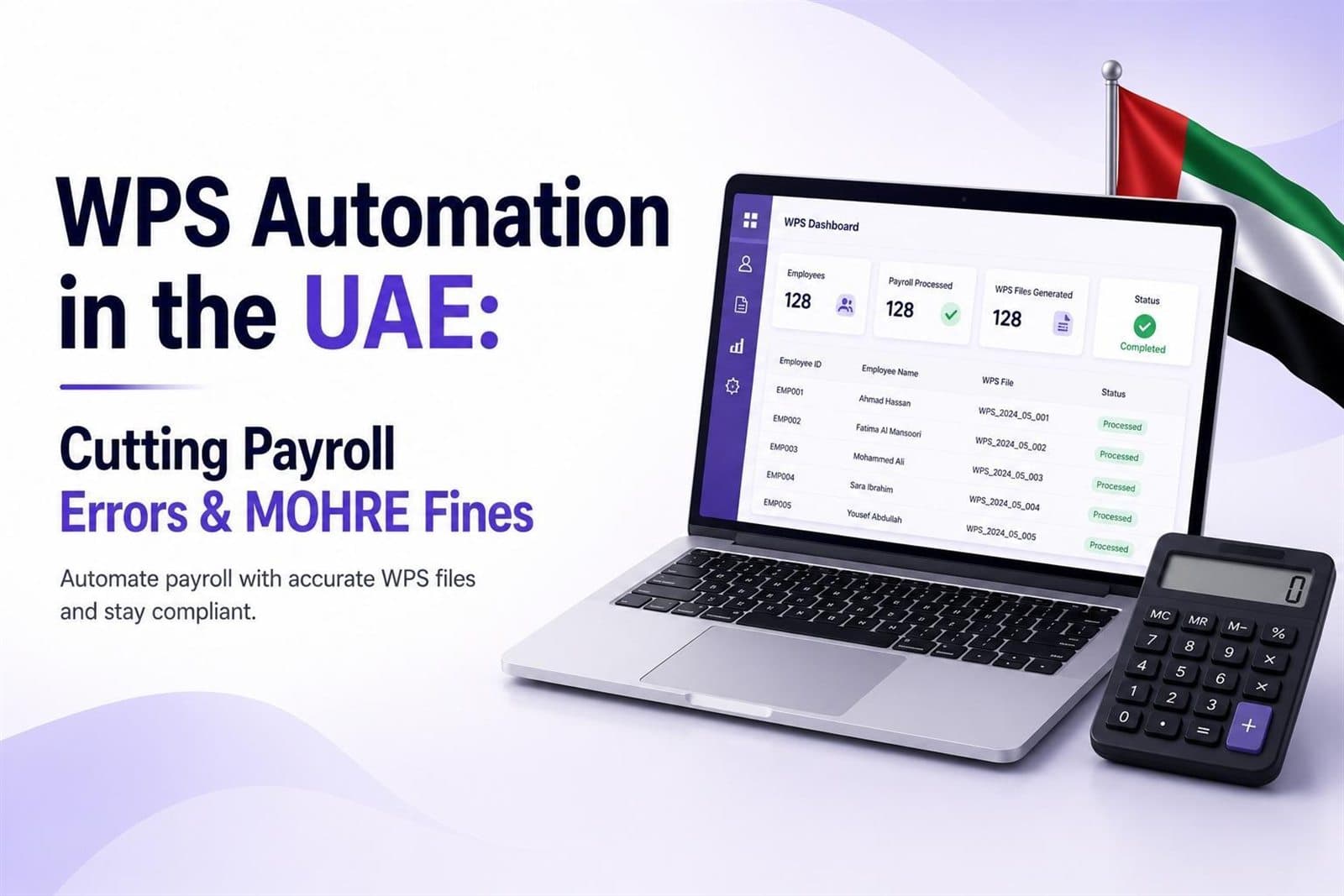
WPS Automation in the UAE: Cutting Payroll Errors & MOHRE Fines
A single wrong IBAN digit can turn an on-time payroll into a MOHRE violation. Here's how WPS automation in the UAE prevents SIF rejections and fines: where manual filing fails, how automated SIF generation and validation work, the 1st-of-month deadline under Resolution 340 of 2026, the graduated penalties it helps you avoid, mainland vs free-zone filing, and an error-prevention checklist.
Annual Leave Encashment UAE: Rules & Calculation
A focused 2026 guide to annual leave encashment in the UAE — when it's allowed, the basic-salary calculation method, carry-forward limits, why there's no tax, employer obligations, common disputes, and worked examples.