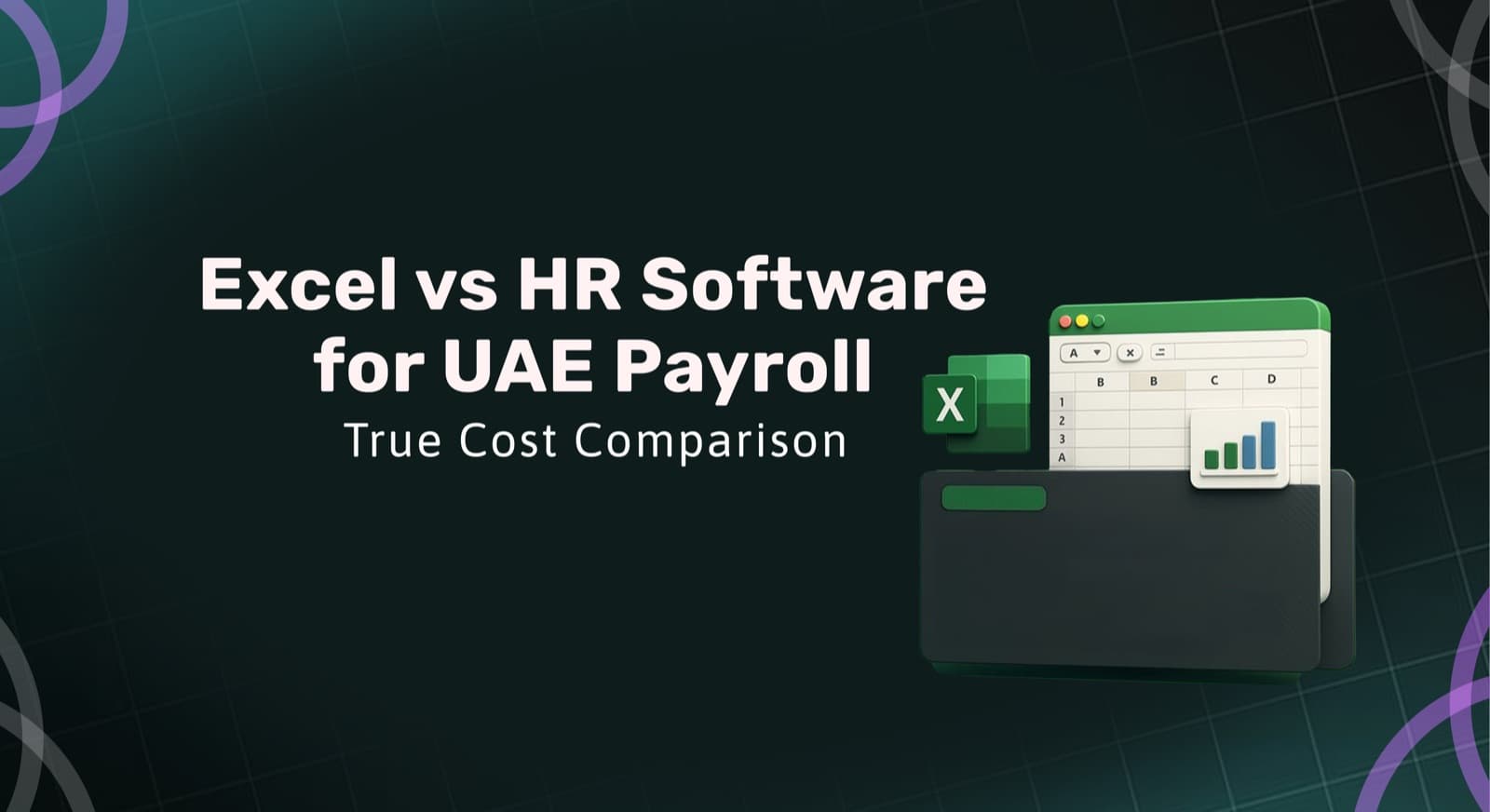
Most UAE businesses started payroll in Excel. For a small team, it makes sense — the licence is already on every laptop, the template is one tab, and the formulas are familiar. The problem is that payroll in the UAE is no longer a calculation exercise. It is a regulated process supervised in real time by MOHRE and the Central Bank of the UAE through the Wage Protection System (WPS). The spreadsheet that worked at 8 employees quietly becomes a liability at 30.
This is an honest 2026 comparison. We are not going to pretend Excel has no role — it does. We are going to count what Excel actually costs a UAE business once you add up time, errors, compliance risk, scalability, and the hidden bills nobody puts on the spreadsheet itself.
What UAE payroll actually involves in 2026
Before comparing tools, it helps to be honest about the workload. A monthly UAE payroll run is not "calculate gross, subtract a deduction, transfer." Per the UAE Labour Law (Federal Decree-Law No. 33 of 2021) and Ministerial Resolution No. 43 of 2022, every cycle includes:
- Capturing attendance, overtime, leave, and unpaid leave per employee
- Splitting basic salary and allowances (basic salary is the reference for end-of-service gratuity)
- Generating a Salary Information File (SIF) for WPS
- Submitting through a WPS-approved bank or exchange house
- Matching every line to the MOHRE-registered labour contract
- Issuing bilingual (English-Arabic) payslips
- Maintaining records for at least 5 years
- Handling Emiratisation, GPSSA for UAE/GCC nationals, and the AED 6,000 minimum salary for Emirati employees in effect from January 2026
Excel handles the arithmetic. It does not handle any of the rest natively.
Hidden cost #1: Time
The first thing Excel hides is the hours.
UAE HR teams running payroll in spreadsheets typically spend 2–4 days a month on the cycle: collecting attendance, reconciling leave, calculating overtime, splitting basic and allowances, building the SIF, validating IBANs, fixing the rejections, then redoing all of it when a salary change or new joiner lands mid-month. Industry surveys consistently show that ~35% of an HR department's time ends up tied to payroll-related work, and that a single data-entry error can waste up to 20% of an HR staffer's day downstream.
For a typical UAE SME with one HR person on AED 12,000–18,000 a month, that translates to AED 3,000–6,000 in monthly internal labour spent on payroll alone — before you've paid a single salary. Multiply by twelve months and the number is hard to ignore.
Dedicated HR software does not eliminate this work; it compresses it. Attendance feeds in from biometrics or geofencing. Leave deducts automatically. The SIF generates from validated data, not a pivot table. Most UAE HR teams that switch report payroll-run time dropping from days to a single afternoon — a 50–70% reduction in payroll cycle time is a realistic, defensible range, not a marketing number.
Hidden cost #2: Errors
The second thing Excel hides is the error rate.
Two decades of peer-reviewed research on spreadsheet quality consistently find a cell error rate of 2–5% in operational spreadsheets, and that over 90% of complex spreadsheets contain at least one material error. Payroll-specific surveys add: a 1.2% error rate per pay period is enough to cost a 100-employee company tens of thousands of dollars a year in over- and underpayments combined.
Excel doesn't catch:
- Wrong basic-to-allowance split (which feeds into gratuity, GPSSA, and Emirati minimum salary checks — our salary calculator shows the split cleanly)
- Missed pro-rating for joiners and leavers mid-month
- Stale tax/contribution rates after a regulatory update
- Duplicated employee rows after a copy-paste
- Broken IBANs or mismatched Emirates ID numbers
- Overtime calculated on the wrong base
- Leave balances not deducted before final settlement
Modern HR platforms catch most of these at validation time. They reject the row before it goes into the SIF, not three weeks later when an employee notices. In a country where the contract registered with MOHRE must match the SIF down to the dirham, that distinction matters.
Hidden cost #3: UAE compliance risk
This is where Excel stops being inconvenient and starts being expensive.
The UAE's WPS framework is not a guideline. Every employer registered with MOHRE must pay salaries through approved channels within 15 days of the due date. Miss that window, and the enforcement timeline is automatic:
- Day 17: MOHRE auto-suspends new work permits for the company. No hiring, no renewals, no transfers.
- Day 30: For companies with 50+ employees, the case is referred to Public Prosecution.
- Late or inaccurate SIFs: fines starting at AED 1,000 per employee for incorrect wage data, and up to AED 50,000 for severe or repeated violations.
- Pattern offences: sanctions can extend to other companies under the same ownership group.
In 2026, MOHRE's WPS 2.0 layer uses real-time monitoring and AI cross-referencing against attendance, contracts, and Emiratisation data. The era of "we'll fix it next month" is over — a mismatch between the SIF and the contract triggers an automated flag the same day.
Excel is structurally weak against this. There is no validation between your spreadsheet and the MOHRE contract database. There is no audit trail showing who changed an employee's salary on what date. There is no automatic alert when an Emirati hire drops below AED 6,000. The system is honest — it will pay what you tell it. If what you told it is wrong, the consequences are yours.
A single avoided WPS fine often covers a year of HR software.
Hidden cost #4: Scalability
Excel scales linearly with effort. Every new employee is another row, another contract to track, another set of leave balances, another visa expiry. At 5 employees, the workbook is manageable. At 25, it has tabs for attendance, leave, overtime, allowances, deductions, gratuity provisions, and a master sheet that links them all. At 50, it has a "do not touch" cell that nobody remembers the logic for.
Common scaling failure points:
- Two people editing the same file — version conflicts, overwrites, "which copy is final?"
- A formula breaks on row 47 but nobody notices until reconciliation
- The HR lead leaves and the workbook becomes institutional dark matter
- Multi-branch or multi-entity setups force duplicate files that drift apart
- Acquired team or sudden hiring round lands and the spreadsheet can't absorb it cleanly
HR platforms scale by design. Adding 20 employees is a CSV import, not a re-architecture. Multi-branch, multi-entity, multi-currency is a setting, not a rebuild.
The decision matrix: should you switch?
Not every UAE business needs HR software today. The honest test is the matrix below.
| Indicator | Excel is probably fine | Switch to HR software |
|---|---|---|
| Headcount | Under 10 | 10+ |
| WPS exposure | No WPS yet (free zone exempt, small team) | MOHRE-registered, monthly SIF required |
| Payroll cycle time | < half a day, no rework | 2+ days, regular rework |
| Error history | No payroll error in past 12 months | One or more errors that reached the employee |
| Visa & Emirates ID tracking | Fewer than 5 expiries to track | 10+ active visas with overlapping expiries |
| Emiratisation | No quota obligation yet | 50+ employees, Emirati quota tracking required |
| Multi-branch / multi-entity | Single entity, single location | More than one branch, free zone + mainland mix |
| HR team | One person who built the workbook | Anyone other than the original author runs payroll |
| Audit-readiness | Have never been audited | Have been audited or expect to be |
| Growth plan | Stable headcount | Hiring 5+ in the next 12 months |
If three or more rows in your situation sit in the right-hand column, you have already outgrown the spreadsheet — the cost is just hiding in places you haven't counted yet.
A simple ROI framework for HR software in the UAE
Use this five-line calculation before any vendor demo. It will tell you in 10 minutes whether the math works for your team, and you can lean on our free HR tools to plug in real numbers as you go.
1. Internal payroll labour cost
(Hours per month spent on payroll) × (Loaded HR cost per hour) × 12
A typical UAE SME: 30 hours/month × AED 100/hour × 12 = AED 36,000/year.
2. Error and rework cost
(Payroll errors per year) × (Average rework cost per error: investigation + correction + off-cycle payment)
Industry benchmarks put this at AED 500–2,000 per material error. Three errors a year = AED 1,500–6,000.
3. Avoided compliance risk (annualised expected cost)
(Probability of a late/incorrect SIF per year) × (Average fine exposure)
Even at a conservative 10% probability of one late SIF a year × AED 5,000 average exposure = AED 500/year as a floor. For a 50+ employee company exposed to AED 1,000-per-employee fines, the floor moves much higher.
4. Avoided opportunity cost
(Days of senior HR time recovered) × (Value of strategic HR work)
Most UAE HR managers value this at AED 8,000–15,000/year — the work they would do if they were not building SIFs.
5. Software cost
(Per-employee monthly fee) × (Headcount) × 12
For 25 employees at typical UAE platform pricing, this is usually AED 1,500–4,500/year.
ROI = (1 + 2 + 3 + 4) − 5
For most UAE companies with 15+ employees, the answer is positive in year one and material from year two onward. The companies for whom the math doesn't work are almost always under 10 people with no WPS exposure — and they were going to be fine on Excel anyway.
When NOT to switch
A balanced comparison has to include this section. HR software is the wrong answer if:
- You have fewer than 10 employees, no WPS obligation, and one person who runs payroll cleanly in under an hour a month.
- You are pre-revenue and every AED of monthly cost is being scrutinised.
- Your team is about to be restructured or acquired and the payroll tool will change as part of that anyway.
- You are running a single-entity, single-country operation with no plan to grow.
For everyone else — meaning the vast majority of UAE SMEs above 10 employees with MOHRE registration — the question is not whether to move off Excel but when. The honest answer is usually "earlier than you think." The cost of staying in Excel one extra year is rarely the price of the software; it is the one WPS misstep that didn't have to happen.
Calculate your savings with RadixHR
If you are running UAE payroll in a spreadsheet today, the most useful next step is not a demo — it is the five-line calculation above, with your real numbers. RadixHR is built specifically for UAE compliance: WPS-ready SIF generation, bilingual payslips, MOHRE-aligned contract data, visa and Emirates ID tracking, Emiratisation reporting, and end-of-service gratuity built in. Pricing starts at AED 5 per employee with the first tier free, so the ROI calculation usually runs in your favour from month one.
Calculate your savings. Visit www.radixhr.com and run the five-line framework above against the platform — if the numbers don't justify the move for your team, we'll tell you.
Disclaimer
This article is for general information only and is not legal, financial, or compliance advice. UAE payroll, WPS, Emiratisation, and labour rules are set by MOHRE, the Central Bank of the UAE, and related authorities, and change frequently. Penalty amounts, deadlines, and procedures cited reflect publicly available 2026 information and may vary by case, emirate, and circumstance. Always verify current requirements with the relevant authority or a licensed PRO before acting.
Authoritative sources
MOHRE (mohre.gov.ae) · UAE Government Portal (u.ae) · Federal Decree-Law No. 33 of 2021 (UAE Labour Law) · Ministerial Resolution No. 43 of 2022 (WPS) · Ministerial Resolution No. 598 of 2022 · EuSpRIG spreadsheet error research · Alight Global Payroll Complexity Index.