Free Zone Today, Mainland Tomorrow? A Readiness Checklist for Emiratisation Before It's Mandatory
Free zones sit outside the mandatory Emiratisation quota today, but 2026 compliance commentary increasingly frames extension as a matter of when, not if. A no-regret readiness checklist for free zone HR leaders — framed as reported industry expectation, not confirmed policy.
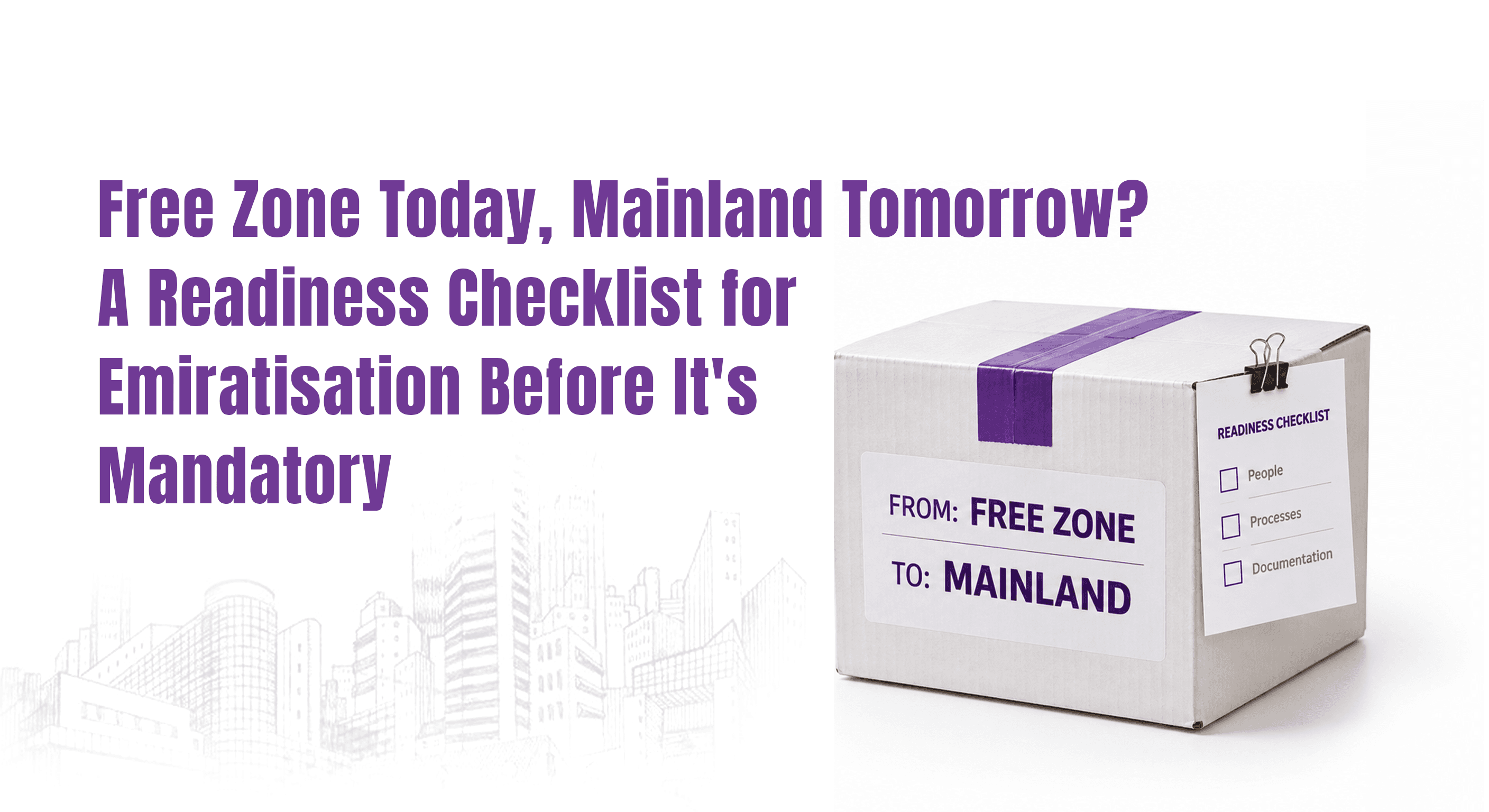
A forward-looking, practical guide for free zone HR leaders and founders. Last updated: September 2026.
If you run HR in a UAE free zone, you have almost certainly asked the question, or been asked it by your leadership: are we going to get pulled into Emiratisation? Right now the answer is no — free zone companies sit outside MOHRE's mandatory Emiratisation quota. But it is a question that keeps coming back, because a growing number of 2026 compliance commentators describe extension to free zones as a matter of when, not if, with some pointing to a possible phased rollout in 2027–2028.
Informational only — not legal advice. This article is point-in-time (last updated September 2026). It describes reported industry expectation about possible future policy, which is not confirmed and may not happen. Free zones are currently exempt from the mandatory Emiratisation quota. Verify the current position with MOHRE (mohre.gov.ae), Nafis (nafis.gov.ae), and your free zone authority before acting.
To be clear from the outset: that expectation is industry commentary, not confirmed government policy. No mandate currently applies to free zones, and none has been officially announced. What this guide offers is not a prediction but a readiness framework — the no-regret moves a sensible free zone employer can make now, so that if extension ever comes, it is a formality rather than a scramble. Being ready costs little; being caught flat-footed could cost a lot.
Where free zones actually stand today
The current position is straightforward: mandatory Emiratisation quotas apply to mainland companies registered with MOHRE, not to free zone entities. The 10% skilled-role target for companies with 50 or more employees, and the fixed-number rule for smaller companies in designated sectors, are mainland obligations. Free zone companies are, as a current policy matter, outside that framework.
The important word is policy. Several compliance sources characterise the free zone exemption as a policy position rather than a permanent statutory carve-out — that is, something within the government's discretion to revisit, rather than a fixed feature of the law. That framing is part of why so many observers treat extension as plausible: a policy-based exemption is, by nature, easier to change than a statutory one. This is analysis, not a government statement — but it is the reason the "when, not if" language keeps appearing.
The signals people are pointing to
Why do so many 2026 commentators expect extension? Three signals come up repeatedly:
- The scope has already been widening on the mainland. Emiratisation began with larger companies and has been extended downward — smaller mainland companies (20 to 49 employees) in 14 designated sectors were brought into scope under Cabinet Resolution No. 44 of 2024. A framework that keeps expanding its reach is one observers reasonably expect to keep expanding.
- Industry commentary on 2027–2028. A number of advisory and compliance firms have publicly floated a phased extension to selected free zones in the 2027–2028 window. This is expectation-setting by practitioners, not an announced timeline — but it is consistent and widespread enough that free zone employers keep hearing it.
- The direction of national workforce policy. Emiratisation, and the Nafis programme behind it, was extended to 2040 — signalling a long-term national commitment. In that context, leaving a large share of the private-sector workforce permanently outside the framework strikes many commentators as unlikely to be the end state.
None of these is a mandate. Together they explain why the question is live — and why readiness, rather than either panic or complacency, is the sensible posture.
The nuance that already catches some "free zone" employers
Before planning for a hypothetical future, check a real present-day trap. A mainland LLC operating under a free zone holding structure already carries the Emiratisation quota today on its mainland licence. Corporate structures in the UAE are often mixed — a free zone holding company with one or more mainland operating entities beneath it — and it is the licence type of the employing entity that determines the obligation, not the group's overall "free zone" identity.
So the first readiness step is not about the future at all: confirm which of your entities are actually mainland-licensed. If any employing entity in your structure holds a mainland licence and meets the headcount threshold, that entity has a live quota now — no policy change required. Employers who think of themselves as "a free zone company" sometimes discover a mainland subsidiary has been in scope all along.
The no-regret readiness checklist
Everything below is worth doing regardless of whether extension ever happens — which is what makes it no-regret. None of it commits you to anything; all of it leaves you better prepared and better run.
- Confirm your entity structure and licences. Map every employing entity and its licence type (mainland vs free zone). Flag any mainland-licensed entity, which may already carry a quota.
- Map your current skilled headcount. Emiratisation targets are measured against skilled roles (broadly, professional, technical, and managerial positions under MOHRE's classification), not total headcount. Know what your skilled-role base would be if the measure ever applied.
- Identify which roles would count. Work out, hypothetically, how many Emirati skilled roles a 10%-style target would imply for your entity — so you know the scale of any future gap rather than guessing.
- Build an Emirati talent pipeline early. You do not need a mandate to start building relationships with Emirati candidates and universities. Employers who begin before they must are not competing against everyone else in the same rush later.
- Consider voluntary Nafis participation. Nafis is open to participation and offers support for hiring Emiratis. Engaging voluntarily now lets you build genuine Emirati hiring experience, benefit from available support, and position ahead of any future requirement — while it is a choice, not an obligation.
- Keep your data clean. Accurate headcount, role classification, and payroll records mean that if the rules ever change, you can assess your position in an afternoon rather than reconstructing it under deadline pressure.
Why "readiness" beats both panic and complacency
There are two wrong reactions to the "when, not if" chatter. One is to panic and hire reactively against a mandate that does not exist yet — spending money and effort ahead of a requirement that may arrive later, differently, or (possibly) not at all. The other is to dismiss it entirely and do nothing, which risks a genuine scramble if extension does come with a short runway.
Readiness is the middle path, and it is cheap. Mapping your structure, knowing your skilled headcount, and optionally building an early Emirati pipeline through Nafis are all things that make you a better-run employer today, mandate or no mandate. If extension never comes, you have lost almost nothing. If it comes, you are ready while your competitors are reading the announcement for the first time.
The bottom line
Free zones are exempt from mandatory Emiratisation today, and any 2027–2028 extension is reported industry expectation, not confirmed policy — treat it as such. But the smart response to a credible "maybe" is not to wait for certainty; it is to make the no-regret moves that leave you ready either way. Confirm whether any of your entities are already in scope through a mainland licence, map your skilled headcount, and consider building an Emirati pipeline voluntarily through Nafis. None of it costs much. All of it means that if "when, not if" turns out to be "when," you are already prepared.
For the mainland framework this may eventually extend, see our MOHRE services guide for employers and our employee visa sponsorship & quota guide. Official guidance is published by MOHRE and Nafis at nafis.gov.ae and on the UAE Government Portal at u.ae.
Book a demo — RadixHR tracks headcount, role classification, and Emiratisation readiness across mainland and free zone entities, so you can assess your position the moment the rules change. Visit radixhr.com.
This article is for general information only and does not constitute legal advice, and is point-in-time (last updated September 2026). Free zone companies are currently exempt from the mandatory Emiratisation quota; any future extension referenced here is reported industry expectation, not confirmed government policy, and may not occur. Emiratisation rules are set by MOHRE and the UAE Cabinet and are subject to change. Verify current requirements with MOHRE, Nafis, your free zone authority, or a qualified adviser before acting.
Related Articles
MoHRE's Fake Emiratisation Crackdown: What "Genuine Employment" Actually Means for Your Payroll Records
MoHRE is using AI to detect fake Emiratisation — 377 cases across 266 firms in H1 2026. This is an audit-readiness guide: the two penalty tracks, how detection works, and the exact documentation you should already have on file for every Emirati hire.
90 Days to the Emiratisation Deadline: A September Action Checklist Before 31 December 2026
The 10% Emiratisation target for 50+ employee companies falls on 31 December 2026 — the final checkpoint of the cycle. A month-by-month countdown for September to December, why the June checkpoint doesn't cover you, and how the AED 9,000 penalty compounds.

Skill Level on the Labour Card: The Classification Detail Behind Emiratisation Counts, Visas and Fines
A practical guide to MOHRE's nine occupation skill levels, how they affect Emiratisation counts and work permit requirements, and how to audit classifications before the 2026 deadline.