Employee Visa Sponsorship UAE: Costs, Process & Quota Guide
A practical 2026 guide to sponsoring employees in the UAE — eligibility, quotas, visa types, the full process, costs, dependent visas, and how to apply for a quota increase.
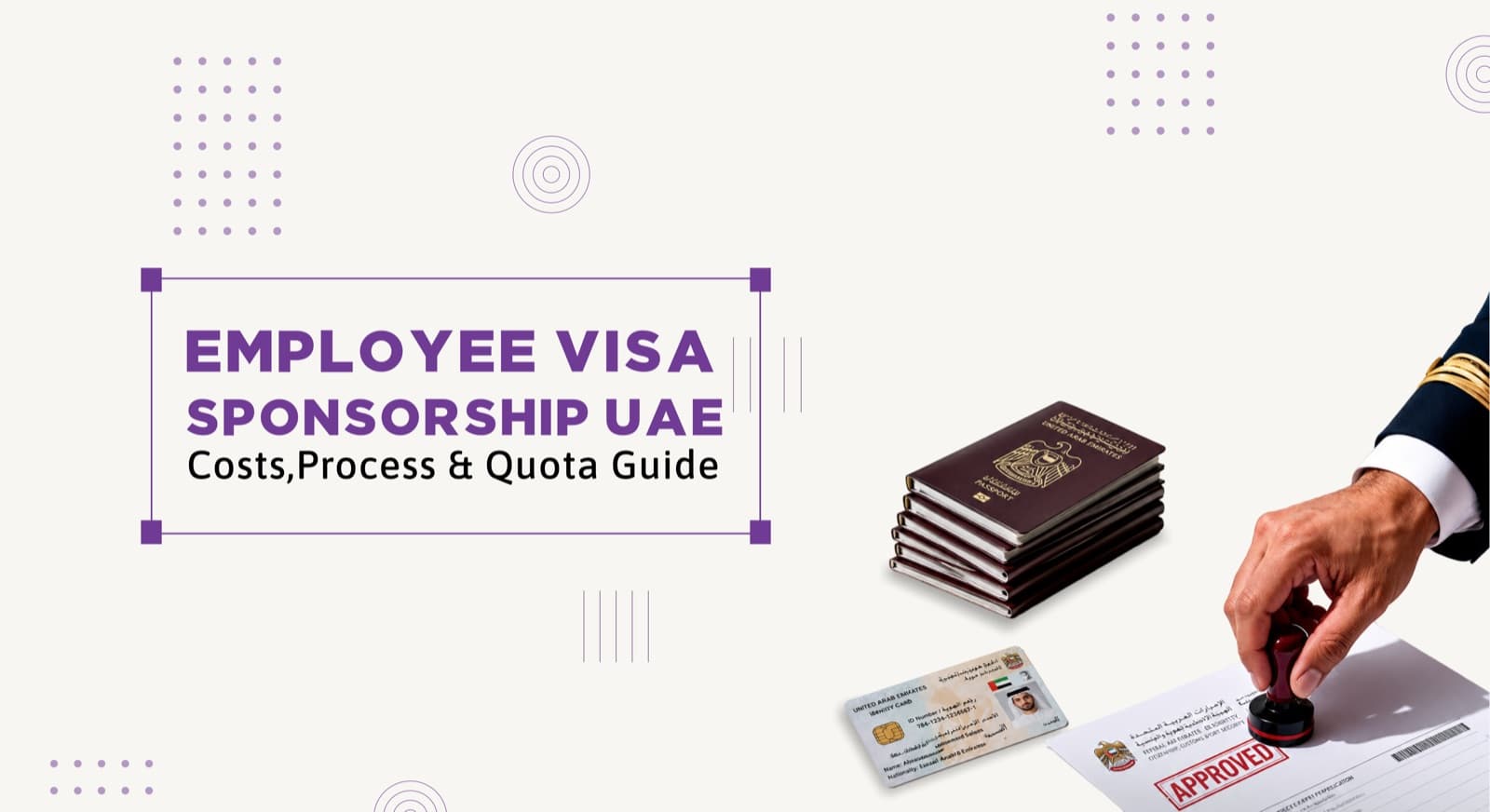
Employee Visa Sponsorship UAE: Costs, Process & Quota Guide
Quick Summary: Hiring foreign talent is the engine of most UAE businesses, and almost every expatriate hire runs through employer sponsorship. This 2026 working reference covers who can sponsor employees in the UAE, how visa quota is calculated, the visa types you will actually use, the step-by-step process, current cost ranges (mainland AED 5,200–7,500; free zone AED 3,500–6,000), dependent visa rules, and how to apply for a quota increase when your team outgrows its initial allocation.
Hiring foreign talent is the engine of most UAE businesses, and almost every expatriate hire runs through some form of employer sponsorship. For HR managers, founders, and PROs, employee visa sponsorship is not a one-time setup — it is a recurring discipline that touches trade licences, office space, MOHRE quota, GDRFA filings, medical centres, Emirates ID, payroll, and employee dependents.
This 2026 working reference covers who can sponsor employees in the UAE, how visa quota is calculated, the visa types you will actually use, the step-by-step process, current cost ranges, dependent visa rules, and how to apply for a quota increase when your team outgrows its initial allocation.
Important: Visa rules and fees in the UAE are updated frequently by the Ministry of Human Resources and Emiratisation (MOHRE), the Federal Authority for Identity, Citizenship, Customs and Port Security (ICP), and the General Directorate of Residency and Foreigners Affairs (GDRFA). The numbers in this guide reflect generally observed 2026 ranges. Always confirm with the relevant authority, your free zone, or a licensed PRO before submitting an application.
1. Who Can Sponsor Employees in the UAE?
To sponsor an employee, a company must be a properly licensed UAE employer with an active immigration profile. In practice, three things must be in order:
- A valid trade licence. Mainland licences come from the relevant emirate's economic department (DET in Dubai, ADDED in Abu Dhabi). Free zone licences come from the free zone authority (DMCC, JAFZA, DIFC, ADGM, IFZA, RAKEZ, others).
- An active establishment card. Often called the immigration or company card — the company's profile with MOHRE or the free zone, used in every visa transaction.
- A clean compliance record. Outstanding MOHRE fines, expired establishment cards, missed WPS payments, or labour complaints can all freeze new visa issuance.
The role being sponsored must align with one of the activities listed on the trade licence. A trading company generally cannot sponsor a clinical role; a medical licence or specialist activity would be required.
Mainland sponsorship runs through MOHRE's Tas'heel system. Free zone sponsorship runs through the free zone authority and the relevant immigration portal. Mainland visas allow the employee to work anywhere in the UAE for the sponsoring company; free zone visas typically tie work activity to the free zone unless a no-objection arrangement is in place.
2. UAE Visa Quota Explained
Before any visa is issued, the company must have labour quota (also called visa allocation) — formal permission from MOHRE or the free zone to hire a specific number of foreign workers. Quota is calculated from a small set of inputs.
What Drives Quota
- Office space. The dominant factor for mainland companies. A common rule of thumb is around 9 sq m (roughly 80–100 sq ft) per visa, with variation by emirate and activity. A 50 sq m office may support around 5 visas.
- Licensed activity. Labour-intensive activities (manufacturing, construction, hospitality) generally support higher quotas than desk-based ones (consulting, trading).
- Compliance history. MOHRE classification, WPS record, Emiratisation status, and absence of fines all influence how generously quota is granted.
- Free zone package. Free zones bundle quota into the licence. As a guide, a flexi-desk supports 1–3 visas, a small physical office around 6 visas, larger offices proportionally more.
Mainland vs Free Zone
Mainland companies apply for quota through MOHRE and pay per work permit. Free zones include a fixed allocation in the licence fee and charge per additional visa. Mainland licences offer the broadest right to operate; free zones often offer faster turnaround and lower per-visa cost but limit where employees can work.
3. UAE Employee Visa Types You Will Actually Use
MOHRE issues more than a dozen work permit categories. For day-to-day HR, the ones that matter most are:
- Standard employment visa (recruiting from outside the UAE). The default 2-year residence visa for new hires brought in from abroad — three years in some free zones, renewable.
- Work permit transfer. Used when an employee moves from one UAE employer to another, where rules permit, instead of cancelling and re-issuing.
- Mission work permit. A short-term permit (up to 90 days, extendable) for project-based, audit, training, or installation work. Lighter on documentation; medical and Emirates ID are not always required for shorter durations.
- Part-time work permit. Allows an employee on one sponsor's visa to work additional hours for a second employer.
- Family-sponsored work permit. Allows a person on a family/dependent visa to work for a UAE employer, with the employer holding the work permit but not the residence visa.
- Temporary and juvenile work permits. For short-duration roles and applicants aged 15–18 (with restrictions) respectively.
- Golden, Green, and Blue Visa employees. Self-sponsored residents still need an active MOHRE work permit (labour card) to work for a UAE employer. The residence is independent of the employer; the work permit is not.
For most UAE employers, the standard 2-year employment visa is what runs through the system day after day.
4. The Visa Sponsorship Process, Step-by-Step
The end-to-end sponsorship process for a new hire from abroad typically takes 2–6 weeks, depending on documentation, the emirate, and free zone vs mainland route. The standard sequence:
- Issue and sign the offer letter and labour contract in MOHRE-approved format. Role, salary, and contract term must match the licensed activity.
- Apply for quota approval (if not already in place) through MOHRE Tas'heel for mainland or the free zone portal.
- Apply for the work permit (labour card) with the employee's passport, photo, qualifications, and signed offer. MOHRE typically reviews within 2–5 working days.
- Issue the entry permit (also called the pink visa or e-visa) through GDRFA or ICP. Valid for 60 days, this allows the employee to enter the UAE.
- Employee enters the UAE on the entry permit. If the employee is already inside on a visit visa, an in-country status change is filed instead.
- Medical fitness test at an approved health centre — mandatory for adults. Tests for HIV, TB, hepatitis B and C, plus a chest X-ray. Results in 24–48 hours.
- Emirates ID biometrics and application at an authorised typing centre or ICP location.
- Labour contract attestation with MOHRE, generally within 14 days of the medical.
- Health insurance activation. Mandatory before residence visa stamping in Dubai and Abu Dhabi (and now standardised across emirates for new visas).
- Residence visa stamping by GDRFA or digital issuance via ICP. The work permit becomes active once the residence visa is in place.
A practical operating rule: start renewals at least 30 days before expiry to avoid daily fines and the risk of cancellation.
5. UAE Employment Visa Cost Breakdown (2026)
Under Federal Decree-Law No. 33 of 2021 (the UAE Labour Law) and its implementing regulations, the employer pays all visa, work permit, medical, Emirates ID, and stamping costs. Deducting any of these from the employee's salary is not permitted.
A 2-year mainland employment visa typically lands in the AED 5,200–7,500 range; free zone packages run roughly AED 3,500–6,000. The biggest variables are MOHRE company classification, worker skill category, and whether the application is processed in-country (status change) or from outside.
Typical 2026 Cost Components
| Component | Authority | Approximate fee (AED) |
|---|---|---|
| Work permit / labour card (Cat 1, skilled) | MOHRE | 250 – 1,500 |
| Work permit (Cat 3, unskilled) | MOHRE | up to 5,000 |
| Entry permit (out-of-country) | GDRFA / ICP | 500 – 1,200 |
| In-country status change | GDRFA | 520 – 575 (additional) |
| Medical fitness test | DHA / SEHA | 300 – 400 |
| Emirates ID (2 years) | ICP | ~380 |
| Residence visa stamping | GDRFA / ICP | ~550 |
| Health insurance (annual) | Insurer | 700 – 3,500+ |
| Age 65+ surcharge | MOHRE | +5,000 (one-time) |
These ranges exclude VAT, typing centre service charges, federal fees, and PRO fees. Free zones generally bundle several items into the licence package.
Company Classification Matters
MOHRE classifies mainland companies into three tiers based on Emiratisation, skill ratio, and cultural diversity. Class 1 companies pay the lowest work permit fees; Class 3 companies — typically those with low Emiratisation or weak compliance — pay materially more per permit. A single classification change shifts the cost of every new visa for the rest of the year.
6. UAE Visa Cost Calculator: Worked Examples
Use the worked examples below as a planning baseline, then confirm with your PRO before submission.
Example A — Skilled hire from abroad, mainland Class 1 employer. Work permit (Cat 1, Class 1) ~AED 300 + Federal fee AED 100 + Entry permit AED 1,100 + Medical AED 350 + Emirates ID AED 380 + Visa stamping AED 550 + Health insurance AED 800 = estimated total ~AED 3,600 (year 1, ex. VAT).
Example B — Mid-skill hire, free zone, status change. Free zone visa package ~AED 3,500 + In-country status change AED 540 + Medical AED 350 + Emirates ID AED 380 + Health insurance AED 850 = estimated total ~AED 5,620 (year 1, ex. VAT).
Example C — Senior hire, mainland, age 65+. Standard mainland package ~AED 6,800 + Age surcharge AED 5,000 + Senior health insurance AED 4,500 = estimated total ~AED 16,300 (year 1, ex. VAT).
A simple planning formula:
Total visa cost ≈
   Work permit fee (by Class + Skill Category)
 + Federal + Entry permit OR Status change
 + Medical + Emirates ID + Visa stamping
 + Refundable insurance deposit (one-time)
 + Annual health insurance
 + Any age / attestation surcharges
 + VAT, typing, and PRO fees
Run this per hire, not per company average. Skill category, age, and processing route move the number more than most HR teams expect. To fold these visa costs into the full cost of a hire, try our employee cost calculator.
7. Medical Fitness, Emirates ID, and What Employees Actually Do
Two steps in the process are employee-dependent and often the source of delays:
- Medical fitness test. Required for all adult applicants. Conducted at DHA-approved centres in Dubai (Tasjeel, Al Mamzar) and SEHA centres in Abu Dhabi. Standard turnaround is 24–48 hours; VIP/express services run same-day at higher cost. A failed test (HIV, active TB) leads to visa rejection.
- Emirates ID. Mandatory national identity card for all UAE residents. Application is filed through ICP, biometrics are captured at an authorised centre, and the card is delivered by Emirates Post. The Emirates ID number is the single most important employee identifier in UAE payroll, WPS, healthcare, and government services. HR systems should treat Emirates ID validity as a core compliance field, not just an HR document.
For employees already in the UAE on a visit visa, both steps usually happen as part of an in-country status change, without leaving the country.
8. Dependent Visas: Sponsoring Family Members
Once an employee holds a valid UAE residence visa, they can typically sponsor immediate family members under the dependent visa framework, governed by the executive regulations of Federal Law No. 29 of 2021 on entry and residence of foreigners.
The salary thresholds enforced in 2026 are broadly:
- Spouse and children: sponsor must earn at least AED 4,000/month, or AED 3,000/month plus employer-provided accommodation. Same threshold applies regardless of sponsor gender (a 2019 reform that remains in force).
- Parents: higher threshold, generally AED 20,000/month, plus a refundable deposit of AED 2,500–3,000 per parent, mandatory health insurance, and proof of accommodation.
- Sons: sponsorable up to age 18, extendable up to 25 if enrolled in accredited education.
- Daughters: sponsorable at any age while unmarried.
- Children of determination: extended limits with supporting documentation.
- Golden, Green, and Blue Visa holders: sponsor family members without a minimum salary requirement; sponsorship duration matches the holder's primary visa.
Adults aged 18+ must complete the medical fitness test. Marriage and birth certificates issued outside the UAE must be MOFAIC-attested. A typical dependent visa runs AED 3,000–6,000 per family member depending on emirate, processing route, and insurance.
A useful HR habit: keep a dependents register against each employee record. Cancellations, absences, and renewals are simpler when family relationship and document validity are tracked alongside the employee's own visa.
9. How to Apply for a UAE Visa Quota Increase
A growing company will eventually hit its initial visa allocation. The route to a higher quota depends on the licensing authority, but the underlying logic is the same: the company needs to demonstrate the operational basis for more headcount.
Mainland (MOHRE) Route
- Expand or upgrade the office space. Submit the new tenancy contract and Ejari to MOHRE through Tas'heel as evidence of additional capacity.
- Submit a quota increase request. MOHRE evaluates licensed activity, financial standing, WPS history, Emiratisation compliance, and any prior labour disputes.
- Address compliance flags first. Outstanding fines, unpaid WPS, expired establishment cards, and missed Emiratisation targets will block or delay approval.
- Provide a business case where required. For larger increases, a short justification (volume of work, new contracts, project pipeline) strengthens the application.
Free Zone Route
Most free zones list quota tiers tied directly to office size and licence package. Increasing quota usually means moving up an office tier (flexi-desk → executive office → larger fitted office) or buying additional visa allocations as a top-up. The free zone authority handles it internally; documentation is generally lighter than mainland but more dependent on physical space.
Realistic Timelines
Mainland quota increases commonly take 5–15 working days once documentation is complete. Free zone upgrades are often quicker — sometimes within 48 hours where space and payment are already in place.
10. Common Compliance Pitfalls
A few patterns appear repeatedly when sponsorship goes wrong:
- Missed expiry dates. Late visa, work permit, Emirates ID, or insurance renewals trigger fines (often AED 50/day) and can force urgent exit-and-re-entry processes.
- Mismatched job titles. The MOHRE-registered title must match the employment contract and the trade licence activity. Mismatches surface during audits and dependent visa applications.
- Deducting visa costs from salary. Prohibited under Federal Decree-Law No. 33 of 2021 and recoverable by the employee.
- Operating beyond quota. Hiring before quota is approved exposes the company to fines and the employee to legal risk.
- Out-of-date establishment card. A lapsed establishment card freezes new visa transactions until renewed.
The fix is rarely a single intervention. It is a system: every visa, work permit, Emirates ID, insurance policy, and dependent record tracked against a known expiry date, with reminders that fire well before the deadline.
Track Every UAE Visa, Work Permit, and Emirates ID — in RadixHR
Visa sponsorship is one of the few HR processes in the UAE where a single missed date can trigger fines, halt hiring, or force an employee out of the country. RadixHR keeps every visa, work permit, Emirates ID, labour contract, and dependent record in one searchable system, with automated expiry alerts and document templates built around UAE labour law and emirate-specific rules.
If your team is still tracking visas in spreadsheets, you are not tracking visas — you are reacting to them.
Track visas in RadixHR. Visit www.radixhr.com to see how the platform handles UAE visa, payroll, attendance, leave, and WPS compliance in one workflow.
Disclaimer
This article is for general information only and is not legal, immigration, or financial advice. UAE visa rules, fees, and processes are set by MOHRE, ICP, and GDRFA, and change frequently. Costs vary by emirate, free zone, employer classification, employee skill category, and individual circumstances. Always verify current requirements with the relevant authority or a licensed PRO before initiating any sponsorship process.
Authoritative Sources
MOHRE (mohre.gov.ae) · ICP (icp.gov.ae) · GDRFA (gdrfad.gov.ae) · UAE Government Portal (u.ae) · Federal Decree-Law No. 33 of 2021 (UAE Labour Law) · Federal Law No. 29 of 2021 on Entry and Residence of Foreigners.
Related Articles
HR Compliance for UAE Manufacturing Companies: Complete Guide
A practical guide to MOHRE services, Tasheel, WPS, Emiratisation, and labour compliance for HR managers and PRO officers at UAE manufacturing companies. Covers work permits, contract registration, quota management, dispute filing, and the MOHRE mobile app.

MOHRE Services Guide 2026: Work Permits, WPS & Compliance Essentials
Complete MOHRE services guide for UAE employers: Tasheel, work permits, contract registration, WPS monitoring, labour disputes, quota management, Emiratisation reporting, and mobile app. 2026 compliance requirements explained.
UAE End of Year HR Checklist 2026: 15 Tasks Before December 31
Complete UAE HR compliance checklist for 2026: Emiratization quota (10% by Dec 31), WPS audit, gratuity provisions, visa renewals, contract reviews, and record retention. Avoid AED 108,000 penalties per missing Emirati.