A payroll guide for payroll, HR and finance teams with Emirati staff.
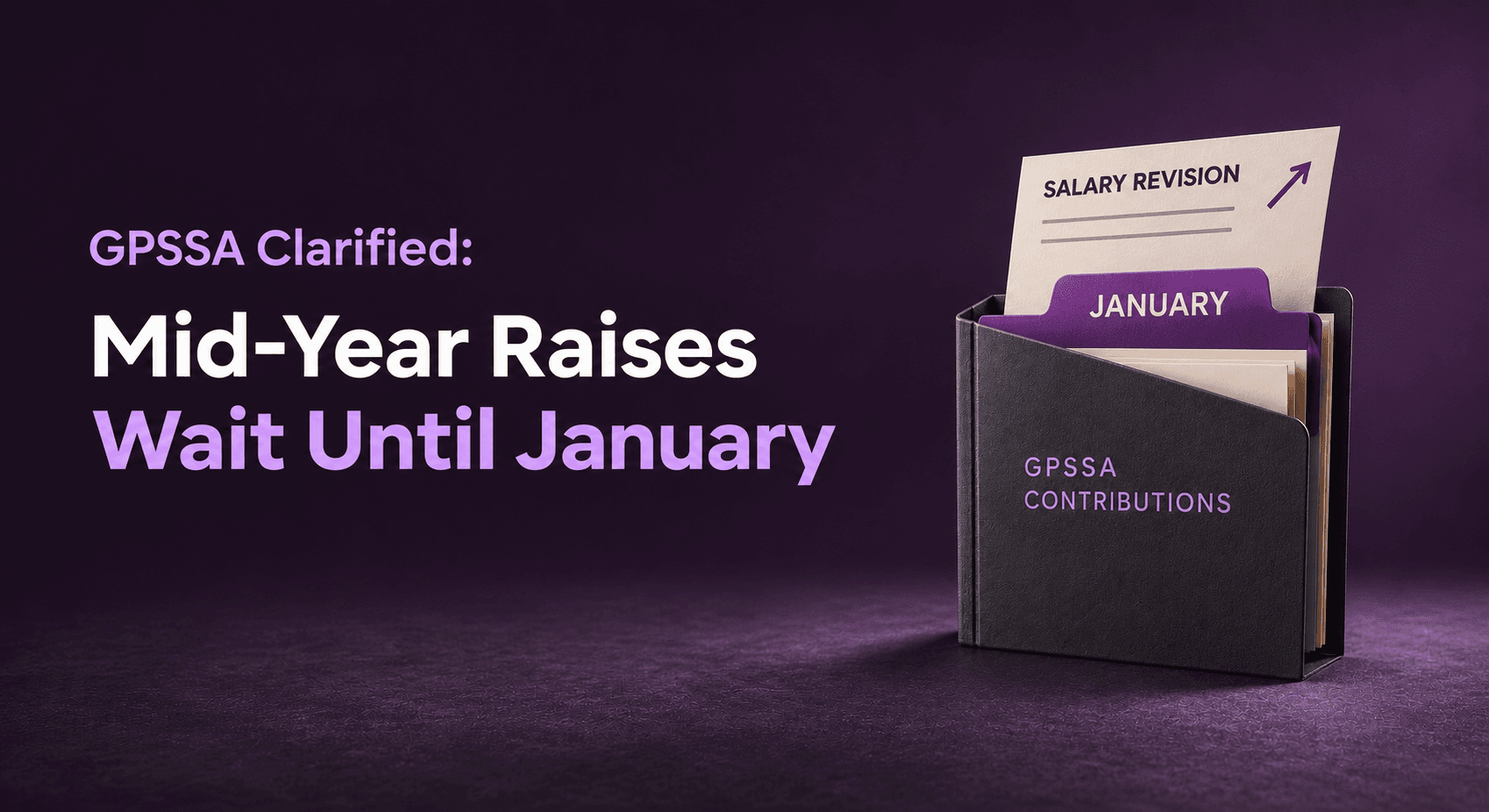
On 12 November 2026, the General Pension and Social Security Authority (GPSSA) clarified a rule that catches out many private-sector payroll teams: when an Emirati employee gets a raise partway through the year, their pension contributions do not change until the following January. The contribution salary is set once a year, not each month.
With January less than six weeks away, this is the right moment to get it straight — because January is when every Emirati employee's contribution salary needs updating on GPSSA's Ma'ashi platform.
Informational only — not legal or financial advice. This article is point-in-time (last updated November 2026) and summarises GPSSA's published clarification. Confirm the rules and any contribution percentages with GPSSA (gpssa.gov.ae) or a qualified adviser before changing payroll. The DIFC and ADGM operate separate employment frameworks; confirm how GPSSA applies to your entity.
The rule: private sector versus government
GPSSA explained that the two sectors work differently:
| Sector | Contribution salary | When a raise counts |
|---|---|---|
| Government | Each month's actual contribution salary | From the month the change takes effect |
| Private sector | The salary approved in January (or the salary when the employee joins) | From the next January |
For the private sector, the contribution salary approved in January applies for the full year. An employee who joins after January is calculated on their joining salary, and that basis holds until the end of December. The next year, the January salary sets the basis again.
GPSSA's worked examples
A mid-year raise. An employee earns AED 15,000 in January and receives a raise to AED 17,000 in July. Pension contributions stay based on AED 15,000 from July to December. From the following January, the newly approved salary becomes the contribution salary for that year.
So for those six months, payroll pays the higher salary, but the pension deduction and the employer contribution are still calculated on the January figure. If your system recalculates contributions automatically whenever the salary changes, it may be over-deducting from the employee and overpaying the employer share — both of which then need correcting.
A raise back-dated to January. The exception is a raise that is approved retroactively from January of the same year. In that case, the revised contribution salary can be applied to the earlier months, and contributions are recalculated and adjusted. A back-dated raise therefore needs a correction for every month since January, not just a new figure going forward.
When contributions must be paid
GPSSA also restated the payment window:
- Contributions become due at the end of the month they relate to.
- They can be paid up to the 15th of the following month.
- If payment is made after that, additional amounts prescribed by law apply.
GPSSA's clarification does not give figures for the late-payment amounts, so we have not quoted any here. The safe practice is to pay with the monthly payroll run, well before the 15th.
The January checklist
Before the January 2027 payroll, work through this for every Emirati employee:
- Confirm each new contribution salary. For anyone whose salary changed during 2026, the new salary becomes the contribution salary from January. Update it on Ma'ashi.
- Leave mid-year joiners' figures alone in 2026. Anyone who joined after January stays on their joining salary until December, then moves to the January-approved salary.
- Process back-dated raises correctly. If any raise was approved retroactively to January 2026, recalculate contributions for the earlier months and settle the adjustment.
- Check your payroll configuration. Make sure your system holds the contribution salary separately from the current salary, and does not change it mid-year.
- Reconcile with payroll. Check that pension deductions and employer contributions for each month match the contribution salary on Ma'ashi, and that payment went in by the 15th of the following month.
January is also when 2027 raises take effect for many companies. If you are planning salary increases now, see RadixHR's guide to 2027 salary budgeting — the timing of a raise now has a pension effect as well as a payroll one.
Why it matters beyond the pension record
GPSSA registration and regular, correct contributions are part of what makes an Emirati hire count toward Emiratisation targets, and contribution support under Nafis was revised in September 2026. A contribution record that does not match GPSSA's rules can surface in either place. For context, see RadixHR's Emiratisation 2026 compliance guide and the Nafis reform explainer; for where pension sits in the monthly close, the payroll close process.
The bottom line
In the private sector, the GPSSA contribution salary is fixed once a year. A mid-year raise is paid in full, but it does not change pension contributions until the next January — unless it was back-dated to January, in which case the earlier months are recalculated. Contributions are due at month-end and payable until the 15th. Update every Emirati employee's contribution salary on Ma'ashi in January, and check that your payroll system is not changing it mid-year.
Keep contribution salaries on GPSSA's rules
See how RadixHR holds each employee's GPSSA contribution salary separately from their pay, applies January updates automatically, and keeps pension deductions on GPSSA's rules.
This article is for general information only and does not constitute legal or financial advice, and is point-in-time (last updated November 2026). It summarises GPSSA's published clarification; the DIFC and ADGM operate separate employment frameworks. Verify current requirements with GPSSA or a qualified adviser before acting.