An HR-facing guide for HR, payroll, and finance teams.
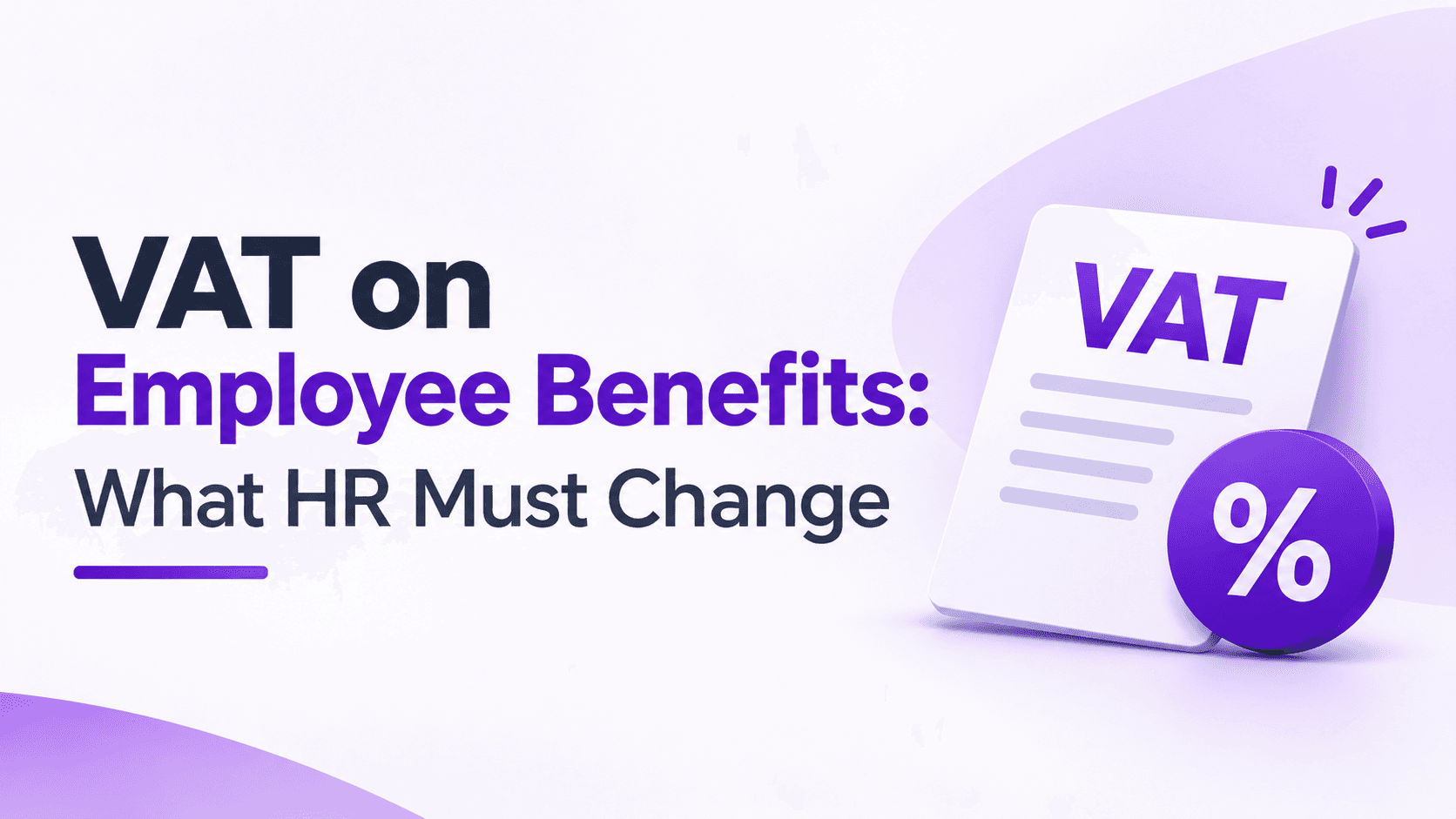
Here is the change in one line: from 1 October 2026, a business can recover the VAT it pays on many staff benefits only when the benefit falls into one of six defined categories and meets every condition attached to that category.
The rule is FTA Decision No. 17 of 2026, issued on 9 September and in force from 1 October. It sits in the VAT Executive Regulation's provisions on employee expenses, and it replaces a looser "normal business practice" style of test with specific cases. Tax advisers have spent October explaining it to finance teams. Almost nobody has explained it to HR — and HR is where most of the work actually sits.
That is because finance files the VAT return, but HR decides what the benefit is, how it is offered, whether there is a cash alternative, and what policy and paperwork stand behind it. Under the new rules, those design choices decide whether the VAT is recoverable. This guide walks through the six categories from an HR point of view, then sets out the practical work: mapping current benefits, deciding allowance versus provided benefit, writing the two policies the rules ask for, and keeping the records finance will need.
Informational only — not tax advice. This article is point-in-time (last updated November 2026) and summarises published adviser commentary on FTA Decision No. 17 of 2026, not the decision text itself. Conditions must be confirmed against the official decision by a qualified tax adviser before you change any benefit. Verify with the Federal Tax Authority (tax.gov.ae).
The principle: every condition, not most of them
The most important thing to understand is that the categories are all-or-nothing. Each one carries a short list of conditions, and a benefit qualifies only if it meets all of them. Meeting four out of five conditions does not get you four-fifths of the VAT back — it gets you none.
For HR, that changes the question you ask about each benefit. It is no longer "is this a reasonable thing to give staff?" It is "does the way we provide this benefit tick every box in its category, and can we prove it?"
The six categories, and the HR decision in each
1. Transport. Covered where transport is for work purposes — home-to-workplace, travel to client sites, or other job-related trips — and not for personal use. A key condition: there is no option to take cash instead. HR decision: if staff can choose a transport allowance in place of company transport, the provided transport may fall outside the category. Decide which model you are running, and make it one or the other.
2. Food and drinks. Covered only in narrow circumstances: the employee lives in a remote or isolated location with no cooking facilities or nearby restaurants, food is provided only for the relevant work or residence period, and there is no cash alternative. HR decision: this is a remote-site benefit, not an office perk. Office snacks, team lunches and meal cards in a city office are not what this category describes.
3. Employee accommodation. Covered where accommodation is provided for operational reasons (the role requires living near the workplace, site or client), for the employee's own use, it is basic and suited to the work without significant recreational features, and there is no cash alternative. It must be provided for the job, not as part of the pay-and-benefits package. HR decision: this is the category most likely to collide with how UAE packages are traditionally structured, where housing is often a negotiable allowance. A housing allowance paid in cash is a payroll item, not a provided benefit — keep it that way and treat it accordingly.
4. Temporary accommodation for new hires. Covered where it is provided temporarily for no more than 30 days and is basic and appropriate to the role. HR decision: set a hard 30-day cap in your onboarding policy and track check-in and check-out dates. Day 31 is outside the category.
5. Mobile phone, data and internet. Covered where the service is needed for the job (including remote or out-of-hours work), personal use is minor, there is a written usage policy, and the employer monitors use and keeps records where the policy is not followed. HR decision: if you do not have a device and data policy, you need one — and you need a way to evidence monitoring, not just a document in a shared drive.
6. Parking. Covered where parking relates to business travel, client visits or similar assignments, there is a written policy covering approval and reimbursement, and receipts show the date, amount and VAT paid. HR decision: everyday commuter parking at the office is a different thing from parking on a client visit. Write the approval policy and make receipts a condition of reimbursement.
Benefit-by-benefit checklist
| Benefit | What has to be true | HR action |
|---|---|---|
| Transport | Work travel only; no personal use; no cash alternative | Choose provided transport or allowance, not both; document the purpose |
| Food & drinks | Remote/isolated site; no facilities nearby; work period only; no cash alternative | Limit to genuine remote-site cases; record the site and dates |
| Accommodation | Operational need; employee only; basic; no cash alternative | Separate operational housing from housing allowances; record the job reason |
| New-hire housing | Temporary; 30 days maximum; basic | Cap at 30 days in policy; log check-in and check-out |
| Phone, data, internet | Needed for duties; minor personal use; written policy; monitoring records | Write a device and data policy; keep monitoring records |
| Parking | Business trips only; written approval policy; receipts with VAT | Write an approval policy; require receipts for every claim |
The HR work, step by step
Map what you currently offer. List every benefit across every grade and site: allowances, provided services, reimbursements. For each, note which of the six categories it could fall into, and whether it is cash or provided.
Decide allowance versus provided benefit. This is the strategic choice the rules force. A cash allowance is simple: it is paid through payroll as part of remuneration, it appears on the payslip, and it is not a VAT recovery question for the business. A provided benefit may allow VAT recovery, but only if it meets every condition — including, in several categories, that there is no cash option. Offering both, or letting staff swap one for the other, is where recovery is most likely to fail. Decide per benefit, deliberately, and with finance in the room.
Write the two policies the rules ask for. The phone/data category and the parking category both expect a written policy. Draft them now: who is eligible, what is covered, approval steps, what evidence is required, and how compliance is monitored.
Keep the records finance will be asked for. The burden of proof sits with the business. Agree with finance what each benefit needs on file — operational reason for housing, site location for food, check-in dates for new-hire housing, monitoring logs for devices, receipts for parking — and make HR the owner of collecting it.
Update offer letters and contracts going forward. If a benefit is being restructured, make sure new offers describe it consistently with the policy, so the paperwork does not contradict the design.
What this decision does not cover
These six categories are the employee-expense cases this decision sets out. Benefits outside them — health insurance is the obvious example — are not addressed by this decision, and their VAT treatment needs separate tax advice. Do not assume a benefit is recoverable, or unrecoverable, because it is missing from this list.
The bottom line
FTA Decision No. 17 of 2026 turns benefit design into a VAT question. Recovery now depends on whether each benefit fits one of six categories and meets every condition — and most of those conditions are about how HR structures and documents the benefit. Map what you offer, choose cleanly between cash allowances and provided benefits, write the device and parking policies, and own the records. Then hand finance a benefit list it can stand behind.
For how allowances should appear on payslips, see RadixHR's guide to UAE payslips and salary structure; for planning next year's package costs, the 2027 salary budgeting guide; and for new-hire housing in the first month, the new employee onboarding checklist. Allowances and provided benefits can be tracked line by line in RadixHR payroll.
Keep every benefit and its paperwork in one place
RadixHR tracks every allowance and benefit line by line, separates cash allowances from provided benefits, and keeps the records finance needs in one place.
This article is for general information only and does not constitute tax advice, and is point-in-time (last updated November 2026). The categories and conditions described are summarised from published adviser commentary on FTA Decision No. 17 of 2026, not the decision text, and may change. Verify current requirements with the Federal Tax Authority or a qualified tax adviser before acting.