A practical guide for HR, payroll, and finance teams.
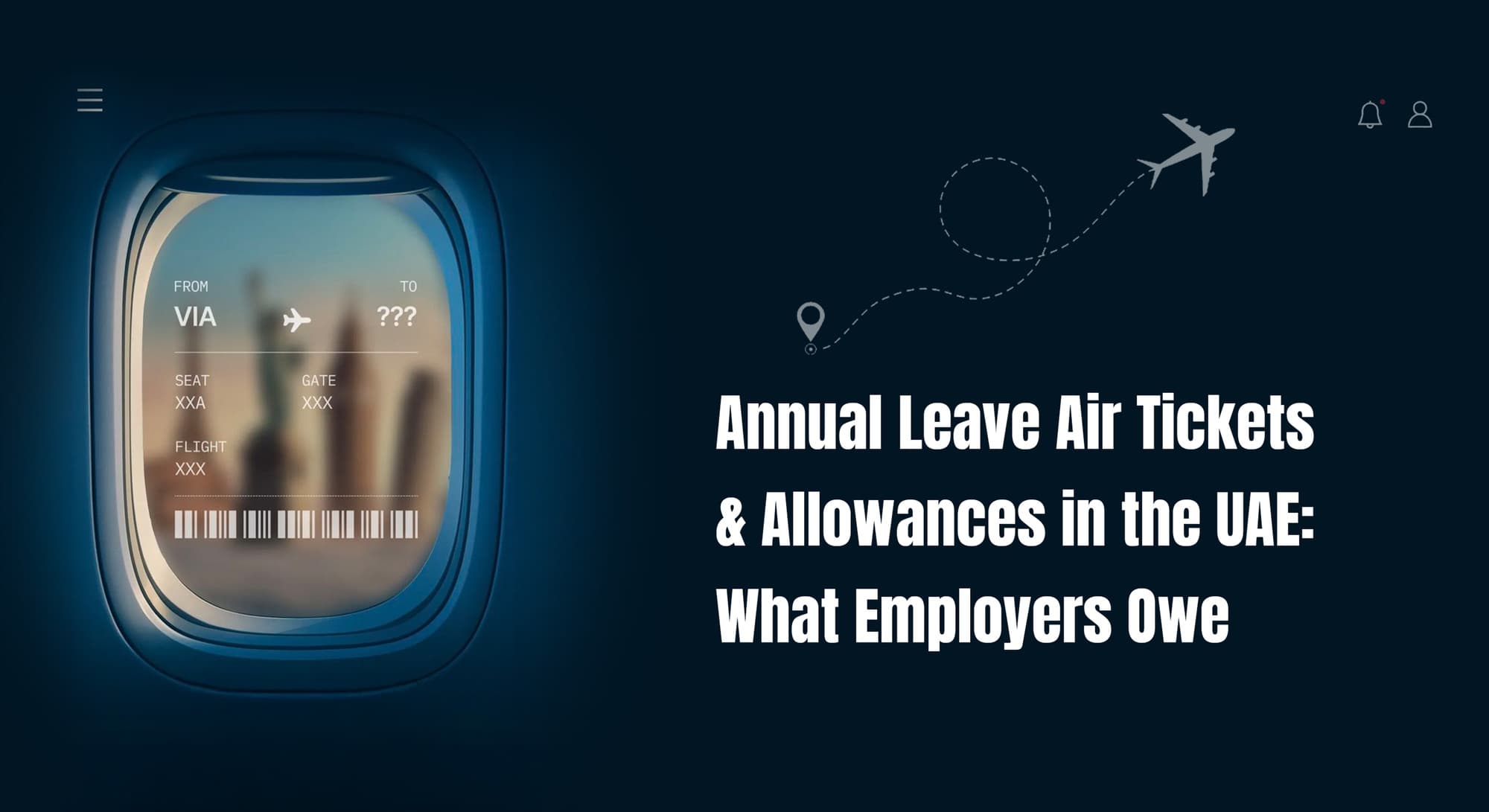
Ask ten UAE employees whether they are entitled to an annual flight home, and most will say yes. Ask what law grants it, and the room goes quiet — because there isn't one. The annual leave ticket is one of the most misunderstood benefits in the UAE market: widely expected, genuinely valuable, and almost entirely a matter of contract rather than statute.
That gap between expectation and law is exactly where disputes start. This guide sets out what employers actually owe: the difference between a statutory repatriation ticket and a customary annual ticket, common market practice, how to word the clause so it does what you intend, how tickets are treated in the final settlement, and how free zones vary — with sample wording and a quick FAQ.
Informational only — not legal advice. This article summarises general principles for the UAE private sector mainland. Rules change, and the DIFC and ADGM operate separate frameworks. Verify your position and any contract wording with a qualified adviser before acting.
Legal entitlement or contractual benefit?
This is the distinction that everything else hangs on, and getting it right prevents most disagreements.
The annual air ticket is not a statutory entitlement. Federal Decree-Law No. 33 of 2021, the UAE labour law in force since February 2022, does not require an employer to provide a yearly flight home for annual leave. It is a customary market benefit, offered by convention to make an expatriate package attractive — and its terms are whatever the contract says.
The repatriation ticket, however, is a legal obligation. Under Article 13 of the same law, when the employment relationship ends, the employer generally bears the cost of returning the employee to their home country — a one-way repatriation ticket — unless the employee joins another employer or the departure is for reasons attributable to the employee. This is a genuine statutory duty, distinct from the annual leave ticket.
So the accurate position is two separate things:
- Annual leave ticket → contractual/market benefit. Owed only if the contract or company policy says so.
- Repatriation ticket at end of service → statutory obligation under Article 13, subject to its conditions.
Confusing the two is the single most common error. An employee may have no contractual annual ticket yet still be owed a repatriation ticket on exit — and vice versa, a generous annual-ticket clause does not remove the separate repatriation duty.
Common market practice
Because the annual ticket is contractual, practice varies — but the market has settled into recognisable norms:
- Annual vs biennial. Many packages provide one economy-class return ticket to the home country each year. Others, particularly for more junior roles, provide a ticket every two years (biennial). Both are common; the contract decides.
- Family tickets. Senior and married expatriate packages often extend the benefit to a spouse and children (frequently up to a set number, and up to a certain age). Junior packages more often cover the employee only. Again, scope is whatever the contract states.
- Cash-in-lieu vs booked flights. Employers take one of two routes: pay a fixed cash allowance in lieu (monthly or annually) that the employee spends as they choose, or book the flight directly. Cash is simpler to administer and gives the employee flexibility; a booked ticket guarantees the money is used for travel. Some cash-in-lieu arrangements are payable whether or not the employee actually travels — a point worth making explicit.
- Home country defined. Good clauses fix the "home country" (usually the nationality or the country stated in the contract) so the destination and cost basis are not open to argument.
None of this is mandated. It is convention, and the value of writing it down clearly is that convention is exactly what gets disputed when it is left implicit.
How to word the clause
Ambiguous ticket clauses cause more trouble than almost any other benefit, because the money is real and the entitlement is annual. A good clause answers: who is covered, how often, what class, to where, cash or booked, what happens to unused entitlement, and how it is treated on exit.
Sample contract wording (illustrative)
Air ticket benefit. The Employer shall provide the Employee with one (1) economy-class return air ticket to [home country], once every [12 / 24] months, for the purpose of annual leave. [Where family cover applies:] This benefit extends to the Employee's spouse and up to [number] children under [age] years, subject to their valid UAE residence.
The Employer may, at its discretion, provide this benefit either by booking the ticket(s) directly or by paying a cash allowance in lieu of AED [amount], payable [annually/monthly]. [If applicable:] The cash allowance is payable whether or not the Employee travels.
This annual air ticket benefit is a contractual benefit and is separate from, and additional to, the Employee's statutory repatriation entitlement on termination of employment under the applicable UAE labour law.
This wording is an illustrative example only, not legal drafting. Adapt it to your policy and have it reviewed before use.
The last paragraph matters: it keeps the contractual annual ticket and the statutory repatriation ticket clearly separate, so neither is mistaken for the other. For the wider drafting picture, see our complete guide to UAE employment contracts.
Treatment in the final settlement
At the end of employment, two ticket questions arise, and they are handled differently.
Repatriation ticket. If the Article 13 conditions are met — broadly, the employee is leaving the country and not immediately joining another UAE employer, and the exit is not for a disqualifying reason — the employer generally owes the one-way repatriation ticket (or its documented cost). This is a statutory item in the final settlement, independent of any annual-ticket clause.
Accrued or pro-rata annual ticket. Whether a departing employee is owed a portion of the annual ticket depends entirely on the contract wording. If the clause says the ticket accrues and is payable pro-rata, it is owed for the fraction earned. If it says the benefit is only payable on taking approved annual leave, an employee who leaves mid-cycle may have no claim. Silence is where disputes happen — so the clause should state explicitly whether the annual ticket is pro-rated on exit.
The practical rule for a clean final settlement: treat the repatriation ticket as a statutory line, treat the annual ticket strictly per the contract, and document both. For where ticket costs and allowances sit in the wider settlement, see our guide to UAE payslips and salary structure and to annual leave encashment. To model the end-of-service side, use the end-of-service calculator and the leave salary calculator.
Free-zone variations
The mainland position above follows the federal law. Free zones differ:
- Most free zones — DMCC, JAFZA, DAFZA, IFZA, RAKEZ and others — apply the federal labour framework, so the annual-ticket-is-contractual and repatriation-is-statutory distinction broadly holds. Ticket terms remain a matter of contract.
- DIFC and ADGM operate their own employment laws, which set out their own end-of-service and repatriation positions. Do not assume the federal Article 13 wording transfers directly; check the applicable free-zone law for entities based there.
As always, the contract is where you control the annual benefit — but the governing framework determines the statutory floor beneath it.
Quick FAQ
Is an annual flight home required by UAE law? No. Recurring annual tickets are a customary market benefit, not a statutory entitlement. They are owed only if the contract or company policy provides them.
Is any ticket legally required? Yes — the repatriation (one-way, home-country) ticket at the end of service, under Article 13 of Federal Decree-Law No. 33 of 2021, subject to its conditions.
Can we pay cash instead of booking flights? Yes. Cash-in-lieu is common and lawful. State the amount, the frequency, and whether it is payable regardless of travel.
Do we have to cover the family? Only if the contract says so. Family cover is common in senior packages and optional in others.
Does an employee who resigns still get the repatriation ticket? It depends on the circumstances of departure and whether they join another UAE employer. The Article 13 conditions govern; the annual-ticket clause is separate.
Annual or every two years? Either is normal market practice. The contract decides.
The bottom line
The annual leave ticket is a benefit you design, not a rule you follow — while the repatriation ticket is a rule you follow, not a benefit you design. Keeping those two straight, and writing the annual clause so it says exactly who gets what, when, and how it is treated on exit, is what turns a common source of disputes into a settled term.
You can see how contract terms, allowances, and end-of-service items connect across RadixHR's payroll and UAE compliance tools, alongside leave management, with more practical guidance on the RadixHR blog.
Sources & references
This guide is based on the following official UAE government sources, current at the time of writing (verify the latest versions directly, as the law and MOHRE guidance are updated periodically):
- Federal Decree-Law No. 33 of 2021 on the Regulation of Employment Relationships (as amended), in force since February 2022 — Article 13, which places the cost of repatriating the employee to their home country on the employer at the end of the relationship, subject to its conditions, and which contains no equivalent obligation to provide a recurring annual leave ticket. Published on the UAE Legislation portal.
- Executive Regulations to Federal Decree-Law No. 33 of 2021 (Cabinet Resolution No. 1 of 2022) — the implementing detail on end-of-service and repatriation obligations.
- MOHRE (mohre.gov.ae) — guidance on employment contracts, benefits, and end-of-service entitlements for the mainland private sector.
- DIFC Employment Law No. 2 of 2019 and the ADGM Employment Regulations 2024 — the separate frameworks governing entities based in those two financial free zones.
The annual air ticket is a matter of contract, not statute, so no government source prescribes its frequency, class, or family scope; the market practice described in this article reflects prevailing convention rather than published rules. Sample wording is illustrative and not a substitute for professional drafting.
Hold every contract benefit in one place
RadixHR keeps contract terms, allowances, and end-of-service entitlements together: air-ticket clauses recorded against each employee, cash-in-lieu allowances flowing through payroll, and repatriation obligations captured in the final settlement — so the contractual benefit and the statutory duty are both settled correctly, and neither is mistaken for the other.
This article is for general information only and does not constitute legal advice. Air-ticket and repatriation entitlements are set under Federal Decree-Law No. 33 of 2021 and its Executive Regulations and depend on individual contract terms; rules are subject to change and the DIFC and ADGM operate separate frameworks. Sample wording is illustrative and not a substitute for professional drafting. Verify current requirements with MOHRE or a qualified adviser before acting.