When Ministerial Resolution No. 340 of 2026 took effect on 1 June 2026, most coverage explained the new rule: salaries clear the Wage Protection System by the 1st of the month, no 15-day grace period, 85% on-time threshold. Roughly four months on, the more useful question is no longer what the rule says — it is what happens if you miss it. The escalation runs on a compressed, day-by-day clock, and this guide walks through that sequence, then translates it into what your payroll process needs in place before Day 2 ever arrives.
If you already know the basics of WPS and Resolution 340, this is the operational follow-up. For the underlying rules, see our UAE WPS compliance guide; this piece assumes them.
Informational only — not legal advice. This article is point-in-time (last updated September 2026). Enforcement figures and thresholds are set by MOHRE and are evolving; verify the current position with MOHRE (mohre.gov.ae) before acting.
Day 1: the fixed due date
Everything starts from a single, non-negotiable point. Wages for the previous month must clear WPS by the 1st of each Gregorian month. There is no 15-day grace period — the flexibility payroll teams built their calendars around for years is gone.
An establishment is treated as compliant if it has transferred at least 85% of total wages due on time. That threshold accommodates legitimate cases — an employee on unpaid leave, a lawful coded deduction, a genuine mid-cycle exit — but it is not a licence to pay most people and leave the rest. From Day 1, monitoring is electronic and continuous, so the clock starts the moment the deadline passes.
Day 2: the notifications begin
The day after the deadline, MOHRE begins issuing electronic notifications and warnings to non-compliant establishments. This is the gentlest stage — but it is also the one that tells you the system has already registered your miss. There is no quiet window in which a late payroll goes unnoticed; by Day 2 it is on the record.
For a payroll team, Day 2 is not where you want to be reacting. It is where a well-run process has already confirmed, days earlier, that the money cleared.
Day 5: work permit restrictions
If non-compliance continues, from around Day 5 MOHRE can suspend the issuance of new work permits for the establishment. For any business that is hiring, renewing visas, or moving staff, this is the first stage that genuinely bites — it freezes part of your ability to operate while the salaries remain unpaid. A payroll delay has now become a hiring problem.
Day 11: fines and reclassification for repeat offenders
From around Day 11, continued or repeated non-compliance can trigger administrative fines and reclassification of the establishment into a lower MOHRE category, particularly for establishments with repeated violations within a six-month window. A category downgrade is more than a fine: it raises MOHRE service fees, restricts quotas, and is visible to banks and partners — a cost that outlasts the specific late payment that triggered it.
Day 16: automatic dispute registration
This is where enforcement stops being about the company and starts being about the workers. From around Day 16, for establishments with roughly 25 or more unpaid workers (or in specified higher-risk sectors), MOHRE can automatically register an individual or collective labour dispute on behalf of the affected employees — without the employees having to file anything themselves — and extend the work-permit suspension. The state is now acting for the workforce against the employer.
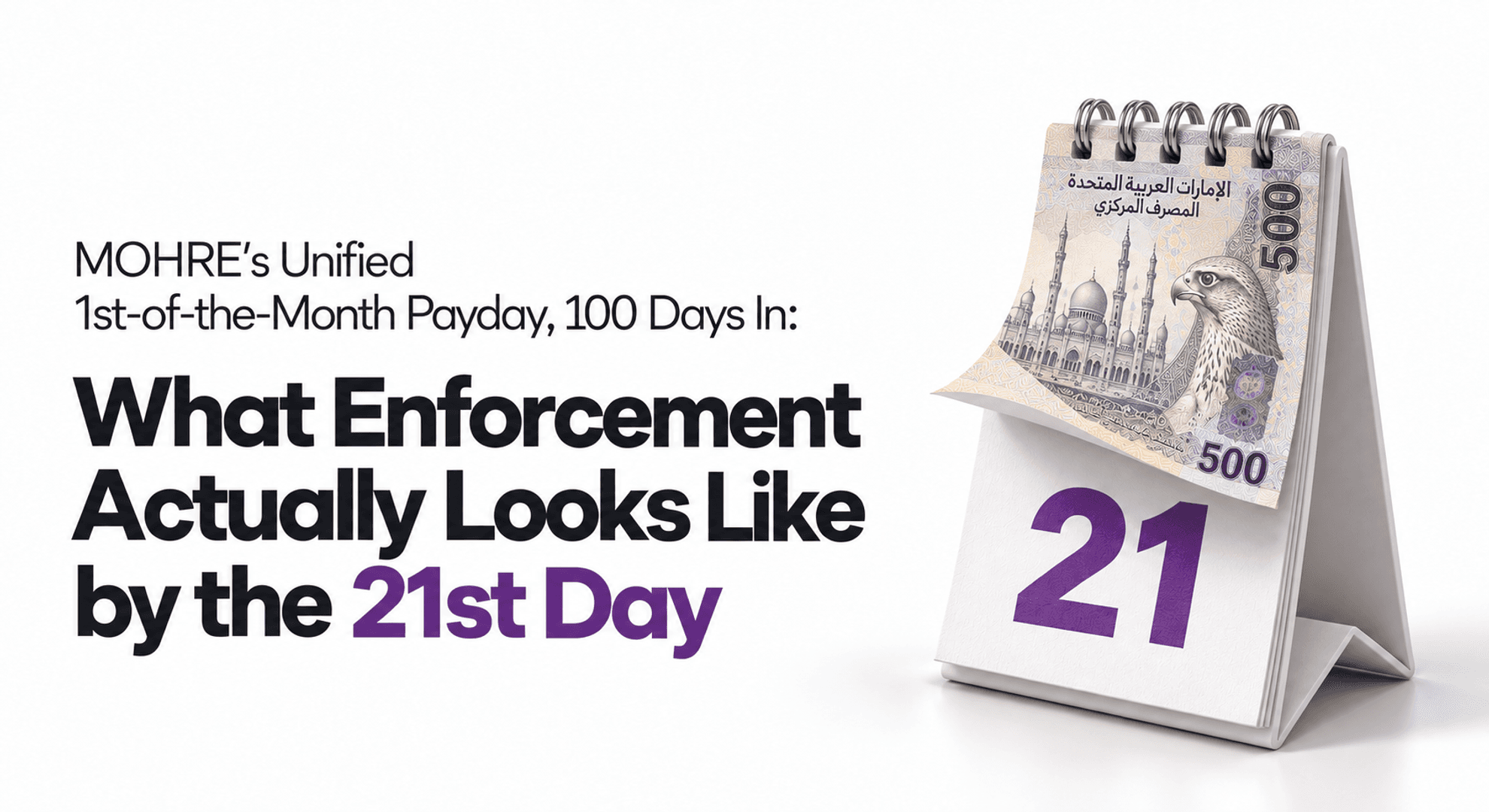
Day 21: the serious measures
By around Day 21, the escalation reaches its most severe stage. Depending on the size of the establishment and the seriousness of the case, this can include executive wage-recovery orders for smaller establishments, collective dispute procedures for larger ones (50+ employees), precautionary attachment of assets, travel bans on the officials responsible, and referral to the Public Prosecution in serious or repeated cases. At this point a missed payroll is no longer an administrative slip — it is a legal and financial event with personal consequences for the people in charge.
The enforcement clock at a glance
| Day | What can happen |
|---|---|
| Day 1 | Unified due date; 85% on-time threshold; electronic monitoring begins |
| Day 2 | Notifications and warnings to non-compliant establishments |
| Day 5 | Suspension of new work permit issuance |
| Day 11 | Fines + category downgrade (repeat violations within 6 months) |
| Day 16 | Automatic labour-dispute registration (25+ workers / high-risk sectors) |
| Day 21 | Asset attachment, travel bans, Public Prosecution referral |
Figures and thresholds are evolving; treat this as the operative shape of the escalation and verify specifics against MOHRE.
What this means for your payroll operation
The whole point of understanding the timeline is to make sure you never enter it. Because the clock starts on Day 2, the work happens well before the 1st. Three things a payroll team needs in place:
- A funding cutoff date, not a submission date. Salaries must clear by the 1st, and bank/WPS processing takes one to two working days. So the money and the SIF have to be with your agent by roughly the 29th–30th — earlier if the 1st falls on a weekend or holiday, because the deadline does not roll forward. Fund to the clearing date, not the submission date.
- A SIF submission buffer. Build the calendar backward from the 1st: data cut-off around the 20th–22nd, payroll calculated and validated by the 26th–27th, SIF submitted and signed off by the 27th–28th, account funded by the 28th, processing buffer on the 29th–30th. Validate the file before it goes, because a rejection discovered on the 30th has no grace period behind it.
- A named escalation owner before Day 2. Someone must own the answer to "did the salaries clear?" before the deadline, with the authority to act if they didn't. The failure mode is a payroll that quietly missed the 1st with nobody watching until a Day 2 notification arrives. Assign the owner, and make confirming the clearance a defined step, not an assumption.
The bottom line
A hundred days in, Resolution 340's enforcement is no longer theoretical — it is a live, automated, day-by-day sequence that moves from a Day 2 notification to Day 21 asset attachment and prosecution faster than most late-payroll problems could historically be resolved. The teams that never see any of it are the ones that treat the 1st as a clearing deadline, fund and submit in the last week of the month, validate the SIF before it leaves, and give one person ownership of confirming the money landed. The escalation clock is unforgiving by design; the answer is a payroll close that finishes early enough never to start it.
For the underlying rules this builds on, see our UAE WPS compliance guide and our UAE payslips and salary structure guide. Enforcement coverage is reported by Gulf News and Khaleej Times; official guidance is published by MOHRE at mohre.gov.ae.
Never miss the deadline that starts the clock
RadixHR builds your WPS close backward from the 1st, validates the SIF before submission, and flags the funding cutoff.
This article is for general information only and does not constitute legal advice, and is point-in-time (last updated September 2026). WPS deadlines, thresholds, and the enforcement sequence are set by MOHRE and the Central Bank of the UAE under Ministerial Resolution No. 340 of 2026 and related regulations, and are evolving and subject to change. Verify current requirements with MOHRE or a qualified adviser before acting.