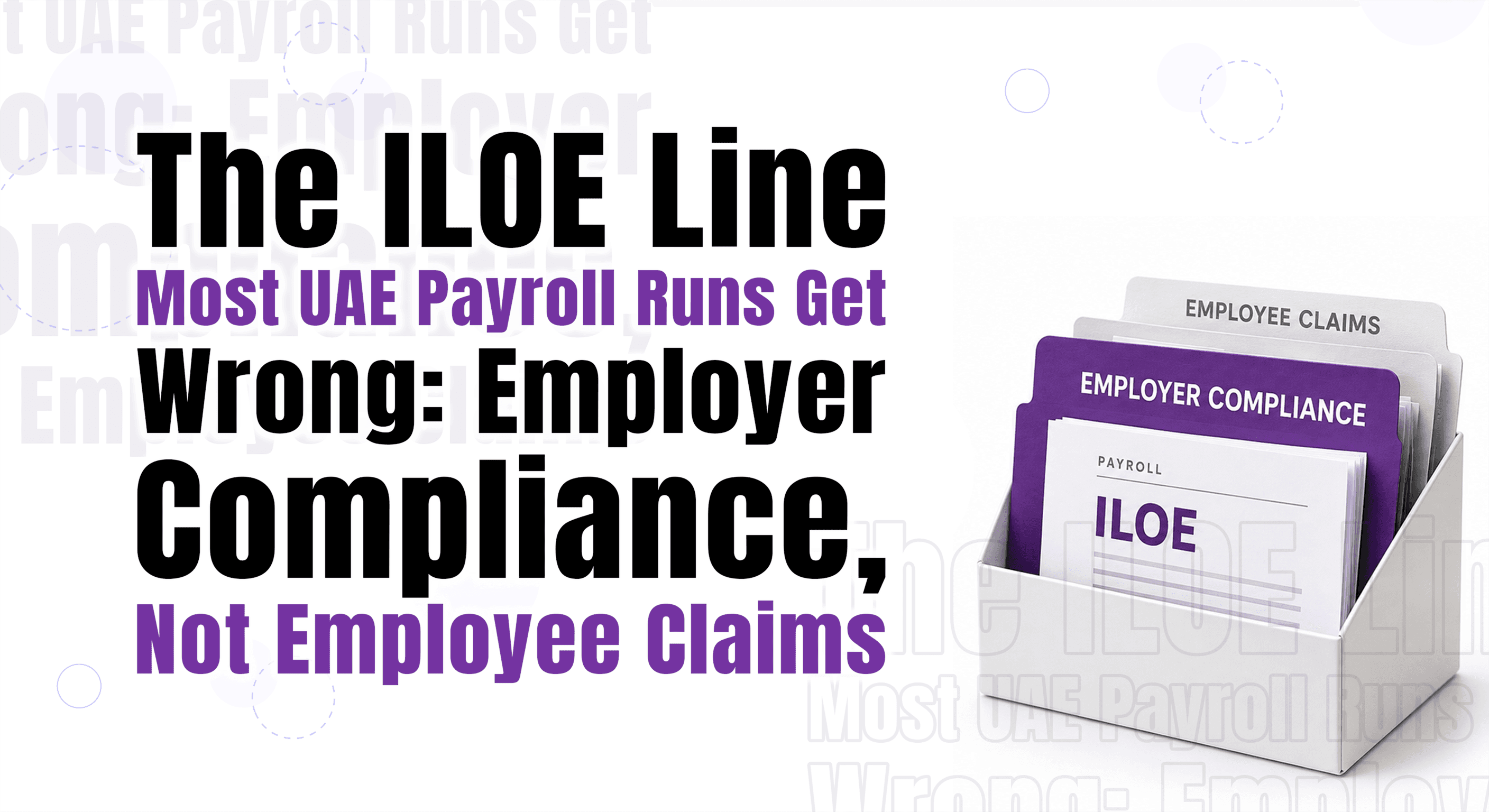
The ILOE Line Most UAE Payroll Runs Get Wrong: Employer Compliance, Not Employee Claims
Most ILOE content tells employees how to claim. This is the employer's side: your actual compliance exposure under Federal Decree-Law No. 13 of 2022, the AED 16,000 Category A/B split, the manual tier update a raise triggers, and termination documentation — with a quarterly ILOE payroll checklist.
A practical, employer-facing guide for HR and payroll teams. Last updated: September 2026.
Search "ILOE" and you drown in employee-facing content: how to subscribe, how to claim, how much you get. Almost none of it answers the question an HR or payroll lead actually needs — what is the employer's own exposure here? ILOE (Involuntary Loss of Employment insurance) has been live since 2023, so it is not news — but because it is framed publicly as an employee benefit, the employer-side compliance angle rarely gets explained, and that is where payroll teams quietly slip.
This guide covers the employer's side: your exposure under Federal Decree-Law No. 13 of 2022, the Category A/B split and the manual tier update a raise can trigger, the documentation HR must issue on termination, and where ILOE fits into the payroll run. It closes with a quarterly ILOE payroll checklist.
Informational only — not legal advice. This article is point-in-time (last updated September 2026). ILOE rules are set by MOHRE and the scheme's implementing decisions and are subject to change. Verify the current position on the official ILOE portal (iloe.ae) and with MOHRE before acting.
First, what the employer is — and isn't — on the hook for
Here is the nuance that reframes everything: ILOE is primarily the employee's own obligation. Under Federal Decree-Law No. 13 of 2022, the employee must subscribe and keep the premium paid, and it is the employee — not the employer — who is fined (AED 400) for not subscribing. The policy is tied to the individual's Emirates ID and follows them across jobs; the employer is not the policyholder.
So why does an employer have exposure at all? Because "not the policyholder" is not "no responsibility." The employer's role is real but specific, in three places:
- Enabling and reminding — making sure employees actually subscribe, because an unsubscribed worker is a compliance and welfare problem that lands back on HR, and because many employers choose to administer or even fund the premium as a benefit.
- Getting the salary category right — the premium tier is set by the basic salary on the MOHRE contract, which is HR's data.
- Issuing clean termination documentation promptly — so a laid-off employee's legitimate claim is not delayed or denied by missing paperwork the employer controls.
Miss those and you have not broken a rule that fines the company directly — but you have created disputes, delayed claims, and payroll inconsistencies that are entirely avoidable. The employers who handle ILOE well treat it as part of the payroll and offboarding process, not the employee's private admin.
The Category A / B split — and the AED 16,000 threshold
ILOE has two premium tiers, and the dividing line is basic salary of AED 16,000:
- Category A — basic salary AED 16,000 or below. Premium AED 5 + VAT per month. Maximum monthly benefit to the employee: AED 10,000.
- Category B — basic salary above AED 16,000. Premium AED 10 + VAT per month. Maximum monthly benefit: AED 20,000.
Two points matter for payroll. The tier is set on basic salary, not total package — the same basic-vs-allowances distinction that governs gratuity and overtime, so an employee with a modest basic and large allowances may sit in Category A even though their headline pay looks higher. And while the amounts are small, correctness is what counts: a claim assessed against the wrong category can be disrupted.
The manual tier update a raise can trigger — the line most runs get wrong
Here is the specific failure this article is named for. When an employee first subscribes, the system determines Category A or B automatically from their salary at that moment. But a salary increase during employment that pushes basic pay across the AED 16,000 line does not automatically re-tier an existing policy. The portal set the category at subscription; it does not silently watch payroll and upgrade the tier the day a raise lands.
So when a raise takes an employee's basic from, say, AED 15,000 to AED 17,000, their category should move from A to B — and someone has to make sure that happens, rather than assume the system did it. Left unattended, the policy sits in the wrong tier, and the premium and benefit ceiling no longer match the employee's real salary — a gap that only surfaces at the worst time: when they are laid off and try to claim.
The fix is process, not heroics: whenever a raise crosses the AED 16,000 basic-salary threshold, add an ILOE tier re-check to the same workflow that updates the contract and the WPS record. If you are changing the salary anyway, that is the moment to confirm the ILOE category still fits.
What HR must document promptly on termination
ILOE pays out on involuntary loss of employment — redundancy, restructuring, business closure — not on resignation or disciplinary dismissal. When an eligible employee is let go, their ability to claim depends partly on documentation the employer controls:
- Accurate reason for termination — the record must reflect that the separation was involuntary and not a resignation or a disciplinary dismissal, because that distinction is what makes the claim valid.
- Timely cancellation and exit paperwork — the MOHRE and visa cancellation steps and the final documentation should be handled without avoidable delay, since a claim runs on tight timelines.
- Consistent records — the termination details, the final settlement, and the WPS record should agree, so nothing in the employee's file contradicts their claim.
None of this makes the employer the insurer. But a laid-off employee whose claim is delayed by slow or inconsistent paperwork has a genuine grievance that reflects on the company. Prompt, accurate offboarding is the employer's real ILOE obligation at exit.
Where ILOE sits in the payroll run
ILOE stays tidy once it is folded into the payroll and offboarding you already run:
- Alongside WPS — the same basic-salary figure drives both the WPS SIF and the ILOE category, so keeping basic pay accurate serves both.
- On salary change — the workflow that updates the contract and WPS record on a raise is the natural home for the ILOE tier re-check.
- At offboarding — the exit process handling the final settlement, gratuity, and visa cancellation is where ILOE-supporting termination documentation gets issued.
Keep those three touchpoints honest and ILOE never becomes a fire drill.
What ILOE is not — keep these separate
A quick but important clarification, because these get conflated:
- ILOE is not GPSSA / pension. Pension contributions for eligible UAE and GCC nationals are a separate, statutory scheme with their own rules and rates. ILOE is unemployment insurance, unrelated to pension.
- ILOE is not end-of-service gratuity. EOSB is the employer's own lump-sum obligation calculated on basic salary at the end of service. ILOE is a small insured monthly benefit paid by the scheme, not the employer, after involuntary job loss.
Treating all three as one "end of employment money" bucket is a common error — three separate obligations, three separate mechanics.
Quarterly ILOE payroll checklist
Run this every quarter alongside your other compliance checks:
- Subscription status — spot-check that employees are subscribed and current, and remind any who have lapsed.
- Category accuracy — confirm each subscribed employee's A/B tier matches their current basic salary.
- Threshold crossings — review anyone whose basic salary crossed AED 16,000 (up or down) since last quarter and confirm their ILOE tier was updated.
- New joiners — confirm new hires have been prompted to subscribe within the expected window.
- Leavers — confirm terminations were documented accurately (involuntary vs resignation/disciplinary) and exit paperwork issued promptly.
- Data consistency — basic-salary figures agree across the contract, the WPS record, and any ILOE administration you handle.
- Separation check — ILOE, GPSSA/pension, and EOSB are each handled under their own rules, not merged.
The bottom line
Almost everything written about ILOE is aimed at the employee trying to claim. The employer's job is quieter but real: make sure people are subscribed, keep the Category A/B tier matched to basic salary — especially after a raise crosses AED 16,000, which the portal will not re-tier for you — and issue clean, prompt termination documentation so a genuine claim is not delayed. Fold those into the payroll and offboarding you already run, keep ILOE separate from pension and gratuity, and it stops being the line your payroll run quietly gets wrong.
For the surrounding mechanics, see our UAE payslips & salary structure guide and our WPS compliance guide. Official ILOE guidance is published at iloe.ae, and the legal basis (Federal Decree-Law No. 13 of 2022) on the UAE Government Portal at u.ae.
Keep ILOE tiers correct without a scramble
RadixHR keeps basic-salary data, WPS records, and offboarding documentation consistent, so ILOE tiers stay correct and terminations are documented cleanly.
This article is for general information only and does not constitute legal or insurance advice, and is point-in-time (last updated September 2026). ILOE is governed by Federal Decree-Law No. 13 of 2022 and its implementing decisions, administered via the official ILOE scheme and MOHRE, and is subject to change. ILOE is separate from GPSSA/pension and from end-of-service gratuity. Verify current requirements at iloe.ae and with MOHRE or a qualified adviser before acting.
Related Articles
No New Rules, Faster Alerts: What MOHRE's Late-Salary Monitoring Means for Your Payroll Team
Headlines called it a crackdown, but MOHRE says its late-salary measures add no new substantive obligations — they standardise how WPS compliance is monitored. Here's the alert sequence, who inside your company should own it, and a same-day response playbook.
Your Annual Leave Records and Your WPS File Now Have to Agree — Here's Where UAE Employers Get Caught Out
As Q4 leave-settlement season arrives, a quiet compliance trap is widening: leave encashment calculated off a payroll salary that never matched the MOHRE contract creates a WPS mismatch. The leave rules, the basic-salary basis, and a Q4 reconciliation checklist.
MOHRE's Unified 1st-of-the-Month Payday, 100 Days In: What Enforcement Actually Looks Like by the 21st Day
Resolution 340's 1st-of-month payday has been live since June 2026. Here's the real day-by-day enforcement sequence — Day 2 notices through Day 21 asset attachment and prosecution — and what a payroll team needs in place before Day 2 ever arrives.