How an AI HR Assistant Answers UAE Leave, Attendance & Payroll Questions
What an AI HR assistant actually does day to day — answering leave balances, payslips, and policy questions from your own data, routing approvals, working in Arabic and English, and how it differs from a generic chatbot.
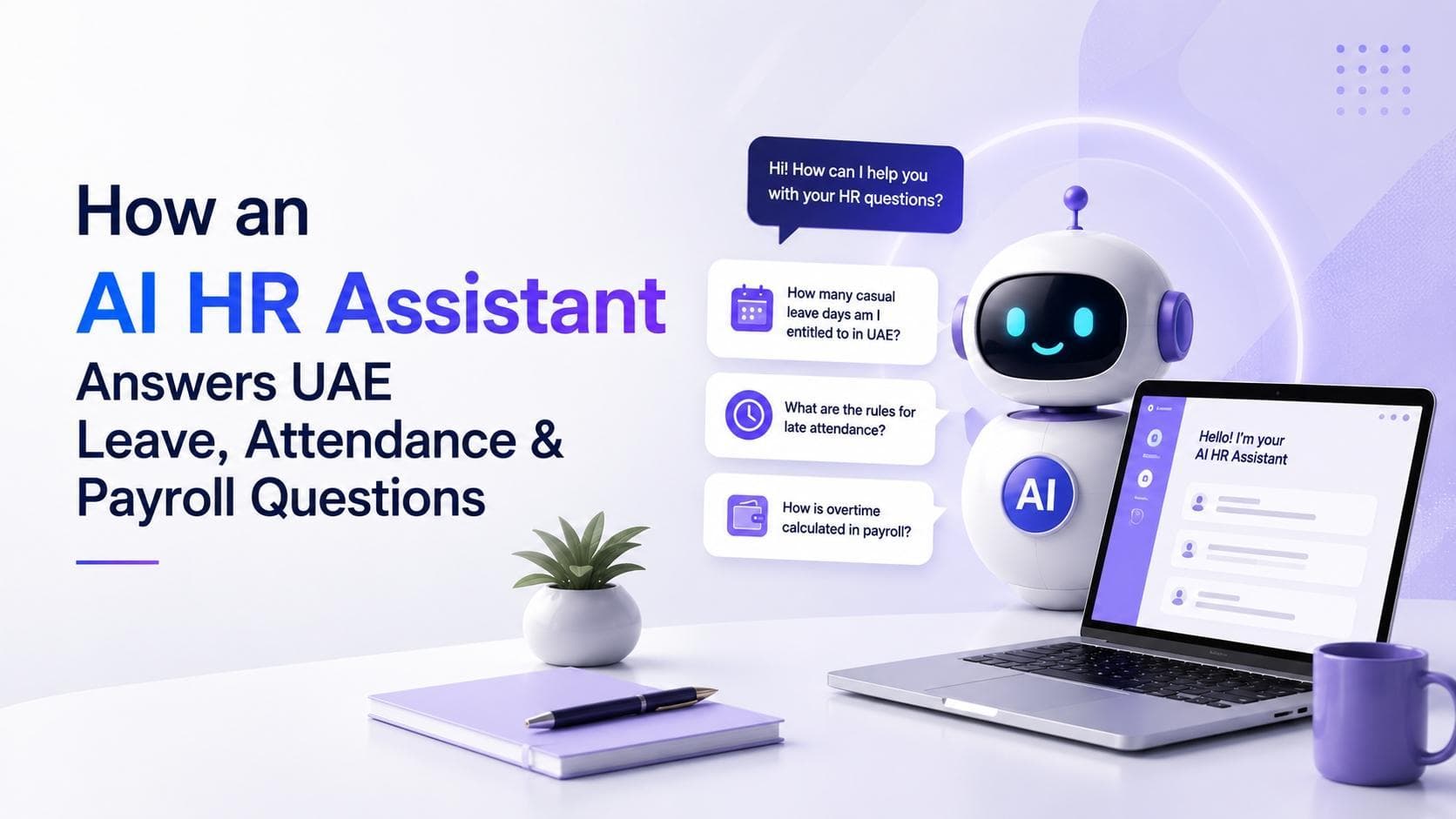
A practical explainer for HR, people ops, and founders.
Open any UAE HR inbox on a Sunday morning and the pattern is familiar: half a dozen versions of "how many leave days do I have left," a request for last month's payslip, someone asking whether Tuesday is a public holiday, two approval requests waiting on a manager, and one genuinely complex case that actually needs a person. The complex case is the job. Everything else is repetition that eats the day.
An AI HR assistant is built for exactly that repetition. It sits on top of your existing HR, payroll, and attendance data and answers the routine questions employees ask, routes the approvals that need a decision, and hands the hard cases to a human with context attached. This guide explains what it actually does day to day, how it differs from a generic chatbot, how it handles bilingual and privacy realities specific to the UAE, and where it fits alongside your payroll and attendance systems.
The everyday questions it answers
Most of what lands in an HR inbox is a small set of questions asked over and over. An AI HR assistant answers them instantly, in plain language, by reading the employee's own record rather than guessing:
- Leave balances and requests — "How many annual leave days do I have left?" The assistant checks the employee's accrued and used leave balance and can start a leave request in the same conversation.
- Payslips and salary queries — "Can I get my March payslip?" or "Why was this month's amount different?" It retrieves the payslip and can explain the components — basic, allowances, deductions — without HR pulling the file manually.
- Policy questions — "How much notice do I give for annual leave?" or "What's the sick-leave policy?" It answers from your actual company policy, not a generic template, so employees get the version that applies to them.
- Holiday entitlements — "Is next Monday a public holiday?" It answers against the current UAE public holiday calendar and your company's working pattern.
The value is not just speed. When employees can self-serve the routine questions, HR stops being a lookup service and gets time back for the work that needs judgement.
How it routes approvals and surfaces reminders
Answering questions is only half of it. The more useful part is moving work forward. A capable assistant:
- Routes approvals to the right person. A leave request goes to the correct line manager with the balance and dates already attached, so the approver decides in seconds rather than opening three screens.
- Chases what is stuck. It nudges a pending approval that is sitting too long, so a leave request does not quietly expire the week before a planned trip.
- Surfaces reminders before they become problems. Probation end dates, visa and document expiries, contract renewals, and the payroll cut-off — the assistant flags these to the right owner ahead of time instead of leaving them to be discovered late.
This is where an assistant earns its place: it does not just talk, it keeps the process moving.
Bilingual Arabic–English support
The UAE workforce is multilingual, and a meaningful share of employees are more comfortable asking questions in Arabic than in English. An AI HR assistant that understands and replies in both Arabic and English removes a real barrier — an employee can ask about their leave balance or payslip in the language they think in, and get an accurate answer in the same language.
This matters most for blue-collar and frontline teams, where a policy written only in English often goes unread. Bilingual support is not a cosmetic feature in this market; it is the difference between a policy that is understood and one that generates repeat questions to HR.
How it differs from a generic chatbot
"Chatbot" has earned a bad reputation, mostly from tools that match keywords and reply with canned links. An AI HR assistant is a different thing in three concrete ways:
- It reads your actual data. A generic bot gives the same answer to everyone. An HR assistant answers from the individual employee's record — their balance, their payslip, their policy — so the answer is specific and correct for that person.
- It respects permissions. It only shows an employee their own information, and only shows a manager what their role allows. A generic chatbot has no concept of who is asking.
- It takes action, not just talk. It can start a leave request, route an approval, or retrieve a document — not simply point at a help page and hope.
The test is simple: ask it "how many leave days do I have left." A generic chatbot links you to the leave policy. An AI HR assistant tells you the number.
Data-privacy considerations
HR data is among the most sensitive data a company holds — salaries, documents, personal details. Any AI assistant touching it has to be handled with care, and the UAE has a clear direction of travel on this.
The federal framework is the Personal Data Protection Law (Federal Decree-Law No. 45 of 2021), which sets out principles that map directly onto how an HR assistant should behave: process data lawfully and only for a clear purpose, collect the minimum needed, keep it accurate, and protect it with proper access controls. Note that the DIFC and ADGM operate their own separate data-protection regimes, so entities based there should check the framework that applies to them.
In practice, the questions to ask a vendor are straightforward:
- Access control — does the assistant enforce role-based permissions so people only see what they are entitled to see?
- Purpose and minimisation — is employee data used only to answer HR questions, and not repurposed?
- Where data sits and who processes it — where is the data stored and processed, and are cross-border transfers handled with appropriate safeguards?
- Auditability — is there a record of what was asked and answered, so access can be reviewed?
An HR assistant should make privacy easier to demonstrate, not harder — a single, permission-aware channel is more controllable than payslips and personal details flying around over chat and email.
Where it fits alongside payroll and attendance
An AI HR assistant is not a replacement for your payroll engine or your attendance system. It is a layer on top of them. Payroll still calculates and runs salaries and generates the WPS file; attendance still records hours, shifts, and leave. The assistant reads from these systems to answer questions and initiates actions that feed back into them — a leave request it starts becomes a record attendance and payroll both rely on.
That connection is the point. When leave, attendance, and payroll share the same underlying data, the assistant's answers are correct because they come from the same source of truth the rest of your HR stack uses. You can explore the calculators and utilities behind these workflows in our free HR tools. Bolted onto disconnected systems, an assistant can only ever be as accurate as the most out-of-date spreadsheet it reads.
A realistic before and after
Before. It is the first working day of the month. The HR inbox has 15 messages: five leave-balance questions, three payslip requests, two "is Tuesday a holiday" questions, a sick-leave process question, two manager approvals waiting, one probation-end reminder someone almost missed, and one genuinely tricky case about an end-of-service calculation. HR spends the morning answering the same four questions in different words, and the tricky case — the one that needed real attention — waits until after lunch.
After. The same 15 messages arrive. The assistant answers the five leave balances and three payslip requests instantly from each employee's record, confirms the public holiday, and walks the employee through the sick-leave process. It routes the two approvals to the right managers with dates and balances attached, and flags the probation date to the owner before it lapses. HR opens the inbox to one message that actually needs them: the end-of-service case — and they get to it first thing, with the employee's record already in front of them.
Nothing about the second morning is dramatic. That is the point. The repetitive load is handled quietly, and the human attention goes where it is genuinely needed.
See the AI assistant with RadixHR
Watch how RadixHR's AI HR assistant answers leave, attendance, and payroll questions from your own data, in Arabic and English, and routes approvals to the right people.
This article is for general information only and does not constitute legal advice. UAE data-protection requirements, including under Federal Decree-Law No. 45 of 2021, are subject to change, and the DIFC and ADGM operate separate regimes. Verify the requirements that apply to your entity, and confirm any vendor's data-handling practices, before acting.
Related Articles
UAE Employees Save 3.6 Hours a Week With AI — and Spend 3.4 Fixing It. What That Means for HR
New October 2026 research says UAE staff save 3.6 hours a week using AI but spend 3.4 hours correcting it. Here's why the gap exists, and the practical HR playbook for making AI time saved actually stick — starting with the questions that touch pay and contracts.

How to Choose HR Software in the UAE: A 2026 Buyer's Checklist
A platform that looks excellent in a demo can still fail the one test that matters here: does it handle WPS, MOHRE, Emiratisation, and gratuity the way UAE law requires? A vendor-neutral buyer's guide for 2026 — the UAE must-haves, attendance and AI, integration and migration, implementation, pricing and total cost of ownership, the questions to ask every vendor, and a scored evaluation checklist.
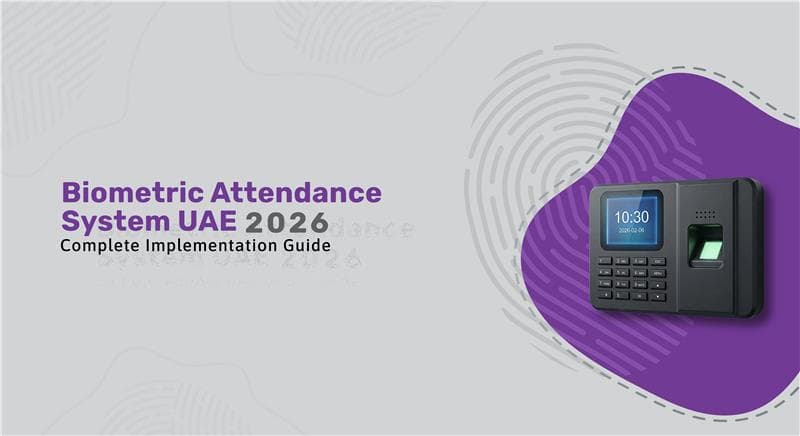
Biometric Attendance System UAE 2026: Complete Implementation Guide
Comprehensive UAE biometric attendance guide covering system types (fingerprint, face recognition, iris), legal requirements, WPS and payroll integration, privacy considerations under UAE data protection law, multi-location setup, implementation challenges, ROI calculation, and vendor selection criteria.