How to Run Payroll for Multi-Branch UAE Companies
A practical 2026 guide for HR teams running payroll across multiple UAE branches — centralised vs decentralised models, biometric and allowance fragmentation, per-establishment WPS submissions, multi-emirate compliance, consolidated reporting, and what to look for in technology.
Growth in the UAE rarely happens neatly. A company that started with one office in Dubai opens a sales branch in Abu Dhabi, then takes on a warehouse in Sharjah. Each new location feels like a small extension of the original payroll process. By the time headcount is split across three or four branches, payroll is no longer a single workflow — it is several near-identical workflows running in parallel, with different attendance systems, different allowance structures, different banks, and different MOHRE establishment IDs.
This guide is for HR managers at growing UAE companies who are starting to feel that strain. Updated for the 2026 regulatory environment — WPS 2.0, the 1st-of-month salary deadline under Ministerial Resolution No. 340 of 2026, and the June 30 Emirati minimum-salary deadline — it covers what changes when payroll goes multi-branch, the centralised vs decentralised decision, common branch-specific challenges, how WPS submission actually works for multiple establishments, multi-emirate compliance, consolidated reporting, and what to look for in technology that scales with the business instead of breaking with it.
What "multi-branch" actually means in the UAE
The first thing to clarify is the legal architecture, because it dictates everything that follows.
In the UAE, every physical location with its own trade activity, hiring authority, or legal personality typically has its own MOHRE establishment card and its own 13-digit Establishment ID (the Employer Unique ID that appears on every WPS transaction). One company can hold multiple establishment cards if its branches operate under separate licences — common for businesses spanning mainland and free zones, or operating across emirates.
This matters because:
- Each establishment ID submits its own SIF. You cannot merge employees across establishment IDs into a single Salary Information File. If you have three establishment cards, you have three SIF submissions every cycle.
- Each establishment may use a different WPS agent bank. Each bank has its own 9-digit routing code in the SIF.
- Each establishment is independently classified by MOHRE. Class 1, 2, or 3 status — and its impact on work permit cost — is per establishment, not per parent company.
- Each establishment has its own Emiratisation count and its own compliance record. A 50-employee threshold for Emiratisation applies at the establishment level, not the group.
The practical implication: multi-branch UAE payroll is structurally multi-entity payroll, even when all the branches roll up to one commercial brand. Treating it as one big payroll run is the most common cause of compliance failure in growing UAE businesses.
Centralised vs decentralised: the strategic decision
Once you have more than one establishment, you face a real architectural choice. There are two clean models and a messy middle.
Centralised payroll
One central HR or finance team runs payroll for every branch from a single system. Branches submit attendance and local data; final calculation, SIF generation, and submission happen at headquarters. Best for companies that prioritise standardisation, audit-readiness, and cost control — group visibility is strong and compliance risk is uniform. Watch out for local context loss: the Dubai office's housing allowance norms are not Sharjah's, and local public holidays can fall through the cracks.
Decentralised payroll
Each branch runs its own payroll, often with its own HR coordinator and software. The group sees consolidated numbers only at month-end. Best for companies where branches operate as semi-independent business units across very different sectors. Watch out for inconsistent compliance — different branches applying different rules, different allowances, different overtime calculations — and group reporting becoming a reconciliation exercise.
The hybrid (and why most UAE companies end up here)
A central team owns policy, software, master data, and consolidated reporting. Branches own local execution: attendance capture, validation of local-specific items, communication with employees. Headquarters generates the SIF for each establishment ID centrally but accepts branch inputs.
This is the model most UAE companies with 3+ branches settle into. It preserves group-level control and audit trail while accepting that branch managers know their local payroll context better than head office ever will.
Branch-specific challenges that don't show up at one location
A single-branch payroll process scales until it doesn't. The breaking points are predictable.
Biometric and attendance system fragmentation
Branches accumulated through organic growth or acquisition rarely share an attendance system. One branch is on a wall-mounted fingerprint scanner, another a mobile geofencing app, a third face-recognition tablets, a fourth a spreadsheet. Each exports differently, calculates overtime differently, and may not handle UAE-specific concepts like Friday/weekend rates or Ramadan hours the same way. The fix is rarely a single replacement device — it is a payroll layer that ingests multiple attendance feeds and normalises them into a consistent overtime, late-arrival, and leave model before any salary is calculated.
Varying allowances by emirate and branch
Housing allowance norms in Dubai are not the same as Sharjah's. Transport allowances for branches with a labour camp differ from city-centre offices. Field-allowance structures for a construction site differ from a retail branch. In a single spreadsheet, this becomes a tangle of conditional formulas. In a properly configured HR system, it should be a branch-level allowance template that overrides the group default where it needs to.
Different WPS agent banks, mainland + free zone mix, local calendars
Some branches grew up banking with one institution and others with another, so the 9-digit bank routing code in the SIF differs, and bank-specific cut-off times and submission portals differ with it. Branches in different jurisdictions inherit different rules: mainland branches sit squarely under MOHRE, while free zones (DMCC, JAFZA, RAKEZ, IFZA, and others) apply their own frameworks that mirror MOHRE but are administered separately — and DIFC and ADGM operate entirely separate employment laws. Public holidays are federally announced but observed differently by sector, so branches in the same group can end up with different working-day counts in the same month, which flows through to overtime, attendance, and gratuity accruals.
WPS file management for multiple branches
This is the operational core of multi-branch UAE payroll and the area where most companies get caught.
For each MOHRE establishment ID, the company must:
- Generate a separate SIF matching that establishment's registered employees — our WPS SIF generator produces one compliant file per establishment
- Validate every line against the MOHRE-registered labour contract for that establishment
- Submit through the specific WPS agent linked to that establishment's corporate account
- Retain the bank acknowledgement and submission timestamp as the compliance audit trail
- Reconcile the total transferred amount with the establishment's payroll register
Common failure modes:
- An employee transferred from Branch A to Branch B mid-month appears in both SIFs, or in neither, because the master-data move was not coordinated with the payroll cut-off.
- Branch A's SIF is submitted on time but Branch B's misses the cut-off, dragging the group's overall compliance rate below the 85% threshold under Ministerial Resolution No. 340 of 2026.
- A bank-code mismatch in one branch's SIF rejects the whole file for that establishment, while the others process normally — and the rejected branch's compliance status quietly deteriorates.
- A new hire onboarded in Branch C doesn't appear in the SIF for 30 days under the standard onboarding grace window, but the central team forgets to add them when the grace expires.
The discipline that prevents these failures is branch-level payroll calendar locking: every establishment's cut-off, validation, and submission steps tracked separately, with explicit ownership and a single dashboard view of all of them.
What changed in 2026: WPS 2.0, Aani, and AI validation
The multi-branch challenge intensified in 2026 with the rollout of WPS 2.0 and two changes every multi-establishment employer needs to plan for:
- Real-time AI validation. WPS 2.0 scans each SIF on submission and rejects it instantly for a wrong IBAN, a Labour ID mismatch, or a one-dirham discrepancy between the submitted figure and the MOHRE-registered basic salary. Across multiple establishments, this means a data error in any one branch's master file surfaces immediately rather than at audit — good for compliance, but unforgiving of the inconsistent data that multi-branch setups accumulate.
- Aani instant-payment rail. Integration with Aani, the UAE's instant payment platform, means compliant salary transfers can clear in seconds. Branches whose bank or exchange house is not connected to the live WPS network and Aani rail risk slower clearance against a tighter deadline.
- Mandatory deduction codes. Every SIF must use the correct deduction codes — NOPAY (unpaid leave), ABSNT (absence), and FINE (disciplinary fine) — applied consistently across all establishments. A branch that codes an unpaid-leave deduction incorrectly can distort its compliance ratio.
- The 1st-of-month deadline (from June 1, 2026). Under Ministerial Resolution No. 340 of 2026, salaries for the previous month must be paid by the 1st. For multi-branch employers, the 85% on-time compliance threshold is measured per establishment — one branch missing the cut-off does not just hurt that branch, it can drag the group's overall compliance posture down.
Compliance across emirates
Federal labour law (Federal Decree-Law No. 33 of 2021) applies uniformly across the UAE, but enforcement, allowances, and procedural details still vary at the emirate and free-zone level.
Practical compliance points multi-branch teams need to keep in mind:
- Establishment classification is per branch. A Class 3 downgrade for one branch raises work permit costs for that branch only, but the reputational signal applies to the whole group.
- Emiratisation thresholds (50+ employees) are measured per establishment. A group with three branches at 30 employees each does not trigger group-wide Emiratisation, but if any single branch crosses 50, that branch does. Branches close to the threshold need active monitoring.
- End-of-service gratuity calculations follow federal rules, but the basic salary used in the calculation may be set differently at each branch — a multi-branch policy must standardise the basic-to-allowance split or accept different EOSB outcomes for similar roles. Our salary calculator helps model the basic-to-allowance breakdown consistently across branches.
- The AED 6,000 minimum salary for Emirati employees (effective January 2026) applies at every branch employing Emiratis. Group-wide policy is safer than branch-by-branch interpretation. Contracts below the threshold must be updated by 30 June 2026 — after that date, any Emirati paid below AED 6,000 is excluded from the Emiratisation headcount for that branch, putting quota compliance and incentives at risk.
- Labour court jurisdiction follows the establishment. A dispute filed against a Sharjah branch is heard in Sharjah, not at the company's Dubai HQ. Branch-level grievance handling and documentation matters.
Consolidated reporting: what the board actually wants to see
Multi-branch payroll generates a lot of data. What headquarters actually needs is a small number of metrics, viewable across all establishments at once:
- Headcount by branch with month-on-month change
- Total wage bill by branch, with basic vs allowance split
- WPS submission status per establishment for the current cycle
- Compliance rate against the 85% threshold per branch and group-wide
- Visa and Emirates ID expiries in the next 30, 60, and 90 days
- Emiratisation count per qualifying branch with progress against target
- Overtime as a percentage of base wage by branch (often the early warning sign of operational stress)
- Gratuity accrual per branch with year-over-year movement
If these eight numbers require pulling data from multiple systems and assembling a spreadsheet, the multi-branch payroll setup is already costing more in HR time than it should.
Technology: what to look for in multi-branch payroll software
Not every HR system handles multi-branch UAE payroll well. Many handle multi-employee but assume single-establishment. The checklist below separates the two:
- Native multi-establishment support. The system stores multiple 13-digit Employer IDs, generates a separate SIF per establishment, and routes each SIF to its own WPS agent bank.
- Multiple WPS agent integration. Different branches can use different banks or exchange houses without forcing a single banking relationship across the group.
- Branch-level allowance templates. Group-default rules can be overridden at branch level for housing, transport, and other variable allowances.
- Attendance integration across vendors. The system ingests data from multiple biometric devices, mobile apps, and manual entries, normalising overtime and leave calculation.
- Role-based access by branch. Branch HR sees only their employees; group HR sees everything. Audit trail preserved across the boundary.
- Consolidated dashboards. The metrics above produced from live data, not month-end exports.
- Multi-emirate calendar awareness. Public holidays, working-day counts, and Ramadan hours configurable per branch.
- Free-zone + mainland support. The system understands that different establishments may sit under different employment regimes.
- Inter-branch employee transfer workflow. Moving an employee between establishments updates the SIF, the contract, the EOSB accrual, and the audit trail in one action.
A system that ticks the first three is the minimum for genuinely multi-branch UAE payroll. A system that ticks all nine is the difference between scaling cleanly to ten branches and rebuilding the payroll process every time a new one opens.
See the RadixHR multi-branch demo
If your UAE payroll already spans more than one establishment — or you can see it heading that way in the next twelve months — the decision is not really "do we need multi-branch software." It is "how much longer can we run multi-branch payroll without it."
RadixHR is built for UAE multi-branch operations from the ground up: native multi-establishment support, multiple WPS agent bank integration, branch-level allowance templates, attendance ingestion across vendors, role-based access with consolidated group dashboards, multi-emirate calendar awareness, and free-zone plus mainland coverage in one system.
See the multi-branch demo. Visit www.radixhr.com to book a walkthrough configured for your branch structure — mainland, free zone, or mixed — and see how the platform handles per-establishment SIF generation, consolidated reporting, and the cross-branch workflows that break in spreadsheets.
Disclaimer
This article is for general information only and is not legal, financial, or compliance advice. UAE payroll, WPS, Emiratisation, and labour rules are set by MOHRE, the Central Bank of the UAE, and the respective free-zone authorities, and are updated periodically. Specific details cited here reflect publicly available 2026 information and may vary by case, emirate, free zone, and establishment. Always verify current requirements with the relevant authority or a licensed PRO before acting.
Authoritative sources
MOHRE (mohre.gov.ae) · UAE Government Portal (u.ae) · Federal Decree-Law No. 33 of 2021 (UAE Labour Law) · Ministerial Resolution No. 43 of 2022 (Wage Protection System) · Ministerial Resolution No. 340 of 2026 (Monthly Salary Deadline, effective 1 June 2026) · Cabinet Resolution No. 1 of 2022 (Executive Regulations) · WPS 2.0 / Aani instant payment platform.
Related Articles

MOHRE's New Salary Rule 2026 (Ministerial Resolution 340): The Unified WPS Deadline Explained
MOHRE's new salary rule 2026 under Ministerial Resolution No. 340: salaries must clear WPS by the 1st of the following month, and the 15-day grace period is gone. What changed, who it applies to, the day-by-day penalties, and a payroll-timing checklist to finish early every month.
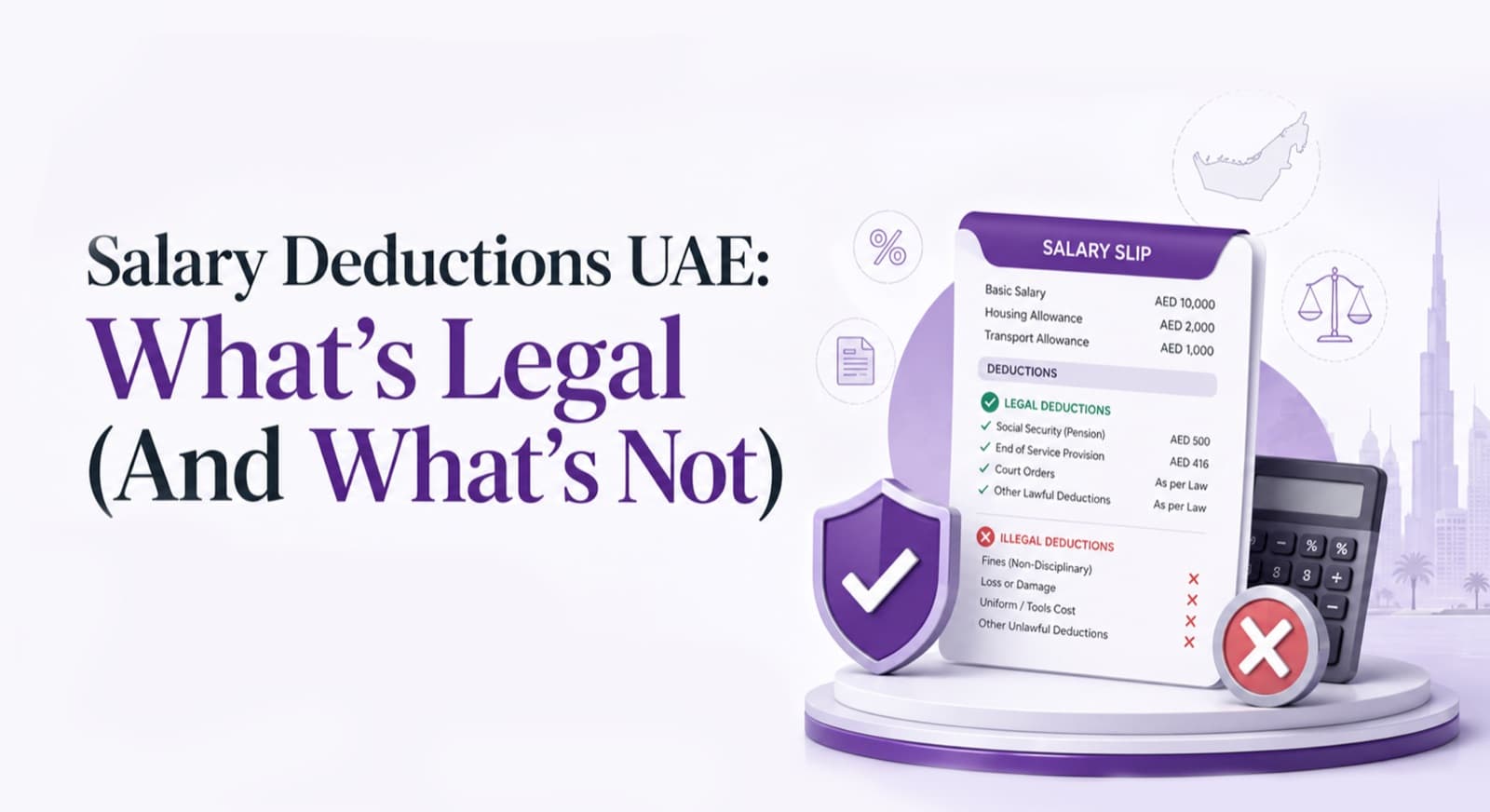
Salary Deductions UAE: What's Legal (And What's Not)
A practical 2026 guide for HR and finance teams in the UAE — what Article 25 of the Labour Law permits, what it prohibits, deduction caps, documentation rules, employee consent, sample policy clauses, and the MOHRE dispute process.

UAE Monthly Salary Deadline 2026: What Every Employer Must Do Before June 1
Ministerial Resolution No. 340 of 2026 makes the 1st of every month the unified salary deadline for UAE private-sector employers from June 1, 2026. Full breakdown of the rule, the 85% compliance threshold, the day-by-day penalty timeline, exclusions, exemptions, and the 13-day pre-deadline checklist.